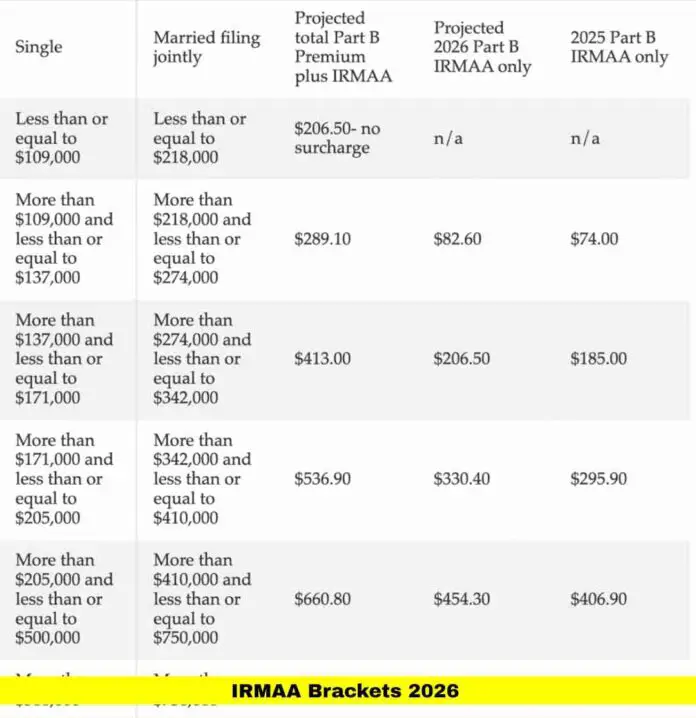
IRMAA brackets 2026 have been finalized, outlining how Medicare Part B and Part D premiums will be adjusted for higher-income beneficiaries based on income from tax year 2024. These updates directly affect healthcare costs for retirees and others on Medicare. Understanding the new thresholds and surcharges is crucial for managing medical expenses in the year ahead.
This detailed guide explains the updated structure, how IRMAA works, strategies for planning, and the impact on monthly premiums.
Table of Contents
Understanding How Income Affects Premiums
Income-based adjustments apply to Medicare Part B and Part D. If your modified adjusted gross income (MAGI) from two years ago exceeds specific limits, additional charges are added to your monthly premiums. This system ensures higher-income beneficiaries contribute more toward their Medicare coverage costs.
For 2026, the initial threshold begins at $109,000 for individual filers and $218,000 for married couples filing jointly. Anyone exceeding these amounts will face surcharges that increase with higher income levels. Awareness of these brackets is vital for budgeting and financial planning.
The Two-Year Look-Back Rule
Medicare calculates IRMAA using a two-year look-back. Premiums in 2026 are based on income reported on your 2024 federal tax return. Tax-exempt interest is included in the calculation of MAGI.
This means changes in income now will affect premiums two years later. Beneficiaries who experience a significant drop in income can appeal to have their premiums reassessed, but the official calculation relies on the prior tax records.
Standard Part B Premium in 2026
The base monthly premium for Medicare Part B in 2026 is $202.90. This amount applies to beneficiaries whose income falls below the first IRMAA threshold. Part B covers outpatient services, doctor visits, preventive care, and some medical equipment. For higher-income beneficiaries, surcharges are added on top of this base premium.
Part B Income Brackets and Surcharges
There are six income brackets for Part B in 2026, each with a corresponding monthly premium:
- Base Premium: $202.90 for individuals earning $109,000 or less, couples $218,000 or less
- Tier 1: $284.10 for individuals $109,001–$137,000, couples $218,001–$274,000
- Tier 2: $405.80 for individuals $137,001–$171,000, couples $274,001–$342,000
- Tier 3: $527.50 for individuals $171,001–$205,000, couples $342,001–$410,000
- Tier 4: $649.20 for individuals $205,001–$500,000, couples $410,001–$750,000
- Highest Tier: $689.90 for individuals $500,000 or more, couples $750,000 or more
Understanding where your income falls helps determine your expected monthly payment.
Part D Income-Related Surcharges
Surcharges also apply to Part D prescription drug plans. These are added to your plan’s monthly premium:
- Tier 0: $0 for individuals ≤ $109,000, couples ≤ $218,000
- Tier 1: $14.50 for individuals $109,001–$137,000, couples $218,001–$274,000
- Tier 2: $37.50 for individuals $137,001–$171,000, couples $274,001–$342,000
- Tier 3: $60.40 for individuals $171,001–$205,000, couples $342,001–$410,000
- Tier 4: $83.30 for individuals $205,001–$500,000, couples $410,001–$750,000
- Highest Tier: $91.00 for individuals $500,000 or more, couples $750,000 or more
Combined with Part B, these surcharges can significantly raise total Medicare costs for higher-income beneficiaries.
Changes from Previous Years
The first IRMAA threshold for 2026 has risen slightly to reflect inflation. Single filers now start paying surcharges above $109,000, while joint filers start at $218,000. Top-tier thresholds remain fixed at $500,000 for singles and $750,000 for couples through 2028. These adjustments ensure the system stays aligned with income growth and economic changes.
Impact on Medicare Advantage Plans
Medicare Advantage plans that include drug coverage are also affected. Part B surcharges are added to plan premiums, and Part D surcharges increase prescription costs. High-income beneficiaries in these plans may face substantial combined monthly payments.
Income Planning Strategies
Since IRMAA is based on income from two years prior, careful planning can help manage future premiums. Strategies include timing withdrawals from retirement accounts, balancing capital gains, and considering Roth conversions in low-income years. These steps can reduce MAGI and limit exposure to higher surcharges.
Appealing IRMAA Adjustments
Beneficiaries who experience life-changing events, such as retirement, death of a spouse, or disability, can appeal their IRMAA determination. Filing with proper documentation allows Social Security to reassess premiums based on current income. Prompt action is critical to ensuring accurate adjustments.
Real-World Impact on Monthly Costs
Part B premiums range from $202.90 to $689.90 in 2026, while Part D surcharges range from $0 to $91. Combined, higher-income beneficiaries may pay thousands of dollars more annually. Understanding these figures helps with budgeting and long-term financial planning.
Percentage of Beneficiaries Affected
Approximately 8% of Medicare enrollees pay IRMAA surcharges. While most beneficiaries pay the base premiums, those impacted need to carefully consider income planning and appeals to manage costs effectively.
Notification and Timing
Beneficiaries receive notices in late fall or early winter outlining their 2026 premiums and any IRMAA surcharges. Reviewing these notices ensures accuracy and provides time to appeal if necessary.
Economic Factors and Adjustments
Brackets are adjusted for inflation and healthcare cost trends. While lower thresholds shift slightly each year, top-tier limits remain fixed. Monitoring these changes helps beneficiaries anticipate premium increases and plan accordingly.
Combining IRMAA with Other Medicare Costs
IRMAA surcharges are separate from Part A premiums, deductibles, and co-pays. Beneficiaries should calculate total monthly out-of-pocket expenses, including base premiums, IRMAA, and supplemental coverage, to understand the full financial impact.
Insurance Options to Complement Planning
Medicare Advantage and Medigap plans do not reduce IRMAA charges but can help manage other costs. Comparing plan benefits, networks, and premiums annually can uncover potential savings, making overall healthcare expenses more manageable.
Final Thoughts
Understanding the 2026 income-based brackets is essential for anyone on Medicare. Knowing thresholds, surcharges, and planning strategies helps manage healthcare costs and avoid surprises. Reviewing notices carefully, planning income wisely, and appealing when eligible are key steps in managing premiums effectively.
How are you preparing for 2026 healthcare costs, and what strategies will help you manage premiums? Share your insights and stay informed.

