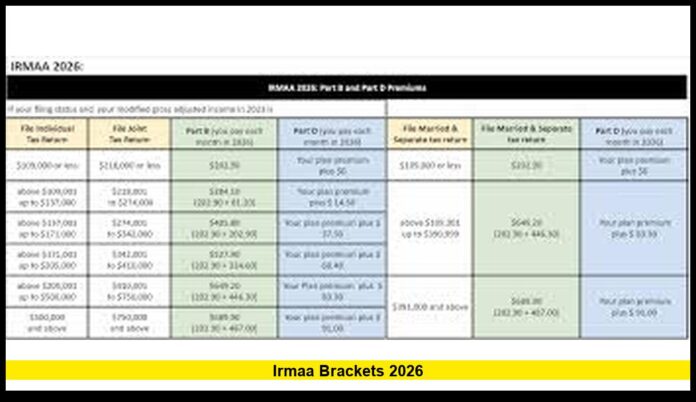
The 2026 IRMAA brackets determine how much higher-income Medicare beneficiaries pay in additional premiums for Medicare Part B and Part D based on their modified adjusted gross income from two years earlier.
The irmaa brackets 2026 are now in effect for Medicare beneficiaries, setting updated income thresholds that determine who pays higher monthly premiums for Part B and Part D coverage. These brackets are based on federal income data and apply to higher-earning retirees and beneficiaries across the United States, directly impacting healthcare costs throughout the year.
Medicare’s Income-Related Monthly Adjustment Amount, commonly known as IRMAA, is not a penalty or tax. It is a required premium adjustment tied to income. Understanding how these brackets work is essential for accurate financial planning, especially for retirees, business owners, and households with variable income.
Table of Contents
What IRMAA Is and Why It Exists
IRMAA was created to ensure that Medicare remains financially sustainable by requiring higher-income beneficiaries to contribute more toward the cost of coverage. Medicare Part B and Part D are subsidized programs, and IRMAA helps balance those subsidies by adjusting premiums for individuals with income above certain levels.
Unlike most Medicare costs, IRMAA is determined by income rather than age, health status, or plan selection. The adjustment is applied automatically, and beneficiaries do not need to enroll separately or request it.
IRMAA applies only to:
- Medicare Part B (medical insurance)
- Medicare Part D (prescription drug coverage)
It does not apply to Medicare Part A.
How Income Is Measured for 2026
For 2026, IRMAA calculations are based on Modified Adjusted Gross Income (MAGI) from the 2024 tax year. Medicare uses a two-year lookback because verified tax data is required before premiums can be set.
MAGI includes:
- Adjusted Gross Income from your tax return
- Tax-exempt interest income
This means income from wages, self-employment, pensions, Social Security (taxable portion), investment gains, rental income, and certain distributions may all count toward IRMAA determination.
Even income that is not fully taxable can influence your Medicare premiums.
Why IRMAA Brackets Change Each Year
IRMAA income thresholds are adjusted annually to account for inflation and broader economic conditions. Without these adjustments, more beneficiaries would be pushed into higher brackets over time, even if their purchasing power did not increase.
For 2026, the brackets reflect updated cost-of-living adjustments and healthcare spending patterns. While the structure of IRMAA remains the same, the income ranges and premium amounts have been recalibrated.
Standard Medicare Part B Premium for 2026
The standard Medicare Part B premium for 2026 is set at $202.90 per month for most beneficiaries enrolled in Medicare’s outpatient and medical insurance coverage. This base premium applies before any Income-Related Monthly Adjustment Amount (IRMAA) surcharges are added. Medicare Part B helps cover doctor visits, preventive care, outpatient services, durable medical equipment, lab tests, and certain home health services.
IRMAA affects higher-income beneficiaries by increasing their monthly Medicare costs based on income reported to the IRS from two years earlier. For 2026 coverage, the Social Security Administration generally reviews 2024 modified adjusted gross income to determine whether an enrollee must pay more than the standard premium. Individuals and married couples whose income exceeds the lowest IRMAA bracket will see higher monthly Part B premiums, with costs increasing across multiple income tiers.
Beneficiaries whose income remains below the IRMAA thresholds will continue paying only the standard $202.90 monthly premium. Many Medicare recipients have their Part B premiums automatically deducted from their Social Security benefits each month, making payments more convenient. Premium amounts can change annually based on healthcare spending projections, inflation, and adjustments approved by federal Medicare officials.
2026 Medicare Part B IRMAA Brackets
The following sections outline how Part B premiums increase as income rises. Each bracket represents a tier. Moving even one dollar into a higher tier results in a higher monthly premium for the entire year.
Single Filers
Single beneficiaries with income at or below the first threshold pay only the standard premium. As income increases, additional IRMAA surcharges apply in steps, eventually reaching the highest tier for very high earners.
At the top end, monthly Part B premiums can be more than three times the standard amount.
Married Filing Jointly
Married couples filing jointly benefit from higher income thresholds, but once those thresholds are exceeded, premiums rise in the same tiered structure. Each spouse enrolled in Medicare pays the adjusted amount individually.
This means a married couple in a high IRMAA bracket may see a significant combined increase in monthly Medicare costs.
Married Filing Separately
Married beneficiaries who file separately and lived with their spouse during the year face the most compressed brackets. Even moderate income levels can trigger higher premiums under this filing status.
2026 Medicare Part D IRMAA Surcharges Explained
Medicare’s Income-Related Monthly Adjustment Amount (IRMAA) also applies to Medicare Part D prescription drug coverage in 2026, increasing costs for higher-income beneficiaries. Unlike Medicare Part B, where the surcharge is added directly to the standard premium, Part D IRMAA works as an extra monthly fee added on top of the premium charged by a beneficiary’s chosen prescription drug plan.
The Part D IRMAA payment is made directly to Medicare rather than to the private insurance company providing the drug plan. Beneficiaries usually receive a notice from the Social Security Administration explaining whether they owe the additional amount and how much they must pay each month. The income thresholds used to determine Part D IRMAA are the same as those applied to Medicare Part B premiums, with calculations generally based on modified adjusted gross income reported from two years earlier.
As income rises, the Part D surcharge increases through several income brackets, meaning higher earners pay progressively larger monthly adjustments. Individuals whose income remains below the lowest IRMAA threshold will only pay their regular Part D plan premium without any added surcharge. These annual adjustments are designed to require higher-income beneficiaries to contribute more toward the overall cost of Medicare prescription drug coverage.
How Medicare IRMAA Payments Are Collected
Medicare Income-Related Monthly Adjustment Amount (IRMAA) surcharges are typically collected automatically from a beneficiary’s monthly Social Security benefits or Railroad Retirement Board benefits. For most retirees, this means the additional Medicare Part B and Part D costs are deducted before benefit payments are deposited, simplifying the payment process and helping beneficiaries avoid missed bills.
Individuals who are enrolled in Medicare but have not yet started receiving Social Security or Railroad Retirement benefits are billed directly by Medicare for their IRMAA charges. These beneficiaries usually receive monthly or quarterly bills outlining the total amount due, including any applicable surcharges for Medicare Part B and Part D coverage.
IRMAA charges are applied on a monthly basis and generally remain in effect for the full calendar year once determined. The Social Security Administration calculates the surcharge using income information reported to the IRS, typically from two years earlier. However, beneficiaries who experience major life-changing events such as retirement, marriage, divorce, or loss of income may request a reconsideration if their current financial situation no longer reflects the income used to calculate their IRMAA amount.
Keeping payments current is important because unpaid Medicare premiums could potentially affect coverage status or lead to billing complications later in the year.
Life Events That Can Change Medicare IRMAA
Although Medicare’s Income-Related Monthly Adjustment Amount (IRMAA) is usually calculated using income reported from two years earlier, certain major life events may allow beneficiaries to request a lower surcharge if their current income has dropped significantly. In these situations, the Social Security Administration may reconsider the original determination and adjust Medicare Part B and Part D premiums using more recent financial information.
Several qualifying life-changing events can trigger an IRMAA review, including:
- Retirement or complete work stoppage
- Reduction in work hours or income
- Death of a spouse
- Divorce or annulment
- Loss of income-producing property
- Employer settlement payments ending
Beneficiaries experiencing one of these events can file an appeal and provide documentation showing the change in financial circumstances. Medicare may then recalculate IRMAA based on updated income estimates rather than older tax return information that no longer reflects the beneficiary’s current financial situation.
This process can help reduce monthly Medicare costs for retirees and others whose earnings have declined unexpectedly. Individuals seeking an adjustment typically need to complete Social Security Form SSA-44 and submit supporting evidence related to the qualifying event. If approved, the lower IRMAA amount generally applies for the remainder of the calendar year, helping beneficiaries avoid paying higher premiums based on outdated income records.
Why IRMAA Planning Matters More Than Ever
Healthcare costs are one of the largest expenses in retirement. IRMAA can add thousands of dollars per year to those costs, particularly for couples and high-income individuals.
Because IRMAA operates in tiers rather than percentages, careful income management can make a meaningful difference. A small increase in income may result in a large jump in premiums.
Common Income Sources That Trigger IRMAA
Many beneficiaries are surprised to learn what income counts toward IRMAA. Common triggers include:
- Required minimum distributions from retirement accounts
- Capital gains from selling property or investments
- Roth conversions
- Business income spikes
- Large one-time bonuses
- Settlement payments
Understanding how these sources affect MAGI is essential for avoiding unexpected premium increases.
IRMAA and Retirement Timing
The timing of retirement can have a direct impact on IRMAA. For example, a beneficiary who retires mid-year may still have a high income for that tax year, triggering higher Medicare premiums two years later.
Strategic planning around retirement dates, income recognition, and distributions can help smooth out future Medicare costs.
Appealing an IRMAA Determination
If you believe your IRMAA determination does not reflect your current financial situation, you have the right to appeal.
An appeal does not dispute the income calculation itself. Instead, it requests reconsideration due to a qualifying life event. Documentation is required, and approval is not automatic.
Long-Term Outlook for IRMAA
As healthcare costs continue to rise and Medicare enrollment grows, IRMAA is expected to remain a permanent feature of the program. While thresholds may adjust annually, the structure is unlikely to disappear.
Future retirees should factor IRMAA into long-term planning just as they would taxes, housing, and insurance.
Key Takeaways for 2026
- IRMAA applies only to Medicare Part B and Part D
- 2026 premiums are based on 2024 income
- Brackets are tiered, not gradual
- Small income increases can cause large premium jumps
- Appeals are possible after certain life events
- Planning ahead can reduce long-term healthcare costs
Understanding the Real Cost Impact
For beneficiaries in the highest income tiers, IRMAA can add more than several thousand dollars per year in Medicare premiums. When combined with prescription drug costs, supplemental insurance, and out-of-pocket expenses, healthcare becomes a major budget line item.
Knowing where your income falls within the brackets allows you to prepare rather than react.
Final Thoughts on Medicare Income Adjustments
Medicare remains one of the most important benefits available to older Americans, but it is not immune to income-based cost sharing. The irmaa brackets 2026 highlight how closely healthcare expenses are tied to financial decisions made years earlier.
Staying informed about IRMAA rules helps you protect your retirement income and avoid costly surprises—share your thoughts or questions below and stay engaged with future Medicare updates.

