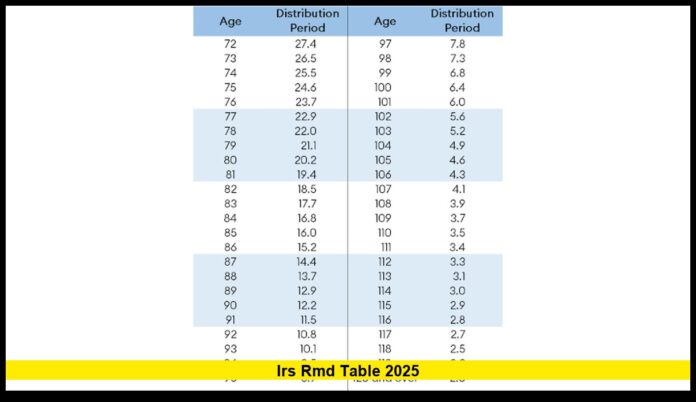
The latest updates on the IRS RMD Table 2025 reveal that the mandatory withdrawal schedule for tax-deferred retirement accounts remains anchored in the Internal Revenue Service Uniform Lifetime Table. This table dictates how much you must withdraw from traditional IRAs and similar accounts once you reach RMD age, and it is a key tool for tax-planning in 2025.
Table of Contents
What’s New for 2025
The RMD rules in 2025 reflect several important points:
- The RMD starting age for most individuals is age 73, following changes made by the SECURE Act 2.0.
- The “Uniform Lifetime Table” (also known as Table III) remains the primary table for most account owners calculating their RMDs.
- The distribution periods (i.e., the denominators you divide your account-balance by) for ages 73 and up are unchanged from the prior year. For example:
- Age 73 → 26.5 years
- Age 74 → 25.5 years
- Age 75 → 24.6 years and so on.
- If you don’t take the required amount, penalties apply — typically a 25% excise tax on the shortfall (can drop to 10% if corrected promptly).
- The calculation for RMDs uses the account’s fair market value as of December 31 of the prior year (i.e., December 31, 2024 for the 2025 RMD).
How to Read the IRS RMD Table 2025
Here’s a simplified excerpt of the table you’ll use for 2025. (Based on the Uniform Lifetime Table.)
| Age | Distribution Period (Years) |
|---|---|
| 73 | 26.5 |
| 74 | 25.5 |
| 75 | 24.6 |
| 76 | 23.7 |
| 77 | 22.9 |
| 78 | 22.0 |
| 79 | 21.1 |
| 80 | 20.2 |
| 81 | 19.4 |
| 82 | 18.5 |
| 83 | 17.7 |
| 84 | 16.8 |
| 85 | 16.0 |
| 86 | 15.2 |
| 87 | 14.4 |
| 88 | 13.7 |
| 89 | 12.9 |
| 90 | 12.2 |
| 91 | 11.5 |
| 92 | 10.8 |
| 93 | 10.1 |
| 94 | 9.5 |
| 95 | 8.9 |
| 96 | 8.4 |
| 97 | 7.8 |
| 98 | 7.3 |
| 99 | 6.8 |
| 100 | 6.4 |
| 101 | 6.0 |
| 102 | 5.6 |
| 103 | 5.2 |
| 104 | 4.9 |
| 105 | 4.6 |
| 106 | 4.3 |
| 107 | 4.1 |
| 108 | 3.9 |
| 109 | 3.7 |
| 110 | 3.5 |
| 111 | 3.4 |
| 112 | 3.3 |
| 113 | 3.1 |
| 114 | 3.0 |
| 115 | 2.9 |
| 116 | 2.8 |
| 117 | 2.7 |
| 118 | 2.5 |
| 119 | 2.3 |
| 120+ | 2.0 |
(This matches data published by online sources tracking the IRS table.)
How to use it:
- Determine your account value at December 31 of the prior year.
- Find your age on your birthday in the distribution year (for 2025, your age as of your birthday in 2025).
- Divide the year-end-prior-year account value by the distribution period from the table above.
- The result is the minimum you must withdraw during the 2025 calendar year (or by deadline).
Key Deadlines and Other Rules for 2025
- If you turn age 73 in 2025, your first RMD must be taken by April 1, 2026 (for the 2025 year) if you delay. But if you delay, you still must take another distribution by December 31, 2026 for the 2026 RMD.
- For all subsequent years, the RMD must be withdrawn by December 31 of each year.
- If your spouse is your sole beneficiary and is more than 10 years younger than you, a different table (“Joint Life & Last Survivor”) may apply instead of the Uniform Lifetime Table.
- The rule applies to traditional IRAs, SEP IRAs, SIMPLE IRAs, and employer-plans (401(k), 403(b) etc) in many cases. Roth IRAs (for original owners) are generally not subject to RMDs.
- You cannot roll over your RMD. The amount you take in excess of the minimum cannot be counted toward a future year’s minimum.
Why It Matters for 2025
- As life expectancy factors (denominators) gradually decline with age, the percentage of your account you must withdraw increases. That means older individuals may see larger RMDs over time even if account value remains flat.
- Missing the RMD or withdrawing too little can trigger significant penalties from the IRS.
- Proper timing and calculation can help manage tax brackets, charitable giving strategies, and estate planning.
- Since the RMD age has shifted under SECURE Act 2.0, many retirees and advisors are still adapting, making it especially important in 2025 to verify if you’re required to withdraw.
Top Checklist for Your 2025 RMD
- ✅ Check your age as of your birthday in 2025 and confirm whether you are required to take an RMD.
- ✅ Determine your account balance on December 31, 2024 (or required previous year for inherited accounts).
- ✅ Identify the correct table (Uniform Lifetime vs Joint Life vs Single Life) for your situation.
- ✅ Use the distribution period from the table (see chart above) to divide your prior year balance and compute the RMD amount.
- ✅ Take the amount by the deadline (usually December 31, 2025 unless it’s your first RMD and you choose to delay).
- ✅ Keep documentation of your withdrawal—amount, date, account.
- ✅ If you have multiple IRAs, you may aggregate RMDs and withdraw from one or more IRAs (but not combine across 401(k) where rules differ).
- ✅ Consult your tax advisor if your spouse is more than 10 years younger, you inherited an IRA, or you hold nontraditional plans.
Final Thoughts
In sum, the IRS RMD Table 2025 remains a vital tool for retirement-account holders who have reached the required age. Following the steps above helps ensure you meet your withdrawal obligations and avoid penalties.
Want help comparing your RMD obligations across account types or planning the tax impact of your withdrawal? Leave a comment below or check back for updated guidance.

