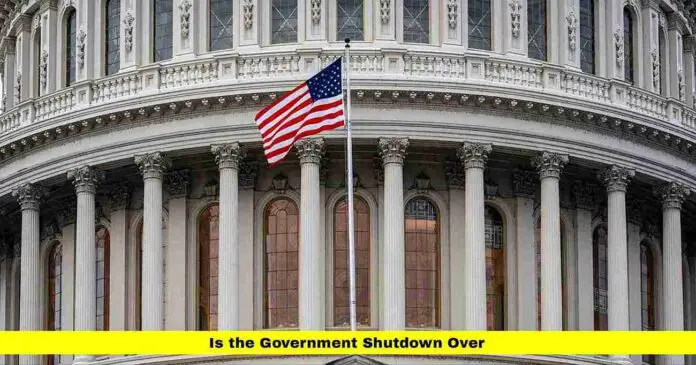
After weeks of political deadlock and nationwide disruption, the question “is the government shutdown over” can finally be answered — yes, the U.S. government shutdown is officially over. President Donald Trump signed a comprehensive funding bill on November 12, 2025, marking the end of the 43-day shutdown, the longest in American history. While this brings relief to federal workers and millions of citizens affected by the closure, the aftermath and recovery efforts are only just beginning.
Table of Contents
How the Government Shutdown Finally Ended
The 2025 government shutdown came to a dramatic conclusion after intense negotiations between the White House, the Senate, and the House of Representatives. Lawmakers spent weeks debating spending priorities before finally agreeing on a temporary funding bill.
The Senate passed the package in a bipartisan vote on November 11, paving the way for final approval in the House of Representatives, which passed the bill by a 222–209 vote the next day. Late on November 12, 2025, President Trump signed it into law, officially reopening federal agencies and restoring normal operations.
The bill ensures funding through January 30, 2026, giving Congress roughly two and a half months to pass full-year appropriations. While it ends the immediate crisis, the short-term nature of the bill means lawmakers will soon face another round of high-stakes budget talks.
Key Provisions of the Funding Bill
The bill that ended the government shutdown includes several major components designed to stabilize government functions and support federal workers:
- Back Pay for Federal Employees: All furloughed employees will receive full compensation for the 43 days they went without pay. The payments are being processed through federal payroll systems.
- Reversal of Federal Layoffs: More than 4,000 layoffs proposed during the shutdown have been rescinded, ensuring job security for thousands of government employees.
- Temporary Funding Extension: The legislation keeps government operations running until January 30, 2026, avoiding another shutdown during the holiday season.
- Exclusions and Future Votes: The measure excludes an extension of the Affordable Care Act (ACA) tax-credit subsidies, one of the most divisive issues in the budget fight. Lawmakers agreed to revisit that issue in December through a separate vote.
- Restoration of Federal Programs: Services like SNAP food aid, air traffic control, and small business loan programs are being restarted nationwide.
Why the Government Shutdown Happened
The shutdown began on October 1, 2025, after Congress failed to reach an agreement on annual spending. The dispute centered primarily around healthcare subsidies under the Affordable Care Act.
Democrats demanded that funding legislation include an extension of ACA tax-credit subsidies to help low- and middle-income Americans afford health insurance. Republicans, led by President Trump and Senate leaders, refused to tie healthcare policy to the budget process, arguing it would complicate broader fiscal reforms.
As negotiations stalled, funding expired, forcing agencies to close non-essential operations. The standoff lasted six weeks, marking the longest continuous shutdown in American history. The delay deeply affected workers, government services, and the overall economy.
Impact on Federal Employees and Essential Services
The 2025 shutdown had wide-ranging consequences across nearly every corner of the federal government. More than 900,000 federal employees were either furloughed or required to work without pay, leading to widespread financial hardship.
Agencies like the Federal Aviation Administration (FAA), Department of Agriculture, and National Park Service were severely disrupted. Air travel delays became frequent, food inspection programs were scaled back, and major national parks were forced to close temporarily due to lack of staff.
Essential services such as Social Security, Medicare, and military operations continued, but other programs—including tax processing, loan approvals, and public benefits applications—faced significant backlogs. The economic cost of the shutdown is estimated to be between $7 billion and $11 billion, a blow that will take months to recover from.
How Federal Services Are Recovering
Now that the government shutdown is over, agencies have begun the long process of restoring normal operations. Federal employees are returning to work, systems are coming back online, and pending applications are being reviewed once again.
However, the recovery is gradual. Many offices face large backlogs, especially in departments dealing with public benefits, licenses, and grants. It may take several weeks before citizens experience a full return to pre-shutdown service levels.
Federal employees are expected to receive back pay within two to three pay cycles, depending on agency payroll systems. Contractors, on the other hand, may face more uncertainty, as compensation for lost work depends on individual contract terms and funding availability.
Air Travel and Transportation Rebound
Airports across the country were among the hardest hit during the shutdown. The FAA and Transportation Security Administration (TSA) faced severe staff shortages as employees missed multiple paychecks. Travelers endured long lines, cancellations, and reduced flight schedules.
With funding now restored, the FAA and TSA have resumed full operations. However, officials warn that flight schedules and staffing levels will take several weeks to normalize. Approximately 6% of scheduled flights remain reduced compared to pre-shutdown levels, as air traffic controllers and technicians catch up on delayed maintenance and training schedules.
Effects on Food and Public Assistance Programs
Millions of Americans who rely on federal food and assistance programs were affected during the shutdown. The Supplemental Nutrition Assistance Program (SNAP) faced disruptions in benefits delivery, while programs supporting women, infants, and children (WIC) ran on reserve funds.
Now, with the reopening, these services are resuming regular disbursements. States have received fresh allocations from the U.S. Department of Agriculture to ensure continued food support. Still, advocacy groups warn that the temporary gap caused lasting hardship for vulnerable communities.
Unresolved Policy Battles Ahead
Even though the government shutdown has ended, the central political dispute remains unresolved. The fight over Affordable Care Act subsidies continues to divide lawmakers. Democrats want a full-year extension of the tax credits, while Republicans are pushing for a narrower, budget-neutral approach.
Both sides agreed to revisit the issue before December 20, 2025, in a separate bill. However, given the political climate, many analysts expect another tense standoff. If negotiations fail again, the same budgetary gridlock could resurface before the January deadline.
Economic Fallout and Business Consequences
The shutdown’s economic effects ripple far beyond Washington. Small businesses that depend on federal contracts or permits have been hit especially hard. Many construction and research projects funded by federal grants were paused, leading to layoffs and delays.
Tourism also suffered, particularly near national parks and monuments that were closed during the shutdown. In several states, hotel and restaurant owners reported significant revenue losses due to reduced visitor numbers.
Economists estimate that the shutdown shaved 0.2% to 0.3% off national GDP growth for the fourth quarter of 2025. Although some of that loss will be recovered as government spending resumes, not all private sector impacts can be reversed.
Political Reactions and Public Sentiment
The end of the government shutdown has brought mixed reactions across the political spectrum. President Trump declared the agreement a “victory for the American taxpayer,” emphasizing fiscal responsibility. Democrats, meanwhile, claimed credit for securing worker protections and forcing a future healthcare debate.
Public opinion, however, remains critical of both parties. Polls taken during the shutdown show that most Americans were frustrated by the political brinkmanship and the human toll it caused. Many see the episode as evidence of how partisan politics continues to override public service priorities.
How This Shutdown Compares to Previous Ones
The 2025 shutdown surpassed the 2018–2019 closure in length and severity. Unlike previous shutdowns caused by spending caps or border security debates, this one revolved around healthcare funding and social welfare priorities.
What makes this shutdown particularly notable is its timing and scale. It occurred during a period of strong U.S. economic growth and relatively low unemployment, amplifying its contrast to the broader financial landscape. The interruption of federal services and delays in aid distribution exposed deep weaknesses in the federal budgeting process.
What Americans Can Expect Next
Now that the shutdown is over, citizens can expect a slow but steady return to normal. Here’s what lies ahead:
- Full Restoration of Services: Agencies are expected to clear backlogs and process delayed applications by early 2026.
- Upcoming ACA Vote: Lawmakers are scheduled to revisit the ACA subsidy extension before the end of December 2025.
- Future Budget Negotiations: The current funding extension runs out on January 30, 2026, meaning Congress will soon start debating long-term appropriations again.
- Economic Adjustment: Federal spending will rebound gradually, with analysts expecting a recovery in Q1 2026 GDP figures.
- Continued Public Scrutiny: Voters are likely to hold both parties accountable as the 2026 midterm elections approach.
A Nation Recovering from Political Fatigue
Beyond the numbers, the 2025 government shutdown revealed something deeper — public exhaustion with partisan gridlock. For six weeks, ordinary citizens bore the burden of political disputes that left them without paychecks, benefits, or essential services.
While the reopening marks a relief, it also serves as a reminder of how fragile the system can be when cooperation collapses. Many federal workers and small business owners have called for reforms that would prevent future shutdowns from being used as political leverage.
Conclusion
So, is the government shutdown over? Yes — it officially ended on November 12, 2025, when President Donald Trump signed the bipartisan funding bill that reopened the government after 43 long days.
But while the crisis has passed, the story is far from over. The debate over healthcare subsidies, budget priorities, and long-term funding remains unresolved. The government may be open again, but America’s leaders still have to rebuild trust with the public and ensure stability moving forward.
If you were affected by the shutdown — whether as a federal worker, traveler, or small business owner — share your experiences below. Your story helps shed light on how deeply these political decisions reach into everyday American lives.

