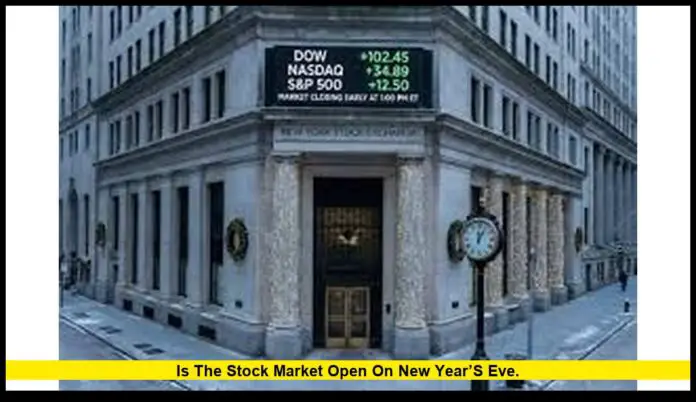
Is the stock market open on New Year’s Eve is a critical question for U.S. investors as the final days of the year approach, and as of today, December 30, 2025, the answer is clear and confirmed. The U.S. stock market will be open on New Year’s Eve, Wednesday, December 31, 2025, with normal trading hours for equities on major exchanges.
This confirmation comes at an important moment for investors who are finalizing trades, adjusting portfolios, and preparing for the transition into 2026. Since markets are closed on New Year’s Day, December 31 represents the final trading opportunity of the calendar year, making clarity around hours and market behavior especially important.
This article provides a complete, current, and in-depth look at New Year’s Eve stock market hours, what is open and closed, how trading conditions typically look, and how investors can approach the final trading day of the year with confidence.
Table of Contents
Stock Market Status on New Year’s Eve 2025
On Wednesday, December 31, 2025, the U.S. stock market will operate under standard conditions for equity trading.
Here is the confirmed status:
- New York Stock Exchange: Open
- Nasdaq: Open
- Regular trading hours: 9:30 a.m. to 4:00 p.m. Eastern Time
- New Year’s Day, January 1, 2026: Closed
New Year’s Eve is not designated as a stock market holiday for equities. There is no early closure scheduled for stock trading on this date.
This schedule allows investors full access to the market until the closing bell marks the end of the 2025 trading year.
Why the Stock Market Remains Open on New Year’s Eve
While New Year’s Eve is widely recognized as a holiday-adjacent day, U.S. stock exchanges do not treat it as a non-trading day when it falls on a weekday. This long-standing policy ensures continuity and predictability for investors.
Several reasons support this approach:
- The federal holiday is New Year’s Day, not December 31
- Markets prioritize consistency in annual trading schedules
- Institutional investors require a final trading day for year-end positioning
- Pension funds and asset managers complete annual adjustments
- Liquidity remains available before the holiday closure
Historically, the NYSE and Nasdaq have remained open on New Year’s Eve unless it falls on a Saturday or Sunday. In 2025, December 31 falls on a Wednesday, reinforcing the decision to maintain normal trading hours.
Official U.S. Stock Market Trading Hours on New Year’s Eve
Regular Equity Trading Session
Equity markets will follow the standard daily schedule.
| Exchange | Status | Trading Hours |
|---|---|---|
| NYSE | Open | 9:30 a.m. – 4:00 p.m. ET |
| Nasdaq | Open | 9:30 a.m. – 4:00 p.m. ET |
There are no special restrictions or shortened sessions for equity trading on New Year’s Eve 2025.
Pre-Market and After-Hours Trading Availability
Many investors ask whether extended trading is available on New Year’s Eve. In most cases, it is.
Pre-Market Trading
- Occurs before 9:30 a.m. ET
- Availability depends on brokerage policies
- Lower volume than regular sessions
After-Hours Trading
- Begins after 4:00 p.m. ET
- Often runs until early evening
- Reduced liquidity and wider spreads are common
Extended trading sessions may be more volatile, particularly on a holiday-adjacent day. Investors should use limit orders and remain cautious.
Markets That May Operate Differently on New Year’s Eve
While stock markets remain fully open, other financial markets may follow different schedules.
Bond Markets
Bond markets often close early on New Year’s Eve, commonly in the early afternoon. This can impact:
- U.S. Treasury securities
- Corporate bonds
- Municipal bond trading
Investors trading fixed-income products should confirm specific cutoff times with their brokerage.
Futures and Derivatives
Some futures contracts may operate on modified schedules. Activity levels often decline as traders reduce exposure ahead of the New Year’s Day closure.
Trading Volume Trends on New Year’s Eve
Although the market is open, trading volume is typically lighter than average on New Year’s Eve.
Common reasons include:
- Institutional desks operating with limited staff
- Fund managers completing trades earlier in December
- Retail traders stepping away for the holiday
- Lower corporate news activity
Lower volume does not mean inactivity, but it can lead to:
- Wider bid-ask spreads
- Short-term price fluctuations
- Reduced liquidity in small-cap stocks
Investors should be aware of these conditions when placing trades late in the session.
Why New Year’s Eve Matters for Investors
December 31 is not just another trading day. It is the final trading day of the calendar year, which gives it added significance.
Common Investor Activities on New Year’s Eve
Many investors use this day to:
- Finalize capital gains or losses
- Complete tax-related strategies
- Rebalance portfolios
- Adjust asset allocations
- Close underperforming positions
Once the market closes, no further equity trades can be executed until January 2.
Tax Timing and Year-End Considerations
For U.S. investors, trade execution date matters. Trades executed on December 31 generally count toward the current tax year, while trades on January 2 apply to the new year.
This timing is one reason New Year’s Eve often sees strategic trading activity, even with lighter overall volume.
What Happens When Markets Close on New Year’s Day
On Thursday, January 1, 2026, U.S. stock markets will be fully closed.
This includes:
- NYSE
- Nasdaq
- Options exchanges
- Most U.S.-based trading venues
Trading resumes on Friday, January 2, 2026, under normal conditions.
Orders placed during the closure will queue and execute when markets reopen.
Brokerage Operations on New Year’s Eve
Most major brokerages fully support trading on New Year’s Eve through:
- Online trading platforms
- Mobile applications
- Automated order systems
However, investors should be aware that:
- Customer service hours may be reduced
- Back-office processing may be slower
- End-of-day cutoffs may be strictly enforced
Placing trades earlier in the day can help avoid last-minute complications.
Common Misconceptions About New Year’s Eve Trading
Many investors mistakenly believe the stock market closes early on December 31. This is not true for equities.
Other misconceptions include:
- Trading stops after noon
- Only select stocks are available
- Orders cannot be placed late in the session
In reality, the market operates normally until the closing bell.
Historical Consistency of New Year’s Eve Market Hours
For decades, U.S. stock exchanges have followed a consistent approach to New Year’s Eve trading. When the date falls on a weekday, markets remain open for a full session.
This consistency allows investors to plan ahead and reduces uncertainty during the holiday season.
Guidance for Retail Investors
Retail investors should approach New Year’s Eve trading with awareness rather than urgency.
Helpful tips include:
- Monitor liquidity levels
- Use limit orders where possible
- Avoid unnecessary last-minute trades
- Be mindful of volatility near the close
Understanding market conditions can help reduce risk.
Guidance for Long-Term Investors
Long-term investors may choose to avoid trading on New Year’s Eve unless a specific strategy requires action. Portfolio rebalancing and tax planning should align with broader investment goals.
Patience and discipline remain key.
International Market Considerations
Global markets follow different holiday schedules. Some international exchanges close early on December 31, while others close entirely.
U.S. investors holding international securities should confirm each market’s status individually.
Key Takeaways at a Glance
- As investors prepare to close out 2025 and transition into 2026, understanding the market calendar is essential. First and foremost, the stock market is open on New Year’s Eve 2025, giving traders and investors a final chance to execute trades, adjust portfolios, and finalize year-end strategies before the holiday break.
- Both the New York Stock Exchange (NYSE) and Nasdaq will trade normal hours on December 31, meaning the markets will open at their regular session start time and continue through the standard close. For most equity investors, this translates to a full day of activity from 9:30 a.m. to 4:00 p.m. Eastern Time, just like any other regular trading day.
- Even though the equity markets operate normally, equity markets will still close at 4:00 p.m. ET sharp, signaling the end of the final official trading session of the year. After this point, no further regular trading activity takes place until markets reopen after the holiday closure.
- It’s also important to remember that while stock trading remains open throughout the day, bond markets may close earlier on New Year’s Eve. Many fixed-income trading desks wind down in the early afternoon to account for reduced holiday liquidity, meaning bond investors should check specific closing times with their brokerage if they intend to trade U.S. Treasuries or corporate debt on December 31.
- Once the calendar flips to January 1, markets are closed for New Year’s Day, marking a complete halt in regular U.S. trading activity. This closure applies to equities, options, and most exchange-based instruments, giving investors and market professionals a designated holiday while global markets may follow their own schedules.
- Throughout New Year’s Eve, trading volume is often lighter than usual, especially in the late afternoon as many institutional traders and retail participants finish their year’s work early. Lower volume can lead to wider bid-ask spreads and more pronounced moves in individual stocks, particularly in less actively traded securities. Even with thinner liquidity, the market still functions and provides price discovery, but investors should be mindful of these dynamics when placing trades late in the session.
- Most importantly, December 31 remains the final opportunity to trade U.S. stocks before the new year begins. Whether you are tax-loss harvesting, rebalancing a portfolio, closing out positions for strategic reasons, or simply monitoring market trends, this day represents the last chance to make equity trades with settlement dates that count in the 2025 tax year. After the markets close and the holiday arrives, trading activity pauses until markets resume in 2026.
December 31 remains the final opportunity to trade U.S. stocks before the new year begins.
Frequently Asked Questions
Is the stock market open on New Year’s Eve 2025?
Yes. U.S. stock markets are open on December 31, 2025, with normal equity trading hours.
Does the stock market close early on New Year’s Eve?
No. Equity markets follow the standard 9:30 a.m. to 4:00 p.m. Eastern Time schedule.
Is the stock market open on New Year’s Day?
No. U.S. stock markets are closed on January 1, 2026.
As the final trading day of the year approaches, knowing exactly when markets are open can help you plan with confidence and avoid unnecessary surprises. Feel free to share your thoughts or stay connected for timely market updates as the new year begins.
Disclaimer
This article is for informational purposes only and does not constitute financial, investment, or trading advice. Market hours, exchange schedules, and trading conditions may change without notice. Readers should confirm details with their brokerage or financial advisor before making investment decisions.

