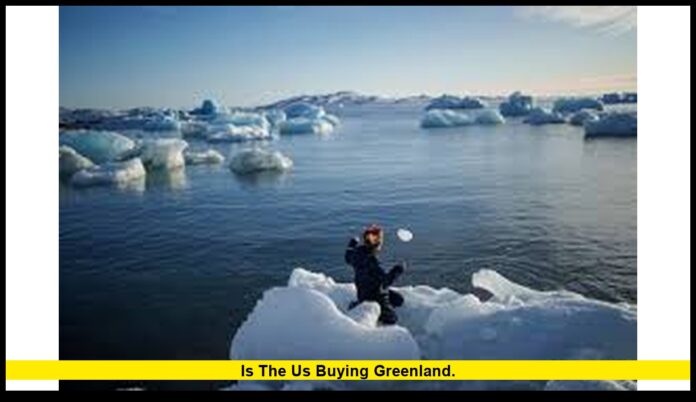
Is the US buying Greenland? That question has surged back into public debate as recent political statements, diplomatic reactions, and Arctic security concerns collide in early 2026. What was once treated as a fringe or symbolic idea is now being discussed with renewed seriousness, drawing global attention and firm responses from Greenland, Denmark, and international partners.
As of today, Greenland has not been sold, transferred, or placed under any formal agreement with the United States. Still, the growing intensity of official remarks has pushed the topic into the spotlight, raising questions about sovereignty, global security, and the future of the Arctic region.
Table of Contents
Why the Question Has Returned Now
The discussion surrounding Greenland’s future has reemerged because geopolitical pressure in the Arctic has reached a critical point. Rapid climate change is transforming the region faster than any other part of the world, opening new sea routes, altering military calculations, and increasing competition among major powers that once viewed the Arctic as strategically distant.
At the same time, global security priorities have shifted. Military positioning in northern regions has intensified as nations reassess early-warning systems, missile defense coverage, and surveillance infrastructure. Greenland’s location places it at the center of these considerations, making it increasingly relevant to modern defense planning and strategic oversight of the North Atlantic and Arctic corridors.
Recent statements from U.S. officials have underscored this reality by highlighting Greenland’s value in terms of defense infrastructure, monitoring capabilities, and geographic reach. Unlike past remarks that were often dismissed as symbolic or speculative, the current language has been more direct and deliberate. This has led international observers to interpret the messaging as a serious reassessment of long-term Arctic strategy rather than passing political commentary.
These remarks prompted immediate responses from European governments and Greenlandic authorities, who viewed the renewed attention as a signal that Greenland’s role in global security calculations is evolving. The shift has reignited public debate, diplomatic engagement, and strategic analysis across allied nations.
Taken together, this change in tone explains why many are again asking whether the United States is pursuing something more concrete than influence. The question has returned not because Greenland has changed ownership, but because the Arctic itself has changed—becoming a central arena in modern geopolitics where geography, security, and sovereignty now intersect more sharply than ever before.
Greenland’s Strategic Importance
Greenland occupies a unique position in the world. Its size, location, and natural features make it central to modern Arctic strategy.
Geographic Advantage
Greenland sits between North America and Europe, making it a key location for monitoring air and sea routes across the North Atlantic. Its position allows for early detection systems and defensive coordination that are increasingly relevant in today’s security environment.
Arctic Expansion
As polar ice continues to recede, new shipping corridors and strategic passageways are emerging. Control and influence in Arctic territories have become central to long-term planning for global powers.
Resource Potential
Greenland is believed to hold significant deposits of rare earth minerals and other valuable resources essential for modern technology, defense systems, and renewable energy development. Access to these materials is now considered a national priority by many governments.
Denmark and Greenland Push Back
Denmark, which retains sovereignty over Greenland while granting it extensive self-rule, has made its position clear. Danish leaders have firmly stated that Greenland is not for sale and that its status cannot be decided unilaterally by any foreign power.
Greenland’s own government has echoed this stance. Leaders in Nuuk have emphasized that the island’s future lies in self-determination, not in becoming the possession of another country. Public opinion within Greenland overwhelmingly supports maintaining control over political decisions and preserving cultural identity.
These responses highlight a key reality: any legitimate change to Greenland’s status would require consent that does not currently exist.
The Impact of Military Language
One of the most controversial aspects of the current debate has been the growing use of military language by political figures. Phrases suggesting that “all options remain on the table” have unsettled allies, escalated tensions, and raised serious concerns about long-standing international norms that govern relations between friendly nations.
Even in the absence of concrete plans, the mere implication of force involving a NATO partner has drawn intense scrutiny. Such rhetoric carries weight in global politics, where words alone can shift markets, influence defense postures, and alter diplomatic relationships. Analysts note that repeated references to military options can unintentionally signal readiness for confrontation, even when diplomatic solutions remain the stated preference.
This language has placed allied nations in an uncomfortable position. Countries that have historically coordinated closely on defense and security are now being forced to publicly reaffirm their commitment to sovereignty and alliance principles. This has added strain to cooperative frameworks that rely heavily on mutual trust and shared expectations.
In the Arctic, the consequences are particularly sensitive. The region has long been managed through cooperation, scientific collaboration, and controlled military presence. Heightened military rhetoric risks transforming the Arctic from a zone of coordination into one of competition, increasing the likelihood of miscalculation or escalation.
Defense experts widely agree that any military-related move concerning Greenland would have consequences far beyond the island itself. It could reshape alliance dynamics, accelerate arms deployments in the Arctic, and redefine how territorial integrity is discussed in global politics. For these reasons, many policymakers argue that careful language is just as important as careful action in preventing long-term instability.
Diplomacy Remains the Primary Path
Despite heightened tension, diplomatic engagement continues. Ongoing discussions between U.S. and Danish officials focus on cooperation rather than confrontation.
Current diplomatic priorities include:
- Strengthening Arctic defense coordination
- Expanding existing security agreements
- Addressing concerns about foreign influence in the region
Many observers believe these efforts reflect a broader strategy aimed at increasing U.S. influence without attempting an outright acquisition.
A Look at Historical Context
The idea of the United States acquiring Greenland is not new. Similar discussions surfaced during the mid-20th century and again in the late 2010s. Each time, the proposal faced immediate rejection from Denmark and Greenland.
This pattern has remained consistent. While interest may resurface during moments of geopolitical tension, the legal, political, and cultural barriers have never disappeared.
Understanding this history helps explain why the question continues to return without producing tangible outcomes.
Legal and Political Obstacles
A lawful purchase of Greenland would face overwhelming challenges:
- Approval from Denmark’s government
- Consent from Greenland’s parliament
- Potential public referendums
- Authorization from the U.S. Congress
- Compliance with international law
Without satisfying all these conditions, any attempt to change Greenland’s status would lack legitimacy. These barriers make a formal purchase highly improbable.
Global Reaction and Public Debate
The renewed discussion has triggered strong and often polarized reactions across the world, extending far beyond government circles into public discourse, policy forums, and international media. Many observers view the idea of acquiring territory in the modern era as a step backward, arguing that it clashes with decades of progress toward rules-based international order and respect for national sovereignty.
Others frame the debate through the lens of security and strategic necessity. Supporters of increased U.S. involvement in Greenland argue that Arctic competition has fundamentally altered global power dynamics. From this perspective, securing influence in strategically vital regions is seen as a defensive response to growing geopolitical pressure rather than territorial ambition.
Public debate within Europe has been particularly intense. Citizens and political groups in several countries have raised concerns that even discussing territorial acquisition sets a dangerous tone, especially among allied nations. The fear is not limited to Greenland itself, but to the broader message such actions could send about the durability of international agreements and alliances.
International concern largely centers on precedent. Allowing pressure-based territorial changes—even rhetorically—could weaken the principles that underpin global stability, including mutual respect, peaceful negotiation, and self-determination. Smaller nations and autonomous regions have expressed unease, worried that normalization of such ideas could expose them to similar pressure in the future.
Within Greenland, the debate has also sharpened public awareness. Many residents see the global attention as both an opportunity and a risk—an opportunity to assert political identity more clearly, and a risk of being drawn into power struggles between larger nations. This has intensified local conversations about autonomy, governance, and long-term independence.
Taken together, these reactions explain why the issue has drawn such widespread and sustained attention. The discussion is no longer just about Greenland itself, but about how power is exercised in the modern world—and whether long-standing international norms will continue to hold under increasing geopolitical strain.
Is the US Buying Greenland Right Now?
The clear answer is no. The United States is not currently buying Greenland, and no formal negotiations are underway. However, Greenland has become a central focus of Arctic strategy, which explains the renewed rhetoric and diplomatic activity.
Rather than a direct purchase, the situation reflects a struggle over influence, security partnerships, and long-term positioning in a changing region.
What to Expect Next
In the coming months, Greenland is likely to remain at the center of intense international discussion, and developments suggest this controversy may deepen rather than fade. Diplomatic engagement between the United States, Denmark, and Greenland is expected to continue as leaders seek formal talks to clarify intentions, reduce tensions, and define pathways for cooperation in the Arctic.
U.S. officials have signaled that Greenland remains a high priority in strategic planning, reinforcing that Washington views the island’s location as essential to national security in response to broader geopolitical competition. This renewed emphasis has prompted Denmark and Greenland to formally request direct discussions with senior U.S. diplomats, underscoring the need for clearer communication and mutual respect.
At the same time, European governments have rallied around Greenland and Denmark, reaffirming that decisions about the island’s future must be made with the consent of its people. Several European leaders have publicly declared their support for defending Greenland’s sovereignty, sending a unified message that undermining international norms would have far-reaching consequences for regional alliances.
Military rhetoric has also shaped what comes next. Even though there is no concrete plan for forceful action, the repeated suggestion that all options remain available has alarmed NATO partners and pushed defense planning conversations to include Arctic security more broadly. This has accelerated discussions about military readiness, joint exercises, and defense spending increases in Arctic nations — with a growing focus on shared monitoring, infrastructure, and deterrent capabilities.
Economic and resource interests are also likely to influence future developments. Greenland’s vast mineral potential continues to attract attention, and heightened geopolitical focus may accelerate investment interest, mining rights debates, and related market attention. At the same time, indigenous and Greenlandic authorities are increasingly asserting their political priorities, especially after recent elections highlighted self-governance and independence as major issues.
Overall, whether tensions ease or escalate will depend on how governments balance national security interests with respect for sovereignty, international law, and cooperative diplomacy. For now, Greenland’s legal status remains unchanged, but the convergence of diplomatic talks, strategic planning, military posturing, and international alliances means the conversation is far from over. Expect sustained global attention, evolving policy responses, and new fractures or alliances in the geopolitics of the Arctic as this situation unfolds.
FAQs
Q1: Is the US officially negotiating to buy Greenland?
No, there is no confirmed negotiation or agreement in place.
Q2: Who decides Greenland’s future?
Greenland’s people and governing institutions play a central role in determining its political direction.
Q3: Why is Greenland so important today?
Its location, resources, and role in Arctic security have made it increasingly significant.
Disclaimer:
This article is for informational purposes only and reflects publicly available developments and statements as of the date of publication. It does not constitute legal, political, or diplomatic advice.

