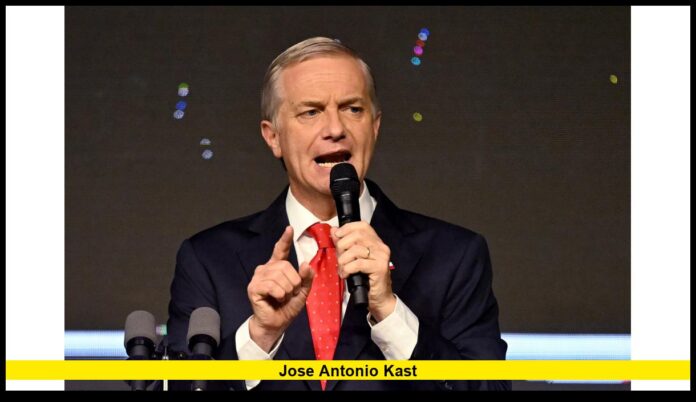
Jose Antonio Kast emerged as the clear winner of Chile’s 2025 presidential election, delivering a decisive conservative victory that is reshaping the country’s political direction as of today’s confirmed results.
Chile’s electoral process concluded with Kast winning the national runoff by a solid margin, defeating left-wing candidate Jeannette Jara. The outcome reflects voter frustration over crime, immigration pressures, and economic uncertainty, issues that dominated the campaign and influenced turnout across the country.
Table of Contents
Election Results Confirm a Clear Mandate
The final vote count showed Jose Antonio Kast capturing close to 58 percent of the vote, while his opponent secured approximately 42 percent. This margin represents one of the strongest performances by a right-wing candidate in Chile since the nation’s return to democracy.
Participation remained high, particularly in metropolitan regions and middle-income communities. Many voters said public safety concerns played a decisive role in their choice. Others pointed to dissatisfaction with the pace of economic recovery and the perceived lack of order in public spaces.
Following the announcement, Kast addressed supporters and called for national unity, while his opponent publicly accepted the outcome, emphasizing the importance of democratic stability.
Jose Antonio Kast’s Political Background
Jose Antonio Kast is the founder and leader of Chile’s Republican Party and a longtime figure in national politics. He previously served as a lawmaker and has remained active in public debate for more than a decade.
Born in Santiago, Kast built his political identity around conservative principles, emphasizing authority, personal responsibility, and limited government. His earlier presidential campaigns in 2017 and 2021 helped establish a loyal voter base, even though both bids ended in defeat.
The 2025 election marked his third presidential run and the first time his message translated into a nationwide majority.
Core Ideas That Defined His Campaign
Throughout the campaign, Jose Antonio Kast maintained a focused message centered on security, immigration enforcement, and economic discipline. Rather than broad ideological arguments, his platform emphasized concrete actions and rapid implementation.
Key themes included:
- Restoring public order through stronger policing
- Tightening border controls to address irregular migration
- Reducing bureaucracy and public spending
- Encouraging private investment and job growth
This clarity helped Kast consolidate conservative voters while also attracting undecided citizens concerned about daily safety and stability.
Public Safety as the Central Issue
Crime emerged as the dominant concern of the election cycle. Surveys and voter interviews consistently showed fear of violence, organized crime, and drug trafficking influencing political attitudes.
Jose Antonio Kast repeatedly described security as a prerequisite for social progress. His campaign promised expanded police authority, increased patrol presence, and tougher penalties for violent offenses.
Supporters argued that these measures were necessary to restore confidence in public institutions. Critics expressed concern about civil liberties, but the security message proved effective with a broad segment of the electorate.
Immigration and Border Control Debate
Another major factor in the election was migration, particularly along Chile’s northern borders. In recent years, increased migration flows placed pressure on housing, healthcare, and local governments.
Kast pledged stricter border enforcement and faster deportation procedures for undocumented migrants involved in criminal activity. He framed the issue as one of state responsibility rather than ideology.
This stance resonated with voters in regions most affected by migration-related challenges, contributing to his strong performance outside traditional conservative strongholds.
Economic Vision and Fiscal Discipline
While security dominated headlines, Jose Antonio Kast also emphasized economic management. His platform focused on fiscal discipline, regulatory reform, and incentives for private-sector growth.
Campaign speeches highlighted concerns about government inefficiency and rising public spending. Kast argued that economic stability would require simplifying regulations and restoring investor confidence.
Business groups reacted cautiously optimistic following the election, while labor organizations signaled they would closely monitor policy changes affecting workers’ rights.
Voter Demographics and Support Base
Kast’s support came from a wide range of voters. He performed strongly among middle-class households, older voters, and individuals who identified security as their top concern.
Younger voters showed more divided preferences, though Kast improved his performance compared to previous elections. Rural areas and smaller cities also delivered higher-than-expected margins for his candidacy.
This broader coalition marked a shift from earlier campaigns, when his support was more narrowly concentrated.
Reaction From Supporters and Critics
Supporters celebrated the victory as a turning point for Chile, arguing that the election reflected a demand for stronger leadership and clearer priorities. Many expressed hope that the new administration would act quickly to deliver visible results.
Opposition figures acknowledged the outcome but voiced concern about social cohesion. Civil society organizations said they would remain vigilant, particularly on issues related to human rights and democratic checks and balances.
Despite political tensions, the transition period began without major unrest, reinforcing confidence in Chile’s democratic institutions.
Challenges Facing the New Administration
Jose Antonio Kast is scheduled to take office on March 11, 2026, beginning a four-year term. His presidency will start amid high expectations and significant challenges.
Among the most pressing issues:
- A fragmented Congress requiring negotiation
- Balancing firm security policies with constitutional protections
- Managing economic growth amid global uncertainty
Although conservative parties made gains, no single bloc controls the legislature, meaning policy progress will depend on coalition-building.
Regional and Global Context
Kast’s election has been widely interpreted as part of a broader shift in Latin America, where voter dissatisfaction has fueled support for conservative candidates promising order and economic stability.
In the United States, analysts are watching closely due to Chile’s role as a regional partner in trade and diplomacy. While policy differences exist, continuity in economic cooperation is expected.
The election underscores how domestic concerns, rather than ideological alignment, are increasingly driving political outcomes across the region.
What Lies Ahead for Chile
As Jose Antonio Kast prepares to assume office, attention is turning from campaign rhetoric to governance. Early policy decisions will likely focus on visible security measures and administrative changes designed to demonstrate momentum.
Public opinion remains divided, but expectations are clear. Supporters want rapid action, while critics are preparing to challenge proposals they view as excessive.
The next phase of Chile’s political story will unfold under intense scrutiny, both domestically and internationally.
How do you think Jose Antonio Kast’s leadership will shape Chile’s future in the coming years? Share your thoughts and stay connected for ongoing updates.

