
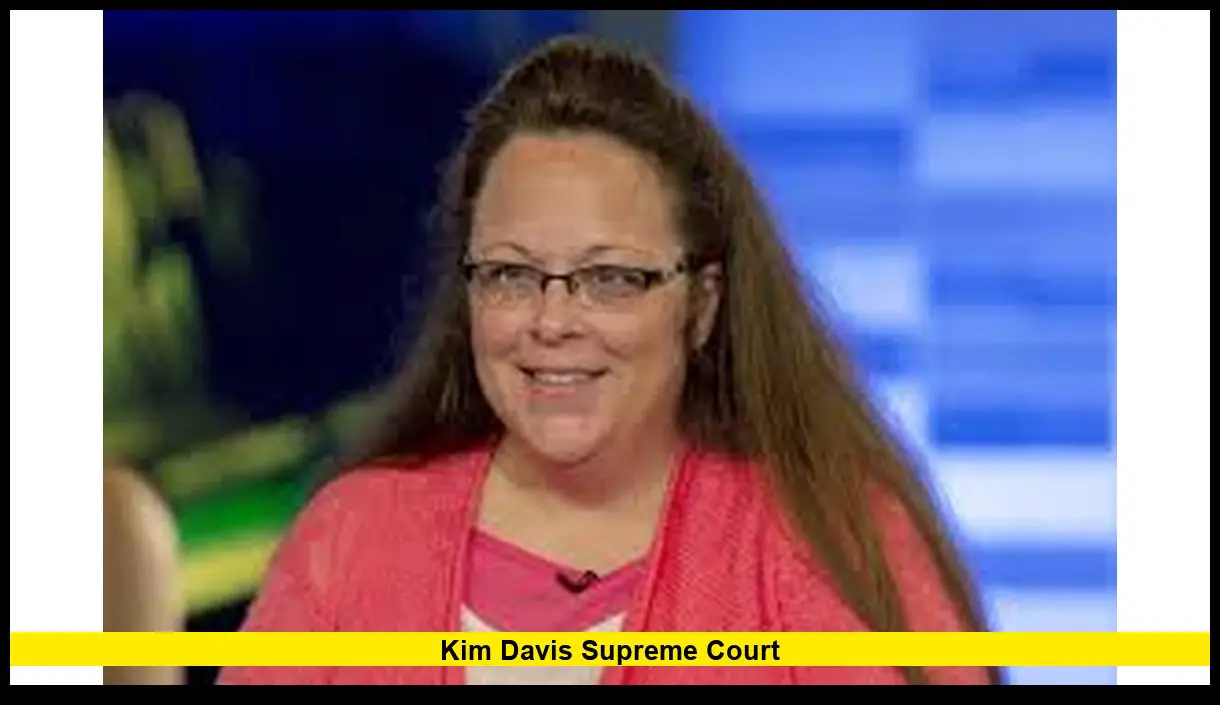
In a major legal development, the Kim Davis Supreme Court case has officially come to an end after the U.S. Supreme Court declined to review her petition on November 10, 2025. The former Kentucky clerk’s appeal aimed to challenge the 2015 landmark ruling in Obergefell v. Hodges, which legalized same-sex marriage nationwide. By refusing to take up the case, the nation’s highest court has effectively reaffirmed the legitimacy of marriage equality under federal law.
Table of Contents
Who Is Kim Davis?
Kim Davis served as the Rowan County Clerk in Kentucky from 2015 to 2019. She rose to national prominence shortly after the Supreme Court’s Obergefell decision in 2015. Davis refused to issue marriage licenses to same-sex couples, citing her Apostolic Christian faith as the reason for her objection.
Her defiance drew both national criticism and strong support from certain conservative and religious groups. When a federal judge ordered her to comply with the law, Davis refused and was jailed for contempt of court for several days in September 2015. Her arrest made her a symbol of the conflict between religious liberty and civil rights in America.
Davis later faced multiple lawsuits from same-sex couples whom she had denied marriage licenses. Among them were David Ermold and David Moore, who sued for damages related to emotional distress. In 2023, a jury awarded the couple $100,000 in damages, with additional attorney fees bringing the total to more than $360,000.
Why Kim Davis Appealed to the Supreme Court
After years of litigation, Davis continued her legal battle by filing a petition for a writ of certiorari to the U.S. Supreme Court in mid-2025. Her petition sought to overturn lower court decisions that held her personally liable for damages and to challenge the constitutional foundation of the Obergefell decision.
Her main arguments included:
- Religious Freedom Violation: Davis argued that being forced to issue marriage licenses to same-sex couples violated her First Amendment rights to free exercise of religion.
- Qualified Immunity Claim: She claimed that, as a public official, she was entitled to legal immunity from damages since she acted according to her understanding of the law.
- Challenge to Obergefell: She urged the Court to reconsider the 2015 ruling, asserting that the decision had infringed on states’ rights and individual religious convictions.
This petition drew attention from conservative advocacy groups, who viewed it as a potential test case for reevaluating the scope of same-sex marriage protections in the post-Dobbs legal era.
The Supreme Court’s Decision
On November 10, 2025, the Supreme Court quietly denied Davis’s petition without issuing any written opinion or dissent. The refusal to hear her case effectively leaves in place the rulings of lower courts, confirming that Davis is personally liable for the damages awarded to the plaintiffs.
The denial came from a Court that holds a 6–3 conservative majority, which some observers believed might entertain the issue of religious freedom in public office. However, the Court’s silence indicates a lack of appetite to reopen the question of same-sex marriage rights — at least for now.
This outcome:
- Keeps Obergefell v. Hodges as binding precedent across all U.S. states.
- Upholds the lower court’s finding that Davis violated the constitutional rights of same-sex couples.
- Reaffirms that public officials cannot deny services based on personal or religious objections when performing official duties.
Timeline of the Kim Davis Supreme Court Case
| Date | Event |
|---|---|
| June 26, 2015 | Obergefell v. Hodges legalizes same-sex marriage nationwide. |
| August–September 2015 | Kim Davis refuses to issue marriage licenses in Rowan County, Kentucky. |
| September 3–8, 2015 | Davis is jailed for contempt of court after defying a federal order. |
| 2019 | Davis leaves office after serving one term. |
| September 2023 | Jury awards $100,000 in damages to a same-sex couple denied a license. |
| Early 2025 | Appeals court upholds ruling against Davis. |
| July 2025 | Davis petitions the Supreme Court for review. |
| November 10, 2025 | Supreme Court declines to hear the case. |
Implications of the Supreme Court’s Refusal
1. Same-Sex Marriage Remains Protected
The Supreme Court’s denial of Davis’s appeal ensures that Obergefell v. Hodges continues to stand as the law of the land. States and local clerks must continue to issue marriage licenses to all eligible couples, regardless of gender.
This decision provides reassurance to LGBTQ+ Americans that their marriage rights remain intact, even amid shifting political and judicial climates.
2. Limits of Religious Freedom in Public Office
While religious liberty remains a deeply held constitutional value, this case reinforces that public officials must act within constitutional boundaries. When a public official’s personal beliefs conflict with the law, they are still required to carry out their official duties or resign from the position.
The Court’s inaction sends a clear message that personal belief does not exempt government employees from upholding civil rights.
3. Broader Legal and Political Context
Davis’s case arrived at a time when social conservatives hoped to leverage the Court’s conservative majority to revisit Obergefell. However, the denial shows that the current justices may be reluctant to reopen socially divisive issues that have broad national acceptance.
The Court’s decision could indicate a desire to maintain stability on established civil rights precedents, even as debates over religious liberty continue to evolve.
Public Reaction and Next Steps
Public response to the Supreme Court’s decision has been divided. Supporters of marriage equality hailed the move as a victory for civil rights and legal consistency. Advocates for religious freedom expressed disappointment, arguing that the case represented a missed opportunity to clarify protections for people of faith in government roles.
As for Davis, the decision likely marks the end of her long legal battle. She remains responsible for the financial judgment awarded against her. The case also serves as a reminder to local officials nationwide that constitutional rights must guide public service, not personal belief systems.
The Supreme Court’s rejection of the Kim Davis appeal reaffirms a decade of marriage equality and underscores that public officials cannot use religion as a basis to deny constitutional rights. The ruling solidifies Obergefell’s place in American law — at least for now.
What are your thoughts on the Supreme Court’s decision in the Kim Davis case? Share your opinions and join the discussion below.