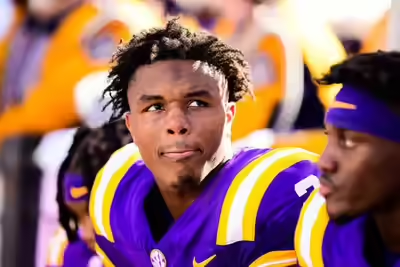
Kyren Lacy death remains one of the most heartbreaking and debated stories in recent college football memory. As of today, the picture includes a complete timeline of the December 2024 crash investigation in Louisiana, fresh defense video evidence aired this week, and the April 12, 2025 events in Texas that ended the former LSU wide receiver’s life. This comprehensive account focuses on the facts now available to U.S. readers, presented clearly and without speculation.
Table of Contents
Who Kyren Lacy Was—and Why His Story Matters
Lacy rose from Thibodaux, Louisiana, to star at LSU after beginning his career at Louisiana–Lafayette. In 2024, he delivered a breakout season with top-tier production, earning national attention and a shot at the NFL. Coaches praised his work ethic. Teammates lauded his leadership. Fans saw a local success story on the cusp of a professional career.
That momentum collided with tragedy and controversy. The months between December 2024 and April 2025 reshaped his life—and, ultimately, his legacy.
The Louisiana Crash: Key Facts from December 2024
On December 17, 2024, a crash occurred on LA Highway 20 in Lafourche Parish. The collision led to the death of 78-year-old Herman Hall, a respected community member from Thibodaux. Investigators said multiple vehicles became involved in a head-on impact. The crash prompted an intensive police inquiry that looked into speed, passing behavior, and lane position in a no-passing zone.
Authorities later alleged that Lacy had driven recklessly before the impact and then continued south without stopping at the scene. Those allegations triggered intense media coverage and immediate public debate.
Arrest Warrant and Charges
In early January 2025, Louisiana State Police obtained an arrest warrant. Lacy surrendered and posted bond shortly thereafter. The listed charges included:
- Negligent homicide
- Felony hit-and-run
- Reckless operation
Prosecutors prepared to present evidence to a grand jury in April 2025. Meanwhile, Lacy’s football future—once firmly pointed toward the NFL—hung in the balance.
Defense Pushback: A Different Read of the Evidence
From the start, defense attorney Matt (Matthew) Ory disputed the state’s version of events. He argued that the available video and measurements didn’t support allegations that Lacy’s actions caused the fatal impact.
Central to the defense case:
- Distance at the moment of impact: Ory has asserted that Lacy’s vehicle was roughly 72 yards behind the crash when the collision occurred.
- Lane behavior: The defense rejects narratives that Lacy weaved through traffic at the point of impact, maintaining that he did not intrude upon other cars at the crucial moment.
- Witness handling: The defense has questioned aspects of the investigative process, including whether officers shaped witness statements and why a key passenger in Lacy’s vehicle was not interviewed promptly.
The push and pull between the state’s allegations and the defense’s account framed the legal fight that would have unfolded at the April grand jury.
The Night of April 12, 2025 in Texas
The final hours of Lacy’s life took place near Houston. Law enforcement received a domestic-disturbance call involving a family dispute. During that dispute, a gun discharged into the ground. Lacy left the location by car. A constable later attempted a stop, and a multi-mile pursuit began.
Investigators say the chase ended when Lacy crashed. When officers approached the vehicle, they found him deceased from a self-inflicted gunshot wound. A firearm was recovered inside the car. Body-worn camera and in-car video reviews did not indicate shots fired by officers after the pursuit ended.
He was 24 years old.
Immediate Aftermath: Football World and Family in Mourning
LSU, former teammates, and coaches issued statements of grief. Friends shared memories of a competitor who stayed late after practice, who kept the locker room loose, who took time with younger players. Lacy’s family asked for privacy and emphasized compassion, with loved ones highlighting the need to talk openly about mental health.
The timing made the news even more wrenching. The grand jury hearing awaited just days later. Fans who tracked his rise struggled to understand how a potential NFL career could turn into a fatal night so quickly.
New This Week: Defense Interview and Video Footage
This week, the defense team publicly showcased a detailed side-by-side presentation of investigative documents and video clips—surveillance and body-camera segments—during a long-form interview on local television. The extended discussion pressed three themes:
- Causation and proximity: The defense argues that video timing and measured distance show Lacy was too far back to have triggered the head-on impact.
- Narrative drift: The presentation claims material differences between early summaries, witness language, and what the footage actually shows on the roadway.
- Investigative choices: The defense points to the lack of an immediate interview with a passenger in Lacy’s vehicle and questions whether officers prompted or steered witness phrasing.
These materials do not erase the tragedy of December 17 or the loss of Herman Hall. They do, however, renew debate about whether the original allegations accurately reflected what occurred on Highway 20. The footage has intensified calls for a meticulous, transparent review of every frame and report line.
Why the Legal Questions Still Matter After His Death
Because Lacy died before the grand jury hearing, the criminal case against him will not proceed to trial. Yet the legal questions haven’t vanished:
- Accuracy of the crash narrative: Communities want clarity on what truly caused the fatal impact.
- Due process and public perception: Critics worry that intense media attention and premature conclusions can damage reputations before adjudication.
- Policy implications: The case spotlights how agencies gather, preserve, and explain video evidence; how witnesses are interviewed; and how quickly allegations travel to the public square.
Families affected by the crash—both Herman Hall’s and Kyren Lacy’s—deserve answers grounded in verified facts. Clear answers can help communities process grief and can shape better investigative practices.
Mental Health, Athletes, and Pressure
The Kyren Lacy death also brings mental health into sharper focus. Young athletes often shoulder a unique load: public scrutiny, draft pressure, family expectations, and the burden of ongoing legal uncertainty. These stressors can stack quickly. Sports programs, agents, and leagues have increased mental-health offerings in recent years, but high-profile cases show gaps still exist.
Three steps experts urge for athletes and their circles:
- Early, stigma-free counseling: Normalize proactive mental-health check-ins, not just crisis-response sessions.
- Crisis protocols: Ensure trusted contacts can connect athletes to support at any hour, especially during legal or career turbulence.
- Media literacy and messaging: Help athletes and families manage public narratives and online storms without feeling utterly alone.
None of this rewrites what happened. It does, however, outline practical ways to reduce the risk of similar tragedies.
Remembering Herman Hall
Any complete account must also honor Herman Hall, who lost his life in the December crash. He was a father, a grandfather, and a neighbor with deep ties in Thibodaux. His family’s loss is immeasurable. Justice, in the best sense, seeks truth for him as well—truth about the exact chain of events on Highway 20, and clarity that respects the dignity of every life touched by that night.
What the Public Should Watch For Next
Even though criminal proceedings will not move forward against Lacy, several developments remain possible:
- Independent case reviews: Agencies or outside experts may reassess crash videos, timing, and narratives to address public concerns.
- Civil litigation: Parties could pursue civil actions that require evidence under oath and expert reconstruction testimony.
- Policy updates: Law-enforcement bodies may refine guidance on witness interviews, video releases, and public statements in high-profile cases.
These steps would not end the pain for either family. They can, however, provide transparency, which communities need to feel that institutions handle tragedy with care and rigor.
SEO Snapshot: Key Timeline
- Dec. 17, 2024: Crash on LA Highway 20 in Lafourche Parish; Herman Hall later dies from injuries.
- Early Jan. 2025: Arrest warrant issued; Lacy surrenders and posts bond.
- April 12, 2025: Domestic disturbance call near Houston; a pursuit follows; Lacy dies of a self-inflicted gunshot wound at age 24.
- April 2025: Grand jury hearing set but does not occur following his death.
- This week (October 2025): Defense presents extended interview with synchronized clips and documents, challenging the original narrative of causation.
Balancing Two Realities
Two truths coexist. A beloved community member, Herman Hall, lost his life in a December crash. Months later, a gifted athlete, son, and teammate, Kyren Lacy, died by suicide. The law’s job is to trace causation without bias. The public’s job is to insist on fairness and to treat grief with empathy. The media’s job is to keep the details straight and avoid rushing to judgment.
The newest defense footage doesn’t close the book. It does, however, underscore why accuracy and process matter, especially when headlines move faster than investigations. If further analysis confirms that early narratives overstated Lacy’s role, reforms should follow. If analysis supports the original theory of the crash, that conclusion should rest on transparent, verifiable evidence.
Either way, clarity honors both families.
Have thoughts on this case or updates from your community? Share your perspective below, and check back for verified developments as they emerge.

