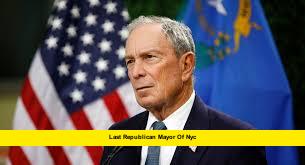
When people search for the last Republican mayor of NYC, one name dominates the conversation — Michael Bloomberg. His twelve-year leadership, from 2002 to 2013, represents the final chapter of Republican influence in New York City politics. While Bloomberg’s political identity evolved over time, his first two victories as a Republican officially made him the last GOP candidate to win the city’s highest office.
As of November 2025, more than a decade after he left City Hall, no Republican has come close to repeating his success. Bloomberg’s tenure is remembered not just for his policies but for his unique ability to bridge party divides, modernize city governance, and reshape what it meant to be a mayor in a post-9/11 world.
Table of Contents
Michael Bloomberg’s Unlikely Entry into Politics
Before entering politics, Michael Bloomberg was already a household name in finance. As the billionaire founder of Bloomberg L.P., his data and media empire made him one of the most influential businessmen in the world. But after the September 11 attacks in 2001, New York City faced unprecedented challenges — economic uncertainty, security fears, and a desperate need for steady leadership.
That same year, Bloomberg made a bold move. Although a lifelong Democrat, he switched his political registration to Republican to run for mayor. The Democratic primary was crowded and fiercely competitive, while the Republican ticket offered a clearer path to the general election.
His campaign focused on recovery, resilience, and economic renewal. With outgoing Mayor Rudy Giuliani enjoying high approval ratings after 9/11, Bloomberg earned Giuliani’s endorsement — a significant boost that helped him narrowly win the election.
On January 1, 2002, Bloomberg was sworn in as the 108th Mayor of New York City, officially marking the beginning of a new era — and unknowingly, the last Republican-led one.
Early Years: Rebuilding a City in Crisis
The early 2000s were a defining moment for New York City. The economy was struggling, thousands of jobs were lost, and the emotional scars of 9/11 were still fresh. Bloomberg took office amid these challenges, positioning himself as a pragmatic problem solver rather than a partisan politician.
He prioritized restoring fiscal stability. To close the city’s massive budget deficit, Bloomberg implemented difficult cost-cutting measures while maintaining essential public services. His financial expertise, honed from years in business, proved critical in guiding the city through recovery.
During his first term, Bloomberg also emphasized public health, environmental reform, and modern infrastructure — themes that would come to define his legacy. He launched initiatives to clean the city’s air, expand green spaces, and promote sustainable urban planning, long before “climate resilience” became a political buzzword.
The 2005 Re-Election: A Republican Victory in a Blue City
In 2005, Michael Bloomberg ran for re-election as a Republican. Despite New York’s overwhelmingly Democratic voter base, his managerial style, fiscal discipline, and visible progress in rebuilding the city helped him secure a landslide victory.
His second term solidified his reputation as a results-driven executive. He focused on improving education, public health, and quality of life. Bloomberg pushed for accountability in public schools, supporting both charter schools and data-driven reforms.
One of his most controversial but impactful policies was the citywide smoking ban in restaurants and bars, passed in 2003. Though unpopular at first, it became a national model for public health reform. Similarly, his “green” agenda — including expanded bike lanes and sustainability goals — positioned New York as a leader in urban innovation.
Throughout his tenure, Bloomberg’s approach remained grounded in efficiency and innovation rather than ideology. That pragmatic stance earned him bipartisan respect — even as it increasingly distanced him from the national Republican Party.
Breaking with the GOP: Bloomberg Becomes Independent
By 2007, Michael Bloomberg officially left the Republican Party and registered as an independent. His reasoning was simple: he believed that partisan politics were obstructing effective governance.
Although this shift raised eyebrows, it didn’t dramatically change his policies or leadership style. In fact, it highlighted his centrist philosophy — one focused on practical solutions, data-driven management, and long-term planning.
In 2008, during the national financial crisis, Bloomberg’s independent leadership proved valuable. While other cities struggled, New York’s balanced budgeting and diversified economy helped it rebound faster than expected. His administration streamlined operations, attracted new industries like tech and media, and positioned the city as a global hub for innovation.
A Controversial Third Term
In 2008, New York City’s term limit law prevented Bloomberg from seeking a third term. However, with support from the City Council, the law was temporarily amended to allow him to run again — a move that sparked heated debate.
Bloomberg argued that his steady leadership was needed as the city navigated the aftermath of the financial crisis. In 2009, he was re-elected to a third term as an independent, defeating both Democratic and Republican challengers.
His third term emphasized modernization — from digital infrastructure and data analytics in city management to ambitious public health campaigns. Under his leadership, initiatives like PlaNYC sought to make New York more environmentally sustainable and technologically advanced.
Despite criticism over income inequality and his extended tenure, Bloomberg left office in 2013 with New York City boasting low crime rates, improved school performance, and a strong economy.
The End of Republican Mayors in New York City
Since Bloomberg’s departure, New York City has been led exclusively by Democrats. Bill de Blasio took office in 2014, followed by Eric Adams in 2022. Each administration has focused on progressive issues like housing affordability, criminal justice reform, and social equity — signaling a clear political shift in the city’s electorate.
Demographically, New York’s population has grown younger, more diverse, and more liberal. These factors, combined with national polarization, have made it increasingly difficult for Republican candidates to win citywide elections.
While Bloomberg was not a conventional Republican — especially by today’s standards — he remains the last Republican mayor of NYC in historical terms. His 2001 and 2005 victories under the GOP banner officially mark the last time a Republican candidate captured City Hall.
Bloomberg’s Legacy: Beyond Party Lines
Michael Bloomberg’s influence on New York City extends far beyond party politics. His administration was defined by data, discipline, and innovation. Whether tackling environmental issues or balancing budgets, he brought a business-like efficiency to city government.
Key achievements include:
- Introducing PlaNYC, a comprehensive sustainability plan that guided urban development for decades.
- Expanding public parks and green spaces, increasing tree planting, and promoting cleaner air.
- Pioneering public health measures such as smoking bans, trans-fat restrictions, and calorie labeling.
- Supporting education reform through accountability measures and increased school choice.
- Investing in technology to create “smart city” solutions that improved public services.
Bloomberg also redefined philanthropy after leaving office. Through Bloomberg Philanthropies, he has continued to shape policy on climate change, education, and public health across the globe.
The Political Meaning of His Era
Michael Bloomberg’s time as the last Republican mayor of NYC represents more than just a historical footnote — it captures the evolution of urban politics in America. His ability to win as a Republican in a predominantly Democratic city demonstrated that voters could still prioritize competence over party allegiance.
Yet, his success also highlights a political era that may never return. The national Republican Party’s shift toward more conservative social policies has widened the gap between urban voters and GOP candidates. New York City, now deeply progressive, hasn’t elected a Republican mayor since 2005 — and few analysts expect that to change anytime soon.
Still, Bloomberg’s tenure stands as proof that leadership grounded in pragmatism, fiscal responsibility, and innovation can transcend traditional partisanship.
Timeline: From Election to Legacy
| Year | Event |
|---|---|
| 2001 | Michael Bloomberg switches to Republican Party and wins mayoral election |
| 2002 | Takes office as 108th Mayor of New York City |
| 2005 | Re-elected as Republican for a second term |
| 2007 | Leaves Republican Party, becomes independent |
| 2009 | Wins third term as an independent candidate |
| 2013 | Leaves office after 12 years in City Hall |
| 2025 | Remains recognized as the last Republican mayor of NYC |
Why Bloomberg’s Tenure Still Matters
More than a decade after he left office, Bloomberg’s leadership continues to influence New York’s political and economic identity. His balanced approach to governance — fiscally conservative yet socially progressive — left a blueprint that later mayors have drawn from, even if they lead under different party banners.
He showed that leadership in New York requires adaptability, resilience, and an understanding of how to manage a city of unmatched complexity. His policies on public health, sustainability, and innovation continue to inspire cities worldwide.
Michael Bloomberg’s time as the last Republican mayor of NYC may have closed one chapter in the city’s political history, but it opened another — one that redefined what urban leadership could look like in the modern era.
Do you think New York City will ever see another Republican mayor, or has Bloomberg’s era marked the end of that political possibility? Share your thoughts below and stay tuned for more insights on America’s evolving city politics.

