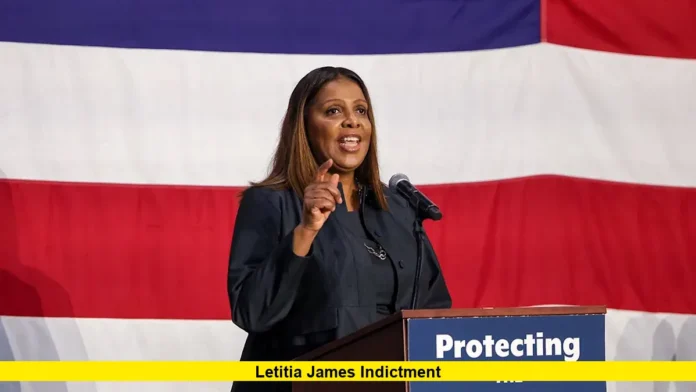
The Letitia James indictment has become a focal point in U.S. politics and law enforcement, with headlines breaking across media outlets. On October 9, 2025, a grand jury in the Eastern District of Virginia indicted New York Attorney General Letitia James on charges of bank fraud and making false statements to a financial institution over her purchase of a Virginia home. The case alleges she misrepresented the home as a second residence to secure favorable loan terms, even though it was leased out in a way inconsistent with that claim. Her first court appearance is expected October 24 in Virginia.
Below is a deep dive into the Letitia James indictment: the allegations, the legal and political context, how her team is responding, potential risks, and the broader implications for accountability and prosecutorial norms in the U.S.
Table of Contents
Charges in the Letitia James Indictment
- The indictment brings two counts: one under the federal bank fraud statute (18 U.S.C. § 1344) and another under the false statements statute (18 U.S.C. § 1014).
- Prosecutors claim James misrepresented a Norfolk, Virginia property as a secondary residence when obtaining a mortgage, to qualify for more favorable loan terms.
- It is alleged that she “saved” nearly $18,933 by using that false characterization of the home.
- The home was allegedly rented out inconsistently with being a “second residence,” and her niece was incorporated into the deal via power-of-attorney or related instruments.
- The indictment states that Lindsey Halligan, U.S. Attorney for the Eastern District of Virginia, presented the case to the grand jury herself, rather than relying on career prosecutors in the office, marking an unusual procedural move.
Under federal law, each count carries potential exposure to significant prison time and fines, though actual sentences depend on the U.S. Sentencing Guidelines, criminal history, and whether plea agreements emerge.
Background & Precursor Events
The Letitia James indictment did not arise in a vacuum. Several developments preceded it:
- Earlier in 2025, the Federal Housing Finance Agency submitted a criminal referral alleging multiple misrepresentations by James concerning her real estate holdings — including descriptions of properties in Virginia and Brooklyn.
- A formal investigation by federal agents followed, focusing on her mortgage applications and representations.
- Meanwhile, James had been a high-profile critic of former President Trump. As New York Attorney General, she brought a civil fraud suit that initially imposed a substantial financial judgment against Trump and his company — though the penalty was later partially voided by appellate courts.
- In the Eastern District of Virginia, DOJ leadership shifted dramatically. Career prosecutors reportedly resisted moving forward with criminal charges against James, citing lack of probable cause. Those dissenting voices were sidelined or removed. Halligan, a Trump ally with no prior prosecutorial experience, moved in and took over the presentation of the case.
- Some prosecutors in the Virginia office had openly questioned the strength of the evidence and whether legal thresholds could be met.
These dynamics have raised intense scrutiny over whether prosecutorial decisions are being influenced by political pressure and whether norms of impartiality and collegial decision-making have been eroded.
Responses and Counterarguments
James has aggressively denied wrongdoing and framed the Letitia James indictment as politically motivated retaliation. Her legal team argues:
- The home purchase was intended for her niece’s use, and documents support that the property’s use aligned with those plans.
- Any errors in paperwork were unintentional, not fraudulent, and do not justify criminal charges.
- The pattern of DOJ reassignments and firings in Virginia suggests the case was pushed by political actors rather than grounded in law.
- Some career prosecutors reportedly concluded that evidence was insufficient but were overridden.
Meanwhile, public defenders of the DOJ process argue that criminal referrals from federal agencies like FHFA carry weight and merit investigation, especially for allegations involving misuse of federal programs and lending rules. The government contends that no one is above the law — regardless of office — and that the charges reflect clear violations of lending statutes.
Potential Legal and Political Consequences
Legal Risks
- If convicted on both counts, James could face decades in prison and large fines (the DOJ press release lists up to 30 years per count).
- Even without a conviction, pretrial motions (to dismiss, to challenge sufficiency, or to contest the key evidence) may shape how criminal doctrine is interpreted in politically charged cases.
- Discovery demands — internal DOJ memos, communications about who approved the indictment, documents from FHFA — could expose internal decision processes and raise transparency issues.
Political Fallout
- The indictment threatens to become a central issue in her next reelection campaign as New York Attorney General, or any future bids for higher office.
- It may also reshape public discourse over the expansion of prosecutorial power and the role of political influence in federal prosecutions.
- James’s supporters and critics alike see this as a crucible moment for norms around accountability and fairness in the justice system.
Key Questions and What to Watch
- Will James enter a plea or aggressively contest the charges?
- Will motions to dismiss successfully challenge jurisdiction, statute of limitations, or admissibility of evidence?
- What documents from DOJ and FHFA will emerge via discovery, and will they illuminate how the case was authorized?
- Will prosecutorial misconduct or political pressure claims take center stage?
- How will public and media reaction shift over time, especially as James continues to serve as Attorney General and maintain her legal posture?
The Letitia James indictment is more than a headline — it’s a legal and constitutional moment. The balance between prosecutorial independence and political influence is on display. In the weeks ahead, the evidence presented, motions filed, and strategies employed will not only test her defense — but may reshape norms around how power, law, and politics intersect.
Would you like me to track further developments or provide breakdowns of individual counts as more filings emerge?

