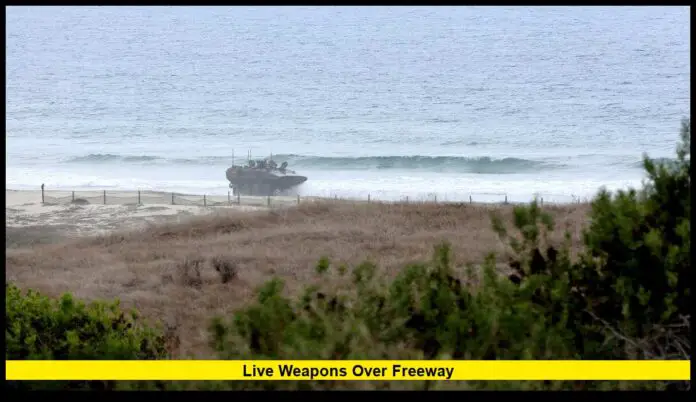
A major event unfolded in Southern California on Saturday when a planned military display involving live weapons over freeway areas forced the closure of a key stretch of Interstate 5 (I-5) near Camp Pendleton. The U.S. Marine Corps exercise — part of the 250th anniversary celebrations — led to a full shutdown of a 17-mile highway segment, sparking confusion, frustration, and a heated debate about public safety and government transparency.
Table of Contents
What Happened
Early in the morning, California transportation officials announced that a 17-mile stretch of I-5 between Oceanside and San Clemente would be closed from 11 a.m. to 3 p.m. The warning signs displayed to motorists read: “LIVE WEAPONS OVER FREEWAY.”
The notice indicated that live-fire artillery rounds would be discharged overhead as part of a Marine Corps demonstration. The event also featured amphibious landings, aerial flyovers, and coordinated operations between the Navy and Marine forces.
While the Marines initially stated that no major roadways would be affected, the state’s Department of Transportation confirmed that live rounds had already been fired in training the previous day — close enough to the freeway to trigger emergency precautions. That led California’s governor to approve the temporary closure of I-5, citing “an immediate life-safety risk.”
Meaning Behind “Live Weapons Over Freeway”
The phrase “live weapons over freeway” came directly from the digital signage along the I-5 corridor and described the event literally: live munitions being fired across or near a public highway.
This phrase quickly spread online as videos and images surfaced showing warning signs, traffic backups, and military convoys moving near the freeway. The unusual warning not only drew public attention but also raised questions about the coordination between state and federal authorities.
Timeline of Key Events
| Date | Event |
|---|---|
| Oct 16, 2025 | The Marine Corps announced a ceremonial live-fire exercise near Camp Pendleton as part of its anniversary celebration. |
| Oct 17, 2025 | State transportation authorities observed practice artillery rounds fired near the freeway and requested additional safety measures. |
| Oct 18, 2025 (Morning) | Officials declared that I-5 would be closed between Harbor Drive and Basilone Road due to “live weapons over freeway” safety risks. |
| Oct 18, 2025 (Afternoon) | The event took place with Vice President J.D. Vance and Secretary of Defense Pete Hegseth in attendance. |
| Oct 18, 2025 (Evening) | I-5 reopened to traffic after safety checks confirmed no structural damage or unexploded ordnance near the route. |
Public and Political Reaction
The closure triggered a wave of political and public reaction almost immediately.
Governor Gavin Newsom criticized the federal government’s handling of the situation, calling it “reckless and unnecessary.” He argued that live-fire exercises should never endanger or disrupt civilian infrastructure.
Federal officials countered that all safety protocols had been met and that the closure was not mandated by the military, suggesting the state acted independently out of caution. This difference in messaging fueled further confusion and intensified the debate over the boundaries of military demonstrations in civilian areas.
Some military supporters argued that such exercises are essential to readiness and morale, while others saw the event as an unnecessary public hazard.
Traffic and Economic Impact
The I-5 is one of the busiest interstates on the West Coast, carrying roughly 80,000 vehicles daily and serving as a critical freight route between San Diego and Los Angeles.
The temporary closure caused severe congestion throughout Southern California, with delays lasting between two and five hours in some areas. Drivers were diverted to I-15 and State Route 91, creating additional traffic bottlenecks.
Public transit and freight services were also affected. Train services running parallel to the freeway were paused for several hours as a precaution. Several trucking companies reported delayed deliveries due to detours and rerouting.
Businesses that rely on weekend tourism — especially along the coastal corridor — reported noticeable drops in visitor traffic that day.
Safety and Communication Concerns
The main public concern revolved around safety and communication. Many questioned why residents were not given earlier notice about a high-risk event that involved live weapons over freeway routes.
State officials stated that they became aware of the risk only after observing live-fire testing the day before. The Marines insisted that they had notified all relevant agencies in advance.
Experts noted that such discrepancies point to larger coordination issues between federal defense agencies and local governments. When live-fire operations occur near populated areas, even brief miscommunication can lead to confusion, panic, or potential accidents.
Fortunately, no injuries, accidents, or structural damage were reported during the exercise.
Why This Event Matters
- Civilian Infrastructure vs. Military Training
The I-5 is not just a roadway — it’s a lifeline for millions of Californians. Turning it into a temporary buffer zone for live-fire exercises raises serious concerns about balancing national defense and public safety. - Public Notification and Transparency
The event highlighted gaps in public communication. Many residents only learned of the closure through social media hours before it happened. - Political Implications
The disagreement between California state officials and the federal administration added a political dimension to what was primarily a safety issue. The dispute reflected broader tensions over state versus federal authority in matters of defense and emergency management. - Future Precedent
The decision to fire live rounds near a major interstate could set a controversial precedent for future demonstrations. State and federal agencies may now need to revise policies on how such exercises are planned, approved, and publicly announced.
Human Impact: Voices From the Ground
Local residents and commuters expressed mixed reactions.
- Frustration: Many drivers stranded for hours criticized the lack of advance warning, with some missing work shifts and family events.
- Concern: Parents in nearby communities worried about safety in case of misfires or explosions near the freeway.
- Curiosity: Others were intrigued by the rare military display, calling it a “once-in-a-lifetime sight,” though they agreed it should have been staged away from busy traffic routes.
Transportation workers reported that cleanup and inspection after the event took several hours, mainly to ensure no debris or shell fragments posed a danger to returning motorists.
Aftermath and Next Steps
Following the incident, California’s governor directed state agencies to review how military coordination requests are handled, especially those involving public safety risks. A task force was proposed to improve real-time communication between the Department of Defense, Caltrans, and local emergency management offices.
The Marine Corps, meanwhile, reaffirmed its commitment to maintaining open communication with state and local authorities. Officials emphasized that all ammunition used during the exercise was safely contained within the training range perimeter.
While both sides appear eager to move forward, public confidence will depend on how transparently these reviews are conducted — and whether lessons learned from the live weapons over freeway controversy lead to better coordination in the future.
The Bigger Picture
The incident underscores a larger debate: how to balance national security interests with civilian life in densely populated areas. Military bases like Camp Pendleton sit close to urban centers, meaning even well-intentioned training exercises can have far-reaching consequences for local communities.
It also raises questions about how much control states have over federally planned military events within their borders, especially when those events intersect with public infrastructure like highways, railways, and airspace.
As of now, officials have confirmed that all major California freeways are operating normally and that there are no plans for similar closures in the near future.
In summary, the “live weapons over freeway” event near Camp Pendleton has become a defining moment in the discussion about safety, communication, and coordination between civilian and military authorities. Though no harm was reported, the public outcry and confusion have made it clear that future exercises must be handled with far greater transparency and foresight.
Share your thoughts below — do you think such military demonstrations belong near public highways, or should they stay confined to secured ranges?

