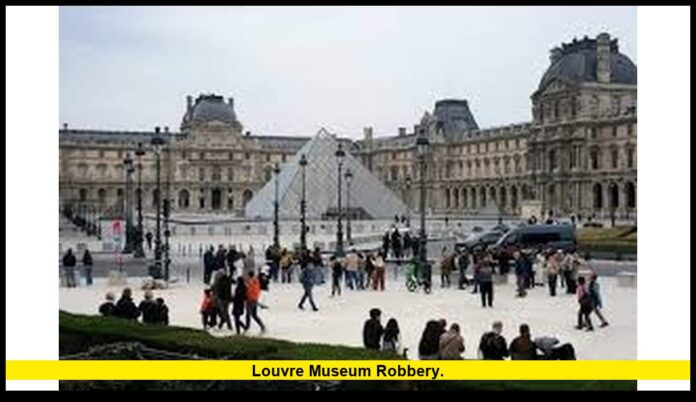
The Louvre Museum robbery has sent shockwaves through France and the global art community after thieves carried out a daring, daylight heist inside one of the world’s most secure and iconic museums. On the morning of October 19, 2025, a coordinated group of criminals stole several priceless pieces from the Louvre’s Galerie d’Apollon, home to France’s historic Crown Jewels.
This brazen theft, which lasted less than ten minutes, has sparked outrage, international headlines, and renewed concern over the security of priceless cultural artifacts. The Louvre, often regarded as the safest art institution in the world, was forced to close its doors immediately following the incident.
Table of Contents
The Heist That Shook the Louvre
Authorities confirmed that around 9:30 a.m. local time, a group of at least four masked individuals gained access to the museum through an external renovation platform. Using construction equipment positioned near a temporary scaffolding area, the thieves entered through a third-floor window connected to the Galerie d’Apollon, the room that displays France’s most valuable royal jewelry collection.
Witnesses reported hearing loud drilling and breaking glass shortly before security alarms went off. Within minutes, the suspects smashed reinforced display cases using industrial cutting tools and removed multiple pieces of jewelry, including a tiara, a brooch, and a diamond-encrusted necklace once worn by French royalty.
The entire operation reportedly took under seven minutes, and by the time security arrived, the suspects had already escaped on two motorbikes, speeding away through nearby side streets in central Paris.
What Was Stolen in the Louvre Museum Robbery
The exact list of stolen pieces is still being verified, but early reports confirm that the missing items belong to France’s 19th-century imperial collection, originally crafted for Empress Eugénie, wife of Emperor Napoleon III.
The stolen artifacts are believed to include:
- A gold and diamond tiara featuring 1,500 gemstones.
- A diamond brooch commissioned by Empress Eugénie in 1855.
- A sapphire and pearl necklace known for its royal lineage.
Experts estimate the combined market value of the stolen items to exceed $10 million, though the historical and cultural worth is considered “irreplaceable.” These jewels are part of France’s national heritage, and their theft represents one of the most significant museum crimes of the decade.
A Breach in One of the World’s Most Secure Museums
Security specialists and former museum staff have expressed shock at how such a meticulously planned robbery could occur inside a fortress-like institution such as the Louvre.
The museum, which houses over 35,000 artworks, including the Mona Lisa and Venus de Milo, operates with round-the-clock surveillance, motion detectors, and security personnel. However, investigators believe the thieves exploited a temporary construction zone, taking advantage of a brief window of vulnerability.
Early findings suggest:
- The group used aerial lift machinery positioned for maintenance work to access a high window.
- The display cases were cut open with power saws, indicating professional equipment and planning.
- The thieves’ movements were recorded on security cameras, giving investigators crucial footage for analysis.
French Interior Minister Laurent Nunez described the crime as a “highly coordinated and sophisticated operation” and confirmed that the suspects likely had prior knowledge of the museum’s internal layout.
Immediate Response from French Authorities
In the hours following the robbery, the Louvre Museum was evacuated and closed to the public. Police cordoned off the area surrounding the historic building as forensic teams began gathering evidence.
France’s Ministry of Culture has since launched a full-scale investigation in coordination with the Brigade de Répression du Banditisme (BRB) — a specialized police unit focused on high-value thefts.
Security analysts say the theft bears similarities to past European art heists, where well-organized groups targeted high-value, portable items such as jewels, coins, and small paintings. Authorities believe the stolen pieces could already be in transit to a private collector or black-market network.
Global Reaction to the Louvre Museum Robbery
The Louvre robbery has made headlines worldwide, with art institutions and museums issuing statements expressing solidarity with French authorities. Many experts warn that the event underscores the growing threat of organized cultural crime targeting national treasures.
For U.S. viewers, the story carries particular resonance. American museums frequently loan and exchange exhibits with the Louvre, and this theft may lead to tighter international security protocols for traveling collections.
Several major American institutions — including the Metropolitan Museum of Art in New York and the Getty Center in Los Angeles — have already begun reviewing their security procedures for high-value exhibits following the Paris incident.
Public Reaction in Paris
As word of the Louvre Museum robbery spread, Parisians gathered near the museum’s perimeter, expressing disbelief that such a heist could take place in broad daylight.
Local witnesses described a scene of confusion: tourists evacuated, alarms blaring, and dozens of police vehicles surrounding the plaza. Many visitors, who had traveled from around the world to see the museum’s treasures, were turned away as forensic teams secured the crime scene.
In statements released by museum officials, staff described feeling “heartbroken” over the loss, emphasizing that the stolen pieces are “symbols of France’s cultural soul.”
Ongoing Investigation and Recovery Efforts
French police are analyzing security footage that reportedly captured the suspects entering through the scaffolding area and fleeing moments later. Authorities have also recovered a damaged gold setting, believed to have been dropped by the robbers near the Seine River.
Interpol has now been alerted, expanding the investigation internationally. Jewelry experts warn that the thieves may attempt to dismantle or re-cut the gemstones, making identification and recovery more difficult. However, given the fame of the stolen pieces, selling them on the open market would be nearly impossible.
Investigators are working with international art crime units, including counterparts in London, Geneva, and New York, to track potential black-market sales or private exchanges of the jewels.
Louvre Museum’s Plan Moving Forward
In the aftermath of the robbery, the Louvre announced that it will remain partially closed until additional security reinforcements are completed. Museum Director Laurence des Cars has ordered a full audit of the institution’s security systems, including:
- Upgrading surveillance cameras and motion sensors.
- Installing reinforced glass casings for high-value items.
- Limiting public access to certain heritage collections until further notice.
The French government has pledged new funding to modernize security at the Louvre and other national museums. Officials assured the public that no other major artworks, including the Mona Lisa, were endangered during the robbery.
Historic Context: The Louvre’s First Major Theft in Decades
This is not the first time the Louvre has faced theft — though none as audacious as this. The most infamous occurred in 1911, when the Mona Lisa was stolen by an Italian handyman and recovered two years later in Florence. However, the 2025 robbery is the largest in modern history for the museum and the first to specifically target the Crown Jewels collection.
Art historians note that the stolen items’ rarity makes them instantly recognizable, which may assist in their recovery, though experts warn the criminals likely intended to dismantle or alter them.
A Wake-Up Call for the Global Art Community
The Louvre Museum robbery is a stark reminder that even the most advanced institutions are vulnerable to strategic criminal operations. Experts predict an industry-wide reassessment of how cultural heritage is protected, particularly as major museums undergo renovations or infrastructure updates.
The event has united global museums, governments, and art collectors in a renewed effort to combat cultural theft and preserve humanity’s shared treasures.
As investigations continue, the world watches closely — not just for the recovery of the stolen jewels, but for what this event reveals about the fragility of global heritage. What are your thoughts on the Louvre Museum robbery? Share your views below and stay tuned for ongoing updates.

