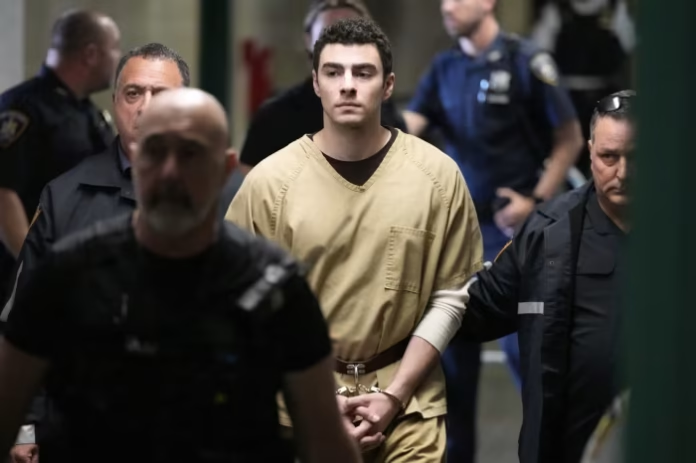
Luigi Mangione terrorism charges have been dropped by a New York state judge in connection to the killing of UnitedHealthcare CEO Brian Thompson, though murder and weapons indictments remain. The ruling was delivered on September 16, 2025, marking a major shift in what was originally a high-profile case tied to terrorism statutes.
Table of Contents
Background: What Led to the Terrorism Allegations
Luigi Mangione, 27, is accused of the December 4, 2024 ambush-style shooting of Brian Thompson, a UnitedHealthcare executive, outside a Manhattan hotel. Mangione allegedly fired a 9mm handgun at Thompson as he walked into a corporate event, then fled the scene. He was arrested in Altoona, Pennsylvania, several days later.
Among the charges filed by Manhattan prosecutors were state charges of first-degree murder as an act of terrorism and second-degree murder as a crime of terrorism. These were based on the argument that Mangione intended, through the killing, to intimidate a civilian population and influence healthcare industry policy.
At the same time, Mangione faces federal charges that carry the possibility of the death penalty, including murder with firearm, stalking, and related offenses.
What the Judge Decided
On Tuesday, September 16, 2025, New York Supreme Court Justice Gregory Carro issued a written decision dismissing the two top state charges tear-tagged with terrorism. Specifically, the judge found:
- The evidence presented to the grand jury was legally insufficient to support the theory that Mangione engaged in terrorism under state law.
- For terrorism charges to stick, prosecutors must show intent to coerce, intimidate, or affect public policy via fear of violence. The court determined that Mangione’s alleged motivations — anger toward the healthcare industry and perceived corporate greed — did not meet that standard.
- The charges dismissed include first-degree murder in furtherance of an act of terrorism and second-degree murder as a crime of terrorism.
While terrorism counts were dropped, several serious charges still stand: second-degree murder (intentional killing), multiple weapons possession counts, and several other state charges.
The judge refused a defense motion to stay the state case pending the outcome of federal proceedings.
Remaining State & Federal Charges
Although terrorism-related charges have fallen, Mangione still faces:
- A second-degree murder charge under state law, which carries 25 years to life in prison.
- Several weapons charges, including criminal possession of a weapon, and related counts.
- Meanwhile, at the federal level, prosecutors have brought indictments in connection with Thompson’s killing where the death penalty is being sought.
Legal Reasoning: Why Terrorism Charges Were Dropped
The central issue was whether Mangione’s act could be legally defined as terrorism under New York state statutes. Key legal points:
- To qualify, the act must be committed “in furtherance of an act of terrorism,” defined by statute as acts meant to intimidate or coerce a civilian population or influence government policy through fear.
- Evidence presented to the grand jury did not prove those elements. Although prosecutors claimed Mangione left writings and made statements hostile to the healthcare industry, Judge Carro found no concrete support for the claim that he sought broader fear or coercion beyond his anger or ideology.
- The judge emphasized that ideological or political motivation alone does not necessarily fulfill the legal definition of terrorism without proof of the intent to influence or terrorize.
Implications of This Ruling
This decision has several important consequences:
- State Case Penalties Reduced in Severity
With the terrorism enhancements gone, Mangione’s exposure under state law is somewhat reduced. While second-degree murder still carries a heavy sentence, removing “terrorism” modifiers means no life without parole at the state level under those counts. - Federal Case Remains Separate and Intact
The ruling does not affect federal charges. Prosecutors continue to pursue arguments there, including use of firearm, stalking, and murder. The death penalty is still on the table under federal law if Mangione is convicted. - Double Jeopardy & Legal Strategy
Defense attorneys have argued that parallel state and federal prosecutions could violate constitutional protections. The judge in state court denied a stay of the state case. Pretrial hearings remain scheduled for December. - Precedent for Use of State Terrorism Statutes
This case may get cited in future cases where prosecutors attempt to apply terrorism laws to individual killings with political or ideological overtones. The ruling draws a line — ideology alone isn’t enough; motive plus intent to terrorize or coerce must be proven.
Next Steps & Court Schedule
- The next state pretrial hearing is set for December 1, 2025. There, matters like admissibility of evidence (such as the notebook, manifesto, or weapons), possible suppression motions, and scheduling will be addressed.
- The federal case timeline isn’t settled publicly, but the Justice Department is pushing ahead. Federal prosecutors had signaled the death penalty would be pursued, a relatively rare move.
Public Reaction and Broader Discourse
The case has stirred widespread debate. Some reactions include:
- Supporters of Mangione view the conspiracy or politics surrounding healthcare costs as part of his motivation and argue the legal system overreached by labeling him a “terrorist.”
- Critics say the removal of terrorism charges aligns with proper legal standards — that a single act of violence, even motivated by political anger, does not equal terrorism unless broader threats or coercion are present.
- Media outlets and legal analysts have focused on whether this case reflects changing norms around how ideological violence is treated under law.
Luigi Mangione terrorism allegations may have been scaled back at the state level, but the case is far from over. With serious charges still pending and federal proceedings underway, observers are watching closely.

