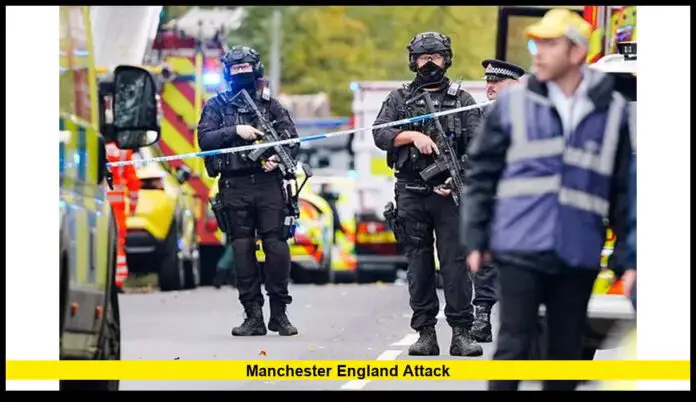
The Manchester England attack during a Yom Kippur service has left two people dead, several others injured, and a nation reeling. The assault, which targeted worshippers at a synagogue in Manchester’s Crumpsall district, is being investigated as a terrorist incident with suspected antisemitic motives. It has triggered widespread grief, heightened security, and renewed debate over how to protect vulnerable communities across the United Kingdom.
Table of Contents
What Happened During the Manchester England Attack
On October 2, 2025, as worshippers gathered at the Heaton Park Hebrew Congregation for Yom Kippur, one of the holiest days in Judaism, a man launched a violent attack. He drove a vehicle into pedestrians near the synagogue entrance, crashed through a security barrier, and then attempted to stab congregants inside.
Police responded within minutes. The attacker was shot and killed by officers at the scene. In the aftermath, two worshippers were confirmed dead, and three others were hospitalized with serious injuries. Several more sustained minor injuries during the chaotic attempt to escape the attack.
Authorities later revealed that the attacker was wearing a fake explosive vest designed to heighten fear. While the vest was not functional, its presence added to the confusion and intensity of the situation.
Victims and Community Mourning
The victims of the Manchester England attack have been identified as two long-time members of the congregation. One was killed while attempting to help others barricade the doors, while the second died after being struck during the initial vehicle assault.
Their deaths have deeply affected the Manchester Jewish community, one of the largest in the U.K. Vigils were held in multiple neighborhoods, with attendees lighting candles, reciting prayers, and standing in silence. Across Britain, synagogues lowered their flags and observed moments of mourning.
For many worshippers, the attack has shaken their sense of safety at a place meant for reflection and prayer. Community leaders have urged unity and resilience while acknowledging the fear that such violence brings.
Investigation and Arrests
Police and counterterrorism units immediately launched a large-scale investigation into the Manchester England attack. In the days following the assault, several individuals were arrested on suspicion of supporting or conspiring with the attacker. While some were released after questioning, multiple suspects remain in custody for further interrogation.
Investigators are focusing on several key areas:
- Motive: Authorities are examining evidence suggesting antisemitic and extremist ideology.
- Networks: Efforts are underway to determine whether the attacker acted alone or as part of a coordinated group.
- Digital trail: Investigators are reviewing the suspect’s online activities, communications, and travel history.
- Security breach analysis: A full review is being conducted to understand how the attacker was able to reach the synagogue perimeter despite existing security measures.
Law enforcement agencies have emphasized that the investigation remains active and that additional arrests may follow.
National and Local Response
The attack has drawn condemnation from leaders across the political spectrum. The Prime Minister called it “an attack on all communities” and pledged to strengthen security around places of worship nationwide. Flags were lowered on government buildings, and national police forces were placed on heightened alert.
In Manchester, local authorities moved quickly to increase patrols around religious institutions, particularly synagogues and mosques. Community leaders met with law enforcement officials to coordinate additional protective measures and discuss long-term security enhancements.
Residents have expressed both sorrow and determination. Many see the attack as a direct assault on the city’s values of inclusivity and resilience. Manchester has faced acts of terror before, and the community’s response has often been defined by solidarity.
The Timing: Yom Kippur and Antisemitism Concerns
The choice to strike during Yom Kippur has amplified concerns over antisemitic violence. Yom Kippur is a day of fasting, reflection, and prayer, drawing large numbers of congregants to synagogues. Targeting a religious community on such a significant day underscores the attacker’s intent to inflict maximum psychological and physical harm.
Jewish community organizations have reported growing anxiety about antisemitism in the U.K. in recent years. This attack has reignited conversations about whether current security measures are sufficient and how to address rising hate crimes targeting minority groups.
Security Under Scrutiny
In the wake of the Manchester England attack, security at religious sites is receiving intense scrutiny. Key questions are being asked:
- How did the attacker manage to breach the synagogue perimeter so quickly?
- Were warning signs missed in advance of the attack?
- Do current security protocols adequately prepare for multi-stage attacks involving vehicles and knives?
- What resources do religious institutions need to strengthen defenses?
Experts have emphasized the importance of layered security approaches—physical barriers, trained security teams, surveillance systems, and strong partnerships with law enforcement. Many religious institutions rely on volunteers for security, but incidents like this highlight the need for professional support.
Manchester’s History with Terror and Community Resilience
Manchester is no stranger to tragedy. The 2017 bombing at Manchester Arena remains one of the deadliest terror attacks in modern British history. The city’s response to that event was defined by unity, compassion, and the refusal to allow hatred to divide communities.
This new attack revives painful memories, but it also calls upon the same spirit of resilience. Civic leaders, faith groups, and residents have emphasized that the city will not allow fear or division to take hold. Interfaith vigils have already been planned to honor the victims and to reaffirm the city’s shared values.
A Turning Point in Security Policy
The Manchester England attack may mark a turning point in how the U.K. approaches the protection of religious institutions. Policy discussions are underway at both local and national levels, focusing on:
- Expanding funding for security upgrades at places of worship.
- Improving intelligence sharing between communities and authorities.
- Updating protocols to address evolving attack methods.
- Enhancing community preparedness through training and awareness initiatives.
Government officials have stated that new measures could be announced in the coming weeks, including potential changes to policing powers in sensitive areas.
International Reactions
Beyond the U.K., the attack has drawn condemnation from global leaders, religious organizations, and Jewish communities around the world. Statements of solidarity have poured in from the United States, Europe, and Israel, underscoring the shared concern over rising antisemitic violence internationally.
In several U.S. cities, synagogues increased security in response to the Manchester attack. American Jewish organizations have also expressed support for Manchester’s community and called for stronger global cooperation to address hate crimes.
Final Thoughts
The Manchester England attack has left deep scars, both emotional and physical. It was a deliberate strike on a religious community during one of its most sacred days. As investigations continue and communities mourn, the focus now turns to ensuring that such an attack cannot happen again.
Manchester’s response—rooted in solidarity and resilience—will shape how the city and the country move forward. The tragedy is a reminder that vigilance, unity, and decisive action are essential to protect communities in a time of rising extremism.
What are your thoughts on how communities and governments should strengthen protections against such attacks? Share your views in the comments below.

