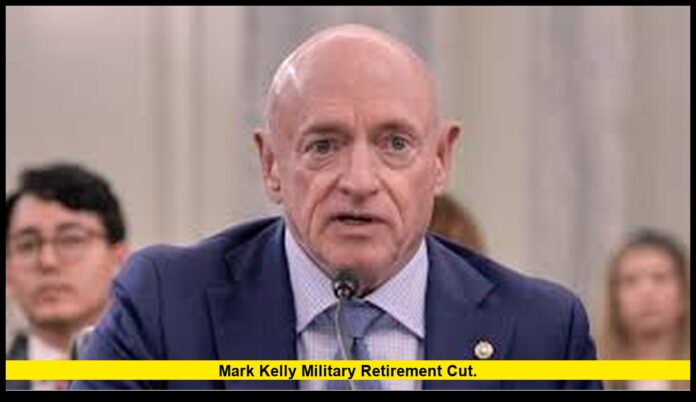
Mark Kelly military retirement cut has become one of the most controversial military and political developments in the United States, after the Pentagon confirmed it has begun formal steps that could lower Senator Mark Kelly’s retired military rank and reduce his retirement pay. The issue has rapidly escalated into a national debate over free speech, military authority, and the treatment of retired service members who hold elected office.
As of today, the Pentagon’s administrative process is ongoing, and no final determination has been issued. However, the implications of this action are already being felt far beyond one individual case.
Table of Contents
Pentagon Confirms Retirement Grade Determination
The U.S. Department of Defense has acknowledged that it has initiated a retirement grade determination involving Mark Kelly, a retired U.S. Navy captain and current U.S. senator. This internal review allows the Pentagon to reassess the rank under which a service member officially retired, which directly affects lifetime military retirement pay.
Officials say the review stems from public remarks Kelly made in late 2025, when he appeared in a video addressing active-duty service members. In that video, Kelly emphasized that military personnel are legally obligated to refuse unlawful orders under U.S. military law.
Pentagon leadership argues that the comments were inappropriate for a retired senior officer and may have undermined military discipline.
What the Pentagon Is Considering
Under the current review, the Pentagon is evaluating several possible actions:
- A reduction in Kelly’s retired military rank
- A corresponding cut in his monthly retirement pay
- Placement of a formal censure in his military service record
If the retired rank is lowered, the reduction in pay could be significant over time. While the retirement grade determination process exists within military regulations, it is rarely applied, especially to a retired officer who now serves in Congress.
Defense Secretary’s Role in the Decision
The action is being overseen by Defense Secretary Pete Hegseth, who has stated that retired officers receiving military pay remain subject to certain standards of conduct. According to Pentagon leadership, Kelly’s comments crossed from protected political speech into guidance directed at active-duty troops.
Defense officials argue that maintaining good order and discipline in the armed forces requires clear boundaries, even for retired personnel with public platforms.
Kelly Pushes Back Against Pentagon Action
Mark Kelly has forcefully rejected the Pentagon’s move, describing it as politically motivated and inconsistent with both constitutional principles and long-standing military law. He has emphasized that his comments were rooted in widely accepted legal standards governing military conduct, not an attempt to undermine authority or discipline. Kelly has repeatedly pointed to his decades of service as a naval aviator, combat veteran, and test pilot, underscoring what he describes as a lifelong commitment to military professionalism and lawful service.
Kelly maintains that his remarks did not encourage disobedience or insubordination. Instead, he argues they reinforced an established legal obligation requiring service members to refuse unlawful orders—an expectation embedded in military training and codes of conduct. From his perspective, reiterating that principle supports, rather than weakens, the integrity of the armed forces.
He has also warned that punishing such statements could have broader consequences beyond his own case. Kelly argues that targeting retired officers for speaking about legal and ethical responsibilities may discourage veterans from engaging honestly in public discussions about military law, accountability, and constitutional duty. He has suggested that this chilling effect could undermine transparency and public trust.
Kelly has made clear that he is prepared to challenge any reduction to his retirement rank or benefits through formal administrative responses and, if necessary, legal action. He has framed the dispute not only as a personal matter but as a test of how retired service members are treated when they participate in civic life and public service.
Legal and Constitutional Questions Take Center Stage
The Mark Kelly military retirement cut debate has elevated a series of complex legal and constitutional questions that reach well beyond standard military regulations. At the heart of the controversy is the unresolved tension between military oversight authority and the constitutional protections afforded to retired service members who later assume elected office.
Several key issues have emerged as central to the dispute:
- Whether retired military officers can be subject to administrative discipline for speech made long after their active service has ended
- The scope and limits of Pentagon authority over retirees who are no longer in uniform but continue to receive military retirement benefits
- How constitutional protections, including free speech and legislative safeguards, apply to lawmakers who are also military retirees
Supporters of Kelly argue that retirement grade reductions were historically intended to address misconduct that occurred during active duty, such as violations of conduct or professional standards while in service. From this perspective, applying such measures to public speech made years later represents a significant expansion of administrative power.
Others point out that retired officers remain on the military’s retired rolls and continue to receive pay from the federal government, placing them in a unique legal category. This status, they argue, creates a gray area in which limited oversight authority may still exist, even after retirement.
As the review progresses, these legal questions are expected to play a decisive role in determining the outcome. The resolution could clarify long-standing ambiguities surrounding retiree status, redefine the boundaries of military authority, and influence how constitutional protections are applied to retired service members in public life.
Reaction on Capitol Hill
Lawmakers across Capitol Hill have reacted sharply to the unfolding situation, with responses largely divided along partisan lines. The case has quickly moved beyond a single administrative action and into a broader debate about the limits of executive power, civil-military relations, and the rights of elected officials with prior military service.
Supporters of Kelly argue that the Pentagon’s action risks establishing a troubling precedent in which financial penalties are used to pressure or silence sitting lawmakers. They warn that allowing executive branch officials to target an elected senator through military retirement mechanisms could undermine democratic safeguards and blur the separation between civilian governance and military authority. Many view the case as a test of whether political speech can be indirectly constrained through administrative leverage.
Critics, however, contend that retired officers must exercise heightened caution when addressing active-duty personnel, especially on matters involving obedience and command structure. They argue that accountability should apply regardless of political position and that public statements from former senior officers can carry significant weight within the ranks, potentially affecting morale and discipline.
The dispute has prompted renewed calls for congressional review of the Pentagon’s authority over military retirees who serve in public office. Some lawmakers have suggested that clearer statutory limits may be necessary to prevent future conflicts, while others believe existing regulations are sufficient but require closer oversight. As the review continues, Capitol Hill is expected to play an increasingly visible role in shaping how this issue is ultimately resolved.
Why This Case Matters to Military Retirees
The implications of this case extend far beyond one senator and have captured the attention of military retirees across the country. For many former service members, the situation raises fundamental questions about their rights and responsibilities once they leave active duty but continue to receive retirement benefits.
Military analysts and veterans’ advocates note that the outcome could significantly influence how retired officers participate in public debate, particularly on issues related to national security, military ethics, and lawful conduct. If administrative penalties are imposed for public statements, some retirees may become more cautious or withdraw from public discussions altogether.
The case also touches on whether veterans feel free to speak openly about military legality and constitutional obligations without fear of financial or administrative repercussions. Many retired service members believe that reinforcing respect for lawful orders has long been a core principle of military service, and they worry that punishing such speech could blur the distinction between ethical guidance and misconduct.
Looking ahead, the decision may shape future guidance on where the boundaries of acceptable speech lie for military retirees. A broad interpretation of Pentagon authority could lead to tighter informal restrictions, while a decision favoring Kelly could reassure retirees that they retain meaningful freedom to engage in civic life.
For countless veterans, the concern is not political affiliation but precedent. Many fear that discouraging open discussion of lawful conduct and constitutional duties within the armed forces could weaken transparency, accountability, and trust—values that service members are sworn to uphold long after they leave uniformed service.
Timeline of Key Developments
| Date | Event |
|---|---|
| Late 2025 | Kelly appears in public video addressing service members |
| Weeks later | Pentagon initiates internal review |
| January 2026 | Formal retirement grade determination begins |
The timeline highlights how quickly the situation escalated from public remarks to potential financial consequences.
Possible Outcomes
If the Pentagon Moves Forward
If defense officials decide to proceed with disciplinary action, Kelly’s retired military rank could be formally reduced following the completion of the retirement grade determination process. Such a decision would directly impact his lifetime military retirement pay, resulting in a permanent financial reduction tied to the lower rank designation.
In addition to financial consequences, a formal censure would remain part of Kelly’s official military record. This administrative mark could carry long-term professional and symbolic implications, particularly given his public role and decades of prior service. A decision to move forward may also signal a broader willingness by the Pentagon to exercise authority over retired officers’ public conduct, potentially reshaping expectations for how military retirees engage in political and civic discourse.
If Kelly Prevails
If the review concludes in Kelly’s favor, his retired rank and military retirement benefits would remain intact, effectively closing the case without punitive action. Such an outcome could reinforce the principle that retired officers retain broad speech protections, especially when their statements reflect established military law and constitutional values.
A favorable ruling for Kelly may also clarify or limit the Pentagon’s authority over retirees, particularly those serving in elected office. This could strengthen broader protections for retired service members, affirming their ability to participate in public debate without fear of administrative retaliation tied to their military benefits.
Broader Implications
Regardless of the outcome, the case is expected to influence future discussions on civil-military relations, the scope of military authority over retirees, and the balance between discipline and free expression. The resolution may set an informal precedent that shapes how similar cases are approached in the years ahead.
What Happens Next
Kelly has been granted a fixed response window to formally address the Pentagon’s notice, during which he is expected to submit a detailed written defense outlining the legal and factual basis for his remarks. That submission will be reviewed by senior defense officials as part of the retirement grade determination process, which will assess whether any administrative action is warranted under existing military regulations.
After reviewing Kelly’s response, Pentagon leadership will determine whether to proceed with a reduction in retired rank and corresponding retirement pay or to dismiss the matter entirely. If officials move forward, the decision could result in permanent changes to Kelly’s military record and financial benefits tied to his retired status.
Beyond the Pentagon’s internal process, the case is already drawing heightened attention on Capitol Hill. Lawmakers from both parties have signaled interest in reviewing the scope of executive authority over military retirees, particularly those serving in elected office. Congressional hearings or legislative proposals addressing retiree protections may emerge as the situation evolves.
Legal challenges also remain a strong possibility. Any final action against Kelly could be contested on constitutional grounds, potentially bringing the matter before federal courts. Such proceedings could further delay enforcement and shape broader interpretations of free speech rights, military oversight, and civilian control of the armed forces.
As these steps unfold, the outcome of the case is expected to have lasting implications, not only for Kelly, but for how retired service members engage in public service and political discourse in the future.
Final Thoughts
The unfolding controversy surrounding the Mark Kelly military retirement cut places free speech, military discipline, and democratic accountability in sharp focus at a time of heightened national debate over civil-military relations. What began as public remarks about lawful conduct has now triggered a formal Pentagon review that could reshuffle long-standing norms governing retired officers who enter public life. With Kelly preparing his official response and legal experts signaling potential constitutional challenges, the case may become a landmark in defining the limits of Pentagon authority over retirees—particularly those serving in Congress. Many Americans, veterans, and legal scholars are closely watching whether this review will affirm the Pentagon’s ability to discipline retirees for speech or whether it will reinforce protections for public discourse and constitutional rights. Regardless of the outcome, the ripple effects of this dispute may shape how future military retirees engage in civic debate and how the balance between national security, military order, and free expression is interpreted for years to come.
What are your thoughts on this issue? Share your perspective and stay informed as new developments emerge.

