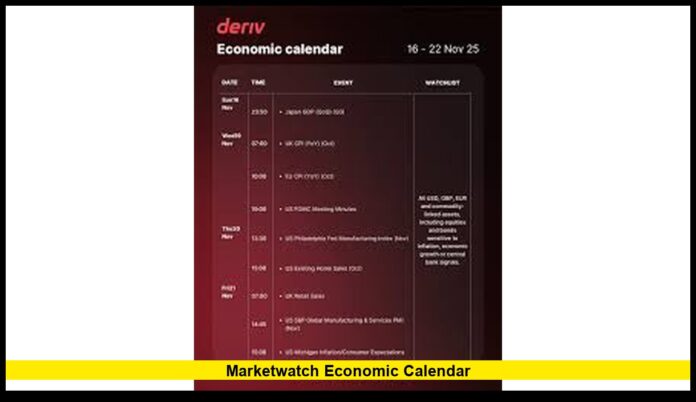
The MarketWatch Economic Calendar is in sharp focus this week as U.S. markets adjust to a renewed flow of economic data following the recent 43-day federal government shutdown. With several key indicators finally being released, investors are relying on the calendar more than ever to track the exact timing of reports that could move stocks, bonds, and currency markets.
Table of Contents
What the MarketWatch Economic Calendar Shows Right Now
The calendar provides a real-time schedule of economic reports, Federal Reserve speeches, and other major events capable of influencing market volatility. This includes the timing of jobless claims, inflation readings, personal spending data, and remarks from central bank leaders.
This week, the calendar is especially busy. Many important indicators that were delayed during the shutdown are now being released, creating an unusually dense round of economic updates. That makes the calendar a crucial tool for anyone trying to understand how the market will respond to a sudden rush of information.
Key Releases Highlighted on the Economic Calendar
Below are the major events and data releases currently featured for early December, all of which are drawing significant attention from analysts and investors:
Thursday, December 4 — 8:30 a.m. ET
• Initial jobless claims for the week ending November 29.
Thursday, December 4 — Throughout the day
• Scheduled public remarks by multiple Federal Reserve officials, including discussions on inflation, labor trends, and monetary policy expectations.
Friday, December 5 — Morning ET
• Release of backlogged Personal Consumption Expenditures (PCE) inflation data.
• Updated personal spending and income figures, also delayed during the shutdown.
These events are viewed as some of the most influential data points for December, especially with the Federal Reserve’s next policy decision approaching.
Recent Confirmed Data Already Released
While several major indicators are still scheduled for release, some early reports have already shaped market sentiment:
• Initial jobless claims recently fell sharply to 191,000, marking the lowest level in more than three years.
• Private-sector payroll numbers from major employment trackers pointed to job losses in November, creating a mixed picture of labor-market strength.
• Market expectations for a December interest-rate cut have climbed, with probability estimates showing strong confidence in a quarter-point reduction.
This blend of falling claims and weakening payrolls is fueling debate about whether the labor market is cooling gradually or signaling deeper shifts. The MarketWatch Economic Calendar now gives investors a clear roadmap for when the rest of the data will arrive.
Why the Calendar Matters Right Now
The recent shutdown created an unprecedented backlog of U.S. economic statistics. Analysts expect the next several days to deliver a surge of information that may quickly move markets.
The MarketWatch Economic Calendar provides:
- Exact release times
- Descriptions of each data series
- A centralized schedule of Federal Reserve speeches
- A clear view of high-impact indicators likely to influence short-term trading
This makes it easier for investors to prepare for volatility and adjust positions in advance rather than reacting after information hits the wires.
How Investors Use the MarketWatch Economic Calendar
1. Timing Trades and Managing Risk
Short-term traders use the calendar to avoid entering positions right before major announcements that could swing prices. Others use it strategically to trade expected volatility.
2. Monitoring Monetary Policy Signals
Because the calendar includes planned appearances by Federal Reserve governors and regional presidents, investors can track when policy insights or rate-cut signals might emerge.
3. Understanding Market Momentum
Key reports such as PCE inflation, consumer spending, and jobless claims can shift expectations about the U.S. economic outlook. The calendar gives investors a head start on when those updates will arrive.
4. Tracking Delayed Data Releases
With multiple reports being published in compressed timeframes, the calendar helps separate the timing of each event so investors know which release is driving the market.
What to Watch in the Coming Days
With the backlog now clearing, several events are expected to shape market direction:
• PCE Inflation Data
Widely viewed as the Federal Reserve’s preferred inflation gauge, this report could influence whether policymakers feel ready to cut rates this month.
• Personal Spending and Income Reports
Consumer spending accounts for a major share of U.S. economic activity. Updated numbers will show whether Americans are slowing their purchases or maintaining momentum.
• Upcoming Jobless Claims
After the steep drop to 191,000, markets will watch whether claims remain low or bounce back in the next report.
• Multiple Fed Official Speeches
Any shift in tone—hawkish or dovish—could immediately move Treasury yields and tech stocks.
Each of these items appears directly on the calendar with precise timing, allowing traders to schedule around likely moments of volatility.
Strengths of the MarketWatch Economic Calendar
• Provides a consolidated, accurate list of upcoming U.S. economic events
• Offers exact dates and times in Eastern Time
• Includes detailed descriptions of each data release
• Helpful for both day traders and long-term investors
• Updated frequently to reflect changes in release schedules
Limitations to Keep in Mind
• It lists events and times but does not provide extended analysis
• Overlapping release times may still create interpretation challenges
• It focuses solely on U.S. data, so global investors may need supplemental calendars
Despite these limitations, the MarketWatch Economic Calendar remains a vital resource for understanding the pace and flow of economic information—especially during periods of heightened uncertainty like the current post-shutdown environment.
Why It’s Crucial for December Market Strategy
As the Federal Reserve prepares for its next interest-rate decision, analysts are paying close attention to every piece of incoming data. The combination of falling jobless claims, mixed payroll numbers, and the upcoming release of delayed inflation and spending reports puts the economy at a critical turning point.
The MarketWatch Economic Calendar helps investors track the order and timing of these releases in real time. With volatility expected to rise, having a clear view of the schedule can help reduce surprises, guide portfolio decisions, and improve market timing.
Stay tuned to the latest updates and share your thoughts on how this week’s data could shape the market.

