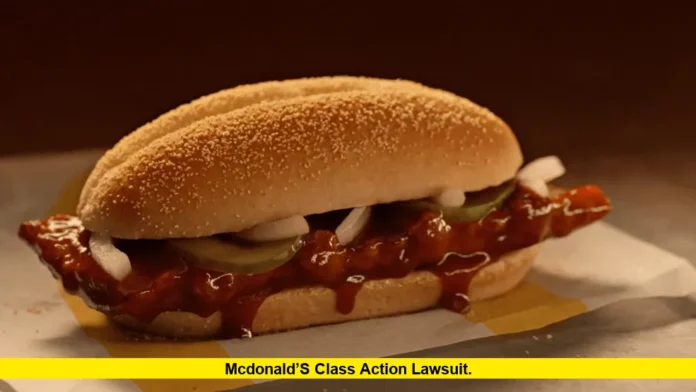
A mcdonalds class action lawsuit has drawn national attention after consumers accused the fast-food giant of misleading marketing related to its popular McRib sandwich. Filed in federal court, the lawsuit alleges that McDonald’s created false consumer expectations by suggesting the McRib contains actual pork rib meat, when in reality it does not. The case has quickly become one of the most closely watched consumer lawsuits involving a major restaurant brand, touching on advertising practices, food labeling standards, and consumer trust.
This article outlines the confirmed facts surrounding the lawsuit, what plaintiffs are claiming, how McDonald’s has responded, and why the outcome could matter to millions of U.S. customers.
Table of Contents
What Sparked the McDonald’s Class Action Lawsuit
The lawsuit was filed in late 2025 by several consumers who say they were misled by the name, shape, and marketing of the McRib sandwich. According to the complaint, McDonald’s presentation of the product leads reasonable customers to believe that the sandwich includes real rib meat. Plaintiffs argue that this belief influenced their decision to purchase the product, often at a higher price point than standard menu items.
The case was brought in federal court in Illinois and seeks to represent a nationwide group of customers who purchased the McRib within the last several years. In addition to a national class, the filing also identifies state-level subclasses in major U.S. markets.
The Core Allegation: What Is Really in the McRib
At the center of the lawsuit is the claim that the McRib does not contain actual pork ribs, despite its name and appearance. The plaintiffs state that the sandwich consists of seasoned boneless pork that has been processed and molded into a rib-like shape.
The lawsuit argues that:
- The name “McRib” implies the use of rib meat
- The rib-shaped patty reinforces that assumption
- Marketing imagery and product descriptions strengthen the impression of a traditional rib sandwich
Plaintiffs maintain that many consumers associate rib meat with a specific cut of pork and a higher quality product. They claim that McDonald’s failed to clearly disclose that the sandwich does not contain that type of meat, resulting in consumer confusion.
Claims of Consumer Deception and Financial Harm
The complaint asserts that McDonald’s actions caused customers to suffer economic harm. According to the lawsuit, consumers paid for a product they believed was made from rib meat, only to receive something different.
The legal claims outlined in the case include:
- False and misleading advertising
- Breach of express and implied warranties
- Breach of contract
- Negligent misrepresentation
- Violations of state consumer protection laws
Plaintiffs argue that the difference between what consumers believed they were purchasing and what they actually received amounts to financial injury, even if the sandwich was edible and met food safety standards.
McDonald’s Official Response
McDonald’s has denied the allegations outlined in the lawsuit. The company has stated that the McRib is made with 100 percent seasoned boneless pork and that its ingredient information is available to consumers. McDonald’s maintains that it has not misrepresented the product and that the claims in the lawsuit are inaccurate.
According to the company’s position, the McRib has long been described as a boneless pork patty, and the brand argues that customers are not promised a specific cut of meat. McDonald’s has indicated that it intends to defend itself against the lawsuit.
Why the McRib Name Is Central to the Case
A major focus of the mcdonalds class action lawsuit is how consumers interpret product names. Plaintiffs rely heavily on what courts refer to as the “reasonable consumer” standard. This legal concept asks whether an average customer, acting reasonably, would be misled by the product’s name or marketing.
The lawsuit claims that:
- Most consumers associate the word “rib” with actual rib meat
- The sandwich’s rib-like shape reinforces that belief
- Consumers are not typically experts in food processing or meat restructuring
The plaintiffs argue that McDonald’s could have avoided confusion by more clearly emphasizing that the McRib contains no rib meat, rather than relying on fine-print ingredient disclosures.
Who Could Be Included in the Lawsuit
If the court approves class certification, the case could involve a very large number of consumers across the United States. The proposed class includes anyone who purchased a McRib during the specified time period.
The lawsuit also identifies subclasses in certain states where consumer protection laws may offer additional remedies. Eligibility will ultimately depend on how the court defines the class and what proof of purchase is required.
For many class members, participation would not require filing an individual lawsuit. Instead, any settlement or judgment would apply automatically unless a consumer chooses to opt out.
What the Legal Process Looks Like Going Forward
The case is still in its early stages. Several key steps remain before any outcome is reached:
- McDonald’s may ask the court to dismiss some or all claims
- The court will decide whether the lawsuit can proceed as a class action
- If allowed to move forward, both sides will exchange documents and evidence
- Settlement discussions may occur at any stage
- If no settlement is reached, the case could eventually go to trial
These types of cases often take months or even years to resolve, depending on the complexity of the legal issues and the court’s schedule.
Why This Lawsuit Matters Beyond McDonald’s
Although the lawsuit focuses on one specific product, its implications extend far beyond the McRib. The case highlights broader concerns about food marketing and consumer expectations in the fast-food industry.
Key issues raised include:
- How clearly companies must describe processed foods
- Whether product names can imply ingredients without explicit statements
- How courts balance marketing creativity with consumer protection
A ruling in this case could influence how restaurants name and promote menu items in the future, especially those made from processed or restructured ingredients.
Consumer Awareness and Industry Impact
For consumers, the lawsuit serves as a reminder to pay close attention to ingredient descriptions and nutritional disclosures. For companies, it underscores the importance of clarity and transparency in advertising, particularly for iconic products with strong brand recognition.
Large brands often rely on familiarity and nostalgia, but this case suggests that even long-standing menu items can face renewed scrutiny if consumer expectations change or legal standards evolve.
Current Status of the Case
As of today, the lawsuit remains active, with no final rulings or settlements announced. McDonald’s continues to offer the McRib as a limited-time menu item, and there have been no changes announced to the product’s formulation or name in response to the lawsuit.
The case remains closely watched by legal analysts, consumer advocates, and the food industry as a whole.
What do you think about food marketing and consumer expectations? Follow this story as it continues to develop.

