
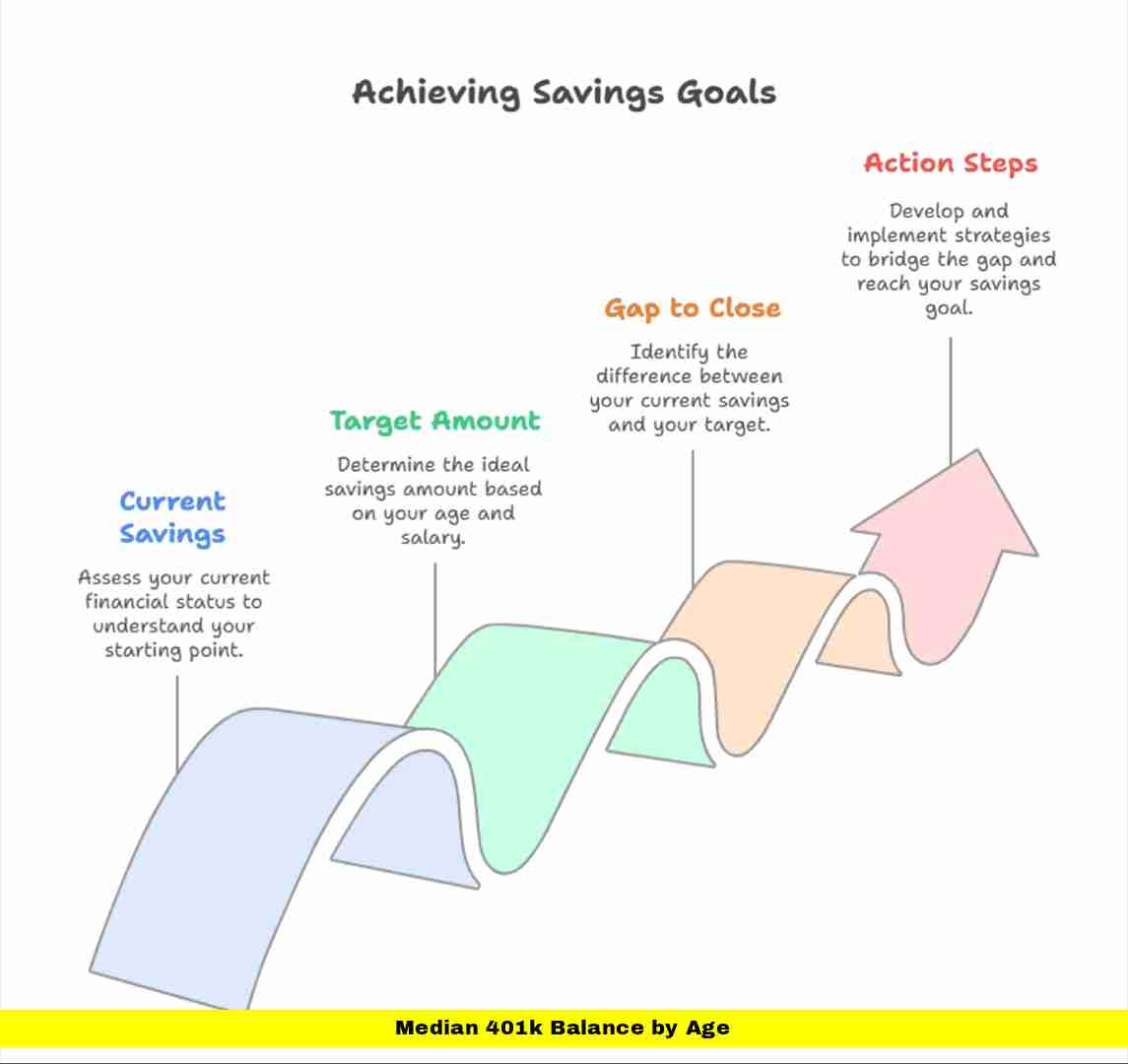
The median 401k balance by age offers a revealing snapshot of how far Americans have come—and how far many still need to go—in building retirement savings. While headlines often highlight soaring average balances, the median paints a more grounded, realistic picture of where typical workers stand today.
Table of Contents
Understanding the Median vs. the Average
When people talk about retirement savings, the average 401(k) balance often grabs the spotlight. But averages can be skewed by a small number of very large accounts. The median, by contrast, represents the midpoint: half of participants have more, and half have less.
- The average 401(k) balance may hit six figures, but that doesn’t mean most workers are that well funded.
- Median balances provide a clearer look at what typical workers hold in their retirement accounts.
- For financial planning and policy design, medians often carry more weight than averages.
How Median 401(k) Balances Vary by Age
Median account balances rise steadily as people move through their careers. But the growth isn’t always linear, and not everyone starts from the same place or contributes at the same rate.
Here’s a breakdown of median 401(k) balances across key age groups:
- Under 25: Entry-level savers in their first jobs often carry very modest 401(k) balances. Many are dealing with student loans, rent, and limited pay.
- 25 to 34: In this age range, median balances rise significantly. New professionals begin contributing more seriously, often taking advantage of employer matching.
- 35 to 44: Mid-career workers typically see a sizeable jump. Many in this cohort are better established at work and earn more, allowing higher contributions.
- 45 to 54: Savers in this bracket usually hit important milestones. They may be more consistent with contributions, and long-term compounding starts to take effect.
- 55 to 64: Here, median balances often approach six figures. Workers in this group may also use catch-up contributions as they prepare for retirement.
- 65 and older: While some continue adding to their 401(k), others begin reducing contributions or shifting investments. The median balance for this group reflects both accumulation and early draw-down.
This progression shows how career stage, earnings growth, and contribution behavior all influence retirement balances over time.
Why Many Workers Still Lag Behind
Despite these increases, median balances highlight some persistent challenges in retirement readiness:
- Late or Inconsistent Saving
Many people delay contributing meaningfully in their early working years. Others move between jobs with different retirement plans, which makes consistent saving more difficult. - Reluctance to Maximize Employer Match
Employer match programs are among the best opportunities to boost retirement savings, but not everyone contributes enough to take full advantage. - Competing Financial Priorities
Student loan payments, mortgages, childcare, and everyday expenses often compete with retirement goals, especially for younger and mid-career workers. - Low Contribution Rates
Even established savers may only set aside a small percentage of their salary, limiting how much they accumulate over decades. - Underuse of Catch-Up Contributions
For those over 50, catch-up options can significantly boost savings, yet not everyone takes full advantage of them. - Lack of Financial Literacy
Many workers don’t fully understand how to set retirement goals or how to use the tools available through workplace plans to hit those targets.
The Role of Market Performance and Plan Design
Two powerful forces shape median balances: market returns and retirement-plan architecture.
- Market Performance
Stock market growth and bond yields directly affect account values. When markets do well, many 401(k) balances grow. But gains often benefit those who’ve been saving for longer or who have larger balances. - Plan Design Features
Modern plans increasingly use design tools that boost savings:- Auto-enrollment ensures workers begin contributing even without actively signing up.
- Auto-escalation gradually raises the contribution rate over time.
- Generous employer matches encourage higher contributions.
- Catch-up provisions let older employees boost their savings significantly.
These features help raise median balances over time—especially for those who stay in the plan long enough.
Realistic Benchmarks Based on Median Balances
Using the median 401(k) balance by age, you can set more realistic goals for your retirement savings. Here are suggested benchmarks:
- In Your 20s: Aim to start contributing as soon as possible, even if it’s a small amount. Automate your contributions.
- In Your 30s: Strive to reach a median-level balance or higher. Increase your contribution rate when you get raises.
- In Your 40s: Focus on consistency and maximizing employer match. Make sure you’re contributing enough to benefit from long-term compounding.
- In Your 50s: If possible, take advantage of catch-up contributions. Redirect any windfalls (bonuses, tax refunds) into your retirement account.
- In Your 60s and Beyond: Balance accumulation with planning. Adjust your asset mix for lower risk, but also think about how and when to draw on your savings.
Why Understanding the Median Is Critical for Retirement Planning
Knowing where you stand relative to the median 401(k) balance by age lets you gauge whether your savings align with broader trends—and whether you need to make a change.
- If your balance is well below the median for your age, it’s time to reassess your contribution rate, investment mix, or plan-hopping behavior.
- If you’re close to or above median, you’re doing better than many—but that doesn’t mean you can be complacent. You still need a strategy for future growth and spending.
- Using median data, you can have more informed conversations with financial planners, HR, or benefits advisers about your retirement path.
Policy and Workplace Implications
Median 401(k) balances influence more than individual savers—they matter for companies, policymakers, and the retirement industry:
- Employers: Organizations designing retirement plans can use median data to understand where participants fall, then adopt contribution incentives, auto features, and education programs to boost savings.
- Policymakers: Legislators and regulators can examine whether the median balances suggest a retirement readiness gap among typical workers. They might push for stronger catch-up rules, better default plan features, or enhanced retirement education.
- Retirement Industry: Providers and advisors can tailor services and tools based on where most participants fall. That could mean more personalized advice, better default options, or new ways to help savers reach median and above-median levels.
Actionable Strategies to Improve Your Position Relative to the Median
If you look at your own 401(k) and see it’s below the median for your age group, don’t worry—there are practical steps you can take to get on track.
- Audit Your Current Plan
Review how much you contribute, whether you’re maximizing your employer match, and how your funds are allocated. - Set Milestones
Use age-based targets based on median balance data. For example, aim to hit the median for your age in three to five years. - Increase Contributions Gradually
If you’re enrolled in a plan with auto-escalation, make sure to opt in. If not, manually raise your contribution rate whenever your income increases. - Revisit Asset Allocation
As your account grows, adjust how you invest. Younger workers typically benefit from more growth-oriented investments, while older savers may shift toward safer assets. - Use Catch-Up Contributions When Eligible
If you’re age 50 or older, take full advantage of IRS catch-up limits. That extra saving power can close gaps quickly. - Stay Engaged
Regularly check your 401(k) statements. Use financial-planning tools or consult a financial advisor if needed. - Educate Yourself and Others
Share median-balance benchmarks with your colleagues. Lead or participate in financial wellness programs at work.
The Broader Reality: Why Median 401(k) Balances Aren’t Enough Alone
Understanding median 401(k) balances is a powerful first step—but it’s not the whole story.
- Retirement readiness isn’t just about your 401(k). Social Security, other investment accounts, home equity, and pensions (if available) also play a role.
- The median doesn’t account for future earnings growth, inflation, or lifestyle changes. A worker in their 30s, for instance, still has decades to save.
- Life expectancy and health care costs can dramatically influence how far your retirement savings need to stretch.
- Taxes and withdrawal strategies will affect how much of your 401(k) you actually keep in retirement.
In short, while median data provides critical context, true readiness depends on a personalized plan.
Looking Ahead: Why the Median 401(k) Balance by Age Will Remain Important
As retirement savings evolve, median balances will continue to matter—for many reasons:
- Benchmarking for Individuals
Individuals will keep using median data to measure their progress and adjust strategies. - Employer Insights
Plan sponsors can track how their participants compare to national medians and make plan improvements. - Regulatory Pressure
Policymakers may continue to design incentives or requirements based on where typical Americans are—and where they need to be. - Industry Innovation
As technology and financial tools evolve, providers will increasingly tailor solutions around median-based goal setting.
Final Thoughts
The median 401k balance by age reveals both progress and concern. On one hand, workers are saving more than in past decades. On the other, many remain below the levels that financial advisers typically recommend.
If your 401(k) is below the median for your age, you’re not alone—and there is time to catch up. By using the data to set realistic goals, increasing contributions, and staying committed, you can close the gap and move toward a more secure retirement.
Where does your 401(k) balance fall compared to these medians? Share your story or questions below — your experience could inspire and help others.