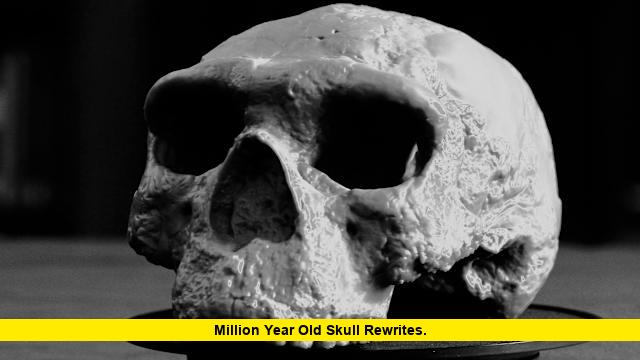
A million year old skull rewrites the timeline of human evolution, shaking long-held beliefs about when our species’ lineage began to diverge from other ancient human relatives. The fossil, unearthed decades ago in China’s Hubei Province and digitally reconstructed this year, has been hailed as one of the most important discoveries in paleoanthropology.
Table of Contents
The Discovery of Yunxian 2
The skull, known as Yunxian 2, was first discovered in the 1990s but remained badly distorted due to geological pressure over hundreds of thousands of years. For decades, experts could only make cautious assumptions about its classification, placing it tentatively within Homo erectus. However, modern imaging technologies, including 3D scanning and digital reconstruction, have now allowed researchers to restore the fossil to its original shape.
Once reconstructed, the fossil revealed features far more advanced than previously thought, suggesting that Yunxian 2 may belong to a lineage closely related to Homo longi—sometimes referred to as “Dragon Man”—rather than Homo erectus. This reassessment could push back the origins of modern humans by at least 400,000 years.
A Timeline Shift in Human Evolution
Until now, scientists widely believed that the divergence of modern humans from Neanderthals and Denisovans occurred between 500,000 and 700,000 years ago. The restored Yunxian 2 skull challenges that framework. With a geological age estimated between 940,000 and 1.1 million years, the fossil suggests that the split in our evolutionary tree may have taken place much earlier.
This means that the story of human evolution is more complex and older than previously assumed. Rather than a neat, linear progression, our ancestry appears to resemble a tangled web of overlapping species that coexisted, interbred, and evolved in parallel across different regions of the world.
Asia’s Unexpected Role
For many years, the dominant scientific narrative emphasized Africa as the sole cradle of modern humans. The new analysis of Yunxian 2 does not replace Africa’s importance but suggests Asia played a far greater role in the evolutionary story than previously acknowledged.
The skull shares anatomical similarities with both early Asian fossils and later species across Eurasia. This raises the possibility that crucial evolutionary developments happened in multiple locations at the same time, including Asia. As a result, the long-established “Out of Africa” model is being reconsidered in light of these findings.
Why This Skull Matters
The significance of this fossil lies in what it reveals about our deep past. Below are key reasons the Yunxian 2 discovery is so impactful:
- Extends the human timeline: Evidence now points to an earlier divergence of Homo sapiens from archaic species, possibly more than a million years ago.
- Challenges traditional models: The fossil suggests Asia was not just a migration route but a central arena in the evolutionary story.
- Inspires reevaluation: Other fossils, especially from the Middle Pleistocene era, will now be reexamined using advanced imaging methods.
- Technological breakthroughs: Digital reconstruction shows how modern science can breathe new life into fossils once thought too damaged for study.
Scientific Debate and Next Steps
Not all experts agree on the interpretation of Yunxian 2. Because DNA cannot be extracted from the skull due to its age, conclusions rely heavily on physical features. Some scientists caution that morphology alone can be misleading and that additional discoveries are needed before rewriting textbooks.
Still, the evidence has been compelling enough to spark global attention. Researchers across the world are now reanalyzing fossils from Africa, Europe, and Asia to compare them with Yunxian 2. Excavations in key regions are likely to intensify, with scientists hoping to uncover more specimens that fill in the million-year gap in our evolutionary record.
Rewriting the Human Story
The implications of this skull extend beyond academic circles. For the public, it is a reminder that science is always evolving. What we know about our origins today could change tomorrow with a single discovery.
For educators, museums, and cultural institutions in the United States, this breakthrough offers an opportunity to update how human history is taught and presented. Students will now explore a timeline that stretches further back in time and emphasizes the interconnectedness of multiple regions in shaping humanity.
Looking Ahead
As scientists continue to study Yunxian 2 and other fossils, the picture of human evolution will become more detailed. Questions remain:
- How exactly does Yunxian 2 connect to Neanderthals, Denisovans, and modern humans?
- Did early Homo lineages in Asia contribute directly to Homo sapiens?
- Could future fossils push our lineage’s divergence even further back?
These unanswered questions are what make the discovery so exciting. It opens new doors for exploration and keeps the story of humanity alive and dynamic.
A million year old skull rewrites not just the scientific record but our own sense of identity. Each new fossil discovery reminds us that the past is not fixed—it is a puzzle still being pieced together.
Do you think this discovery truly changes the way we understand our origins? Share your thoughts in the comments and keep following for updates.

