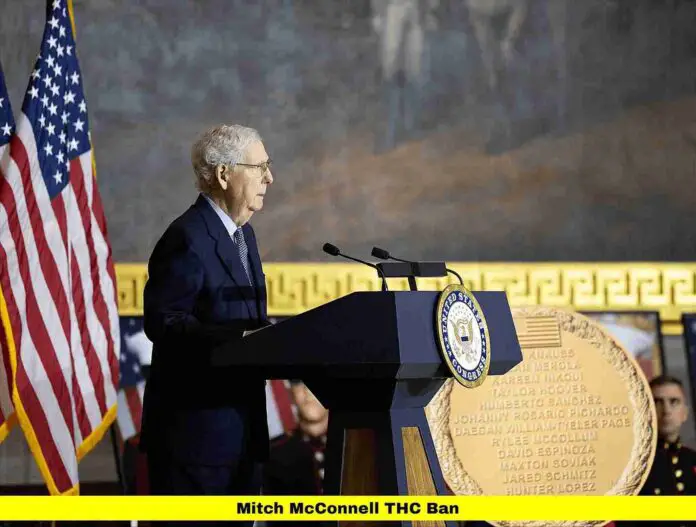
Senator Mitch McConnell’s THC ban proposal has ignited one of the most significant debates over hemp regulation in years, putting the future of hemp-derived THC products on the line. With its implications spreading across farming, manufacturing, and consumer markets, this move from McConnell could reshape how hemp is defined and regulated in the U.S.
Table of Contents
McConnell’s Core Proposal: Redefine Hemp From the Ground Up
McConnell’s plan aims to tighten the legal definition of “hemp” in federal law. Instead of just limiting delta-9 THC, he wants to cap total THC — including acidic precursors — and ban synthetic or lab-derived cannabinoids like delta-8 and delta-10 THC. At the heart of this proposal is a drastic container-level limit: no more than 0.4 milligrams of total THC per finished product.
Why McConnell Says the Rule Is Needed
He argues that the loophole in the 2018 Farm Bill has allowed manufacturers to exploit trace THC in hemp, convert it into more potent compounds, and market intoxicating products with little oversight. McConnell frames his move as a public safety measure — especially focused on protecting young people — while still allowing traditional industrial hemp to thrive.
The Industry’s Outcry: Threat to Jobs and Innovation
The backlash has been swift and multifaceted. Farmers, hemp product makers, and political allies have raised alarms:
- Many argue the 0.4 mg THC limit per container would render most current THC-infused hemp products illegal.
- Hemp-derived THC sales generate major revenue for both small and mid-sized businesses; critics warn that McConnell’s ban could wipe out much of that income.
- Some fear that even CBD products — typically containing trace THC — would be caught under this broad restriction, jeopardizing long-standing wellness brands.
- The proposed law could push businesses toward underground or unregulated markets if legal options shrink, raising broader consumer-safety concerns.
Political Tensions Heating Up
This isn’t purely a regulatory issue — it’s deeply political. McConnell’s push for tighter hemp controls has drawn fierce opposition, including from within his own party:
- Senator Rand Paul strongly opposes the limit, calling it over-regulation that risks destroying the hemp-derived THC industry.
- Rural and hemp-farming states fear federal overreach could undermine local economies and established business models.
- At the same time, McConnell defends his plan as correcting a broad, unintended loophole. He insists he supports non-intoxicating hemp, but not synthetic cannabinoids.
Legislative Stage: How the Ban Could Be Enacted
McConnell’s THC ban has been embedded in key funding legislation — the 2026 Agriculture Appropriations bill — giving it high visibility and major leverage. Key developments:
- Republicans in the Senate have been divided, with support in some quarters but serious pushback in others.
- The provision was removed at one point after a subcommittee raised concerns.
- Negotiations are underway as the full funding package advances, with both industry groups and lawmakers lobbying hard to shape the final language.
- If passed, the law would give regulators broad authority to enforce the new THC limits.
Potential Consequences If the THC Ban Passes
If McConnell’s definition takes effect, the impact could be dramatic and far-reaching:
- Most intoxicating hemp-derived products — from gummies to vapes — could disappear from legal markets.
- Hemp farmers who rely on growing THC-rich types of hemp may face steep financial losses.
- CBD producers could face compliance nightmares if trace THC in their products violates the stricter limits.
- State laws that currently permit higher THC in hemp-based goods might collide with the new federal standard, triggering legal battles.
- Consumers who rely on legal, hemp-derived THC for wellness or recreational use may be shut out or forced to rely on unregulated alternatives.
Why McConnell Is Personally Invested
This is not just another policy fix for McConnell — it’s a legacy issue:
- He was a major architect of the 2018 Farm Bill, which legalized hemp under broad definitions.
- Now, he claims that same law has been twisted in ways he never intended and wants to realign it more precisely with his original vision.
- His proposal reflects a balance: preserving non-intoxicating industrial hemp while cracking down on synthetic or psychoactive derivatives.
The Role of States and Federal Agencies
McConnell’s THC ban also sets up a complex regulatory terrain:
- If enacted, the FDA would likely have a central role in defining and enforcing the new THC thresholds.
- States with more permissive or progressive hemp laws may see their regulatory framework challenged or overridden.
- Some lawmakers are pushing for compromise: age limits, potency caps, and strict testing — rather than an outright ban — as more balanced consumer-protection tools.
- Consumer advocates worry the crackdown could increase demand for unregulated or underground cannabinoid products, potentially undermining safety.
Where Things Go From Here
Here’s what to watch next:
- Final negotiations on the Agriculture Appropriations bill.
- Potential regulatory action if the law passes, including rulemaking by federal agencies.
- Lobbying and possible legal challenges from the hemp industry.
- Responses from states navigating the new federal rules.
- Public reactions, especially from consumers and wellness users who rely on hemp-derived THC.
Final Take:
McConnell’s THC ban proposal is more than just tightening rules — it could redefine which hemp products remain legal in America. The outcome will have major implications for farmers, businesses, and consumers alike.
Do you think this move protects consumers or guts the hemp industry? Share your thoughts below — your voice matters in this debate.

