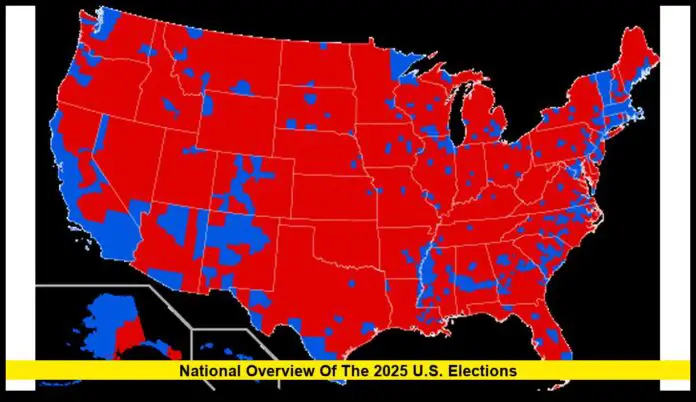
The National Overview of the 2025 U.S. Elections highlights a decisive political shift across several states, reflecting the nation’s evolving priorities ahead of the 2026 midterms. On November 4, 2025, voters across the United States cast their ballots in an off-year cycle that included major gubernatorial, mayoral, and state legislative races. Though not a presidential election year, the results carried significant national implications, offering a clear snapshot of voter sentiment under President Donald Trump’s second term.
Table of Contents
Key Highlights from the 2025 U.S. Elections
This election cycle included a mix of high-stakes state and local contests. Two governorships were on the ballot—in Virginia and New Jersey—alongside hundreds of legislative seats and several city leadership positions, most notably the New York City mayoral race. Additionally, California’s Proposition 50, a ballot measure focused on redistricting reform, drew substantial attention for its potential long-term impact.
Major Outcomes and Political Shifts
Democrats scored key victories across several battlegrounds, signaling a resurgence of momentum at the state level.
- Virginia: Former congresswoman Abigail Spanberger secured the governorship in a highly watched race, restoring Democratic control in the state and strengthening the party’s majority in the House of Delegates. Her win marked a major setback for Republicans, who had hoped to maintain their influence in Richmond.
- New Jersey: Democrats retained the governorship, holding off a late Republican surge. The result confirmed New Jersey’s continued lean toward Democratic governance while emphasizing voters’ concerns about affordability and infrastructure.
- New York City: Progressive candidate Zohran Mamdani achieved a historic win, becoming the city’s first Muslim mayor. His victory symbolized growing acceptance of diverse leadership and a shift toward more progressive urban policies.
- California: Proposition 50, addressing redistricting reforms, passed with broad support. The measure aims to make future district mapping more transparent, reducing partisan influence in electoral boundaries.
Together, these results reinforced Democratic strength in key regions while underlining voter dissatisfaction with national economic conditions.
Voter Sentiment and Core Issues
Exit polls and post-election analyses revealed that the economy was the dominant issue across all major races. Rising costs of living, housing affordability, and wage stagnation influenced many voting decisions.
Key trends included:
- Economic Pressure: A majority of voters listed inflation, housing costs, and healthcare expenses as top priorities.
- Turnout Patterns: Suburban and younger voters showed higher engagement than in previous off-year cycles, suggesting renewed enthusiasm among Democratic-leaning demographics.
- Dissatisfaction with Federal Direction: Across multiple states, voters expressed frustration over Washington’s handling of the economy and social policies, though many localized their concerns rather than directing blame solely at federal leaders.
These trends underscore how domestic economics, rather than cultural issues, continue to drive electoral outcomes in post-pandemic America.
State-by-State Breakdown
| State | Key Contests | Outcome / Significance |
|---|---|---|
| Virginia | Governor, House of Delegates | Democratic sweep; Spanberger elected governor, expanded legislative majority. |
| New Jersey | Governor | Democratic retention; focus on affordability and infrastructure reform. |
| New York City | Mayoral Election | Zohran Mamdani elected as the city’s first Muslim mayor; progressive shift in leadership. |
| California | Proposition 50 (Ballot Measure) | Approved; introduces new redistricting transparency standards. |
These results not only reshaped local governance but also reflected deeper national dynamics that could influence the upcoming 2026 midterms.
National Significance and Political Impact
The National Overview of the 2025 U.S. Elections reveals several key takeaways with long-term consequences for both major parties.
- Democratic Momentum:
The party’s strong performance in key swing states signals renewed voter confidence at the state level. Their victories in Virginia and New Jersey suggest that Democrats are effectively mobilizing suburban voters who were once seen as unpredictable. - Republican Challenges:
Despite strong grassroots efforts and campaign investments, Republican candidates struggled to counter Democratic messaging on economic relief and healthcare. The losses also highlight the need for the GOP to broaden its appeal beyond core conservative bases. - Turnout and Engagement:
Off-year elections typically draw lower participation, but 2025 saw a notable increase in early voting and mail-in ballots. This uptick indicates heightened political engagement even outside federal election cycles. - Policy Implications:
State-level results will influence how future legislation on education funding, infrastructure investment, and economic development unfolds. Governors like Spanberger are expected to push for expanded education programs, healthcare reforms, and climate initiatives aligned with Democratic priorities.
Economic Concerns Drive the Narrative
Across the country, the theme of “affordability” dominated political discussions. Voters in both red and blue states identified rising costs of living as their top concern.
This shared economic frustration bridged party divides, emphasizing that economic performance will likely remain the defining issue heading into 2026. Campaigns focusing on job creation, energy policy, and cost stabilization are expected to resonate strongly in upcoming races.
What These Results Mean for 2026
The 2025 elections serve as a precursor to the 2026 midterms, providing insight into voter behavior and emerging political trends.
- Democrats appear to have regained ground among suburban moderates and young professionals, groups critical to future national success.
- Republicans may recalibrate their strategy, focusing more on local issues and governance rather than national culture wars.
- Independent voters—whose turnout surged in states like Virginia and California—are once again positioned as kingmakers for upcoming contests.
These shifts suggest a more competitive environment heading into the next major election cycle, with both parties reassessing how to connect with economically anxious voters.
Conclusion
The National Overview of the 2025 U.S. Elections underscores that even in an off-year, American politics remains dynamic and deeply consequential. From Virginia’s gubernatorial shift to New York City’s groundbreaking mayoral outcome, voters made their priorities clear: they want responsive, solutions-focused leadership that addresses everyday economic challenges.
Stay tuned for continuing updates and share your thoughts below on how these results might shape the 2026 elections and beyond.

