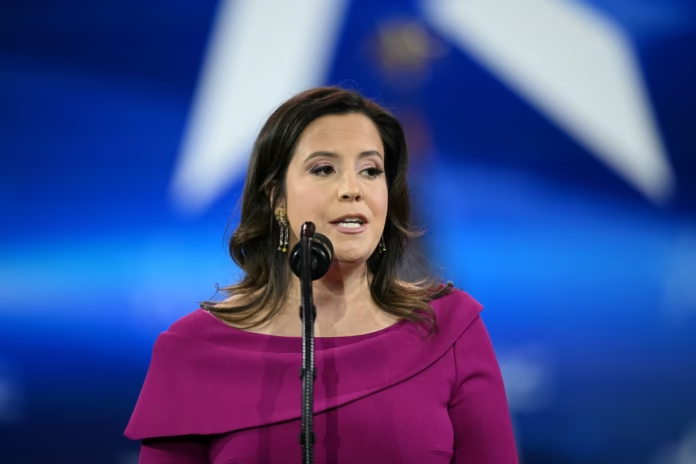
The New York governor race 2026 has officially begun — and it’s already shaping up to be one of the most closely watched political contests in the country. Representative Elise Stefanik, one of the most recognizable faces in the Republican Party, has announced her candidacy for governor, directly challenging Democratic incumbent Kathy Hochul. With two powerful women representing rival visions for the Empire State’s future, this race will be a referendum on everything from affordability and public safety to political leadership and party loyalty.
Table of Contents
Elise Stefanik Enters the Race: A Bold Move for the GOP
When Elise Stefanik declared her intention to run for governor, it immediately redefined the 2026 political landscape. As the highest-ranking Republican woman in the U.S. House of Representatives, Stefanik brings national recognition, a robust donor network, and an unflinching conservative agenda. Her campaign kickoff speech struck a populist tone, promising to “make New York affordable, safe, and strong again.”
Stefanik has long positioned herself as an advocate for upstate and rural communities that feel left behind by Albany’s policies. Her entry gives the GOP its strongest gubernatorial contender in decades — someone capable of energizing the Republican base while appealing to independents frustrated with the direction of the state.
Stefanik’s message is clear: New York’s high taxes, rising crime, and affordability crisis are the product of “failed one-party rule.” She aims to present herself not just as a Republican alternative, but as a practical leader who understands the challenges of working families and small business owners.
Kathy Hochul’s Re-election Fight: Experience vs. Fatigue
Governor Kathy Hochul, who succeeded Andrew Cuomo in 2021 and won a full term in 2022, now faces a serious political test. While she remains a seasoned leader with significant executive experience, her administration has faced mounting criticism over the state’s affordability crisis, the migrant situation, and public safety concerns.
Hochul’s approval ratings have fluctuated, reflecting frustration among voters who feel progress has been slow. Yet she remains a formidable figure — especially with her established network of donors, labor unions, and deep ties to the Democratic establishment.
The governor’s challenge lies in defending her record while re-energizing her base. She has sought to portray herself as a steady, pragmatic leader focused on results rather than rhetoric. Hochul points to investments in infrastructure, clean energy, and housing as evidence of her commitment to long-term prosperity. But critics argue these initiatives haven’t addressed the day-to-day struggles of ordinary New Yorkers.
Complicating matters further, her lieutenant governor, Antonio Delgado, has signaled a possible primary challenge, highlighting growing divisions within the Democratic Party. If that primary becomes contentious, Hochul could enter the general election weakened — a scenario Republicans are eager to exploit.
New York’s Political History: A Blue State with Red Undercurrents
For over two decades, New York has been a Democratic stronghold. Since Republican George Pataki left office in 2006, Democrats have dominated statewide elections. But despite this long streak of blue victories, there are growing signs of voter fatigue and political realignment.
In the 2022 gubernatorial race, Republican Lee Zeldin came surprisingly close to unseating Hochul, narrowing the margin to single digits. His strong performance in Long Island, the Hudson Valley, and upstate counties revealed a shifting political mood — especially among suburban voters concerned about crime and affordability.
That performance emboldened New York Republicans, proving that a competitive race is possible even in one of the bluest states in America. Stefanik’s candidacy seeks to build upon that momentum by uniting conservatives statewide and appealing to moderate Democrats who feel alienated by their party’s direction.
Key Issues That Will Define the 2026 Election
1. The Cost of Living and Affordability Crisis
The single biggest issue dominating the New York governor race 2026 is the cost of living. Skyrocketing housing prices, rising property taxes, and energy costs have made New York one of the most expensive states in the country.
Stefanik has centered her campaign on this theme, promising to cut taxes, reduce government waste, and create incentives for small businesses. She argues that New York’s high taxes are driving residents and companies to other states like Florida and Texas.
Hochul, on the other hand, has defended her administration’s efforts to expand affordable housing, reform zoning laws, and attract business investment. She insists that her economic policies are designed for “long-term stability, not short-term optics.” However, voters may judge her record harshly if inflation and housing challenges persist through 2026.
2. Crime and Public Safety
Public safety remains a deeply emotional issue in New York politics. While major crimes have declined in certain areas, the perception of rising violence continues to dominate public discourse.
Stefanik has promised to reverse bail reform laws that she claims have emboldened criminals and endangered communities. She has also vowed to support law enforcement, restore tougher sentencing laws, and give prosecutors more power to keep repeat offenders off the streets.
Hochul acknowledges that public safety is a concern but argues that simplistic rollbacks won’t solve deeper systemic issues. Her administration has worked to balance fairness in the justice system with community safety, though many New Yorkers remain skeptical about the results.
3. The Migrant Crisis and Immigration Policy
The influx of migrants into New York — particularly in New York City — has become a flashpoint. Shelter shortages, strained city budgets, and political disputes have made this one of the most divisive issues in the state.
Stefanik has criticized Hochul for failing to manage the situation effectively, calling it a “direct result of open-border policies and Albany’s sanctuary stance.” She promises stricter immigration enforcement and greater coordination with federal agencies to secure state resources.
Hochul maintains that the state must uphold humanitarian principles while seeking federal assistance. She has repeatedly called for Washington to provide funding and policy clarity to help local governments manage the migrant influx.
4. Economic Development and Jobs
New York’s post-pandemic recovery has been uneven. While New York City has seen renewed growth, upstate regions continue to lag behind. Stefanik’s campaign focuses on revitalizing manufacturing and investing in infrastructure outside urban centers.
She has pledged to expand broadband access, cut regulatory red tape, and encourage rural entrepreneurship. Hochul counters that her administration’s clean energy initiatives and infrastructure projects are already creating jobs and strengthening the economy statewide.
The question for voters will be whether they feel those benefits personally — or whether they see them as distant promises that haven’t improved their daily lives.
5. Education and Parental Involvement
Education policy could emerge as a surprise battleground issue. Stefanik has been vocal about parental rights, curriculum transparency, and opposing what she calls “political indoctrination” in schools.
Hochul, meanwhile, has focused on increasing teacher pay, expanding early childhood education, and funding school safety programs. Both candidates will likely compete for suburban parents, a group that has grown more politically active and influential in recent elections.
Campaign Strategy and Momentum
Stefanik’s campaign strategy hinges on energizing upstate voters and making inroads into suburban areas like Long Island, Westchester, and the Hudson Valley — the same regions that nearly delivered victory for Zeldin in 2022. Her team believes that if she can reduce Democratic margins in New York City while boosting turnout elsewhere, the governorship is within reach.
Hochul, by contrast, is expected to focus heavily on New York City and its surrounding suburbs, where Democratic voter registration remains dominant. Her strategy will center on mobilizing progressive voters and emphasizing her record on climate, infrastructure, and women’s rights.
Both candidates are already building extensive fundraising operations. Stefanik’s ties to national Republican networks will bring in major donations from across the country, while Hochul’s incumbency offers access to influential donors and political organizations.
The Road Ahead: A Clash of Vision and Values
Beyond the issues, the New York governor race 2026 is a clash of two leadership styles and political philosophies. Hochul represents continuity, moderation, and institutional experience — qualities that appeal to voters who value stability. Stefanik embodies disruption, reform, and unapologetic conservatism — appealing to voters seeking change and energy in government.
The campaign will test how much New York’s political identity has evolved. Is it still firmly blue, or has discontent with Democratic leadership opened the door for a Republican revival?
What’s at Stake for New York
The 2026 election will shape New York’s direction for years to come. From taxes and housing to public safety and education, the outcome could redefine how the state approaches its biggest challenges.
If Hochul wins, she will have a mandate to continue her long-term vision of modernization and sustainability. If Stefanik triumphs, it will signal a political earthquake — the first Republican governorship in over 20 years — and a possible shift in the national political balance.
Either way, the New York governor race 2026 is set to be more than just an election; it’s a defining moment in the story of America’s most influential state.
The 2026 New York governor’s race is just beginning — but the stakes couldn’t be higher. Which candidate do you believe can truly lead New York into a stronger future? Share your thoughts below and stay tuned for updates as this historic contest unfolds!

