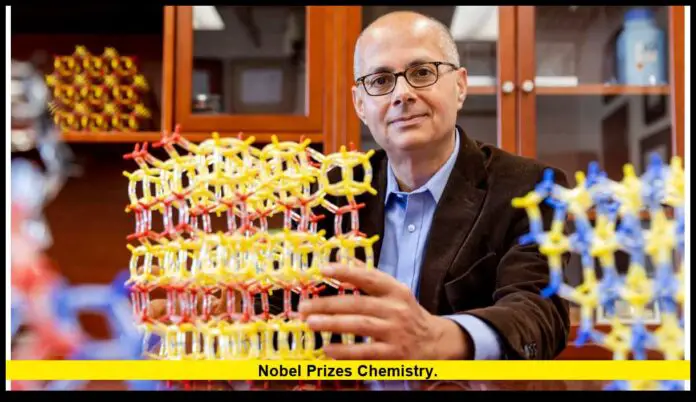
The scientific community is celebrating as the Nobel Prizes chemistry awards for 2025 were officially announced in Stockholm. This year’s prize honors three researchers whose pioneering work in the development of metal–organic frameworks (MOFs) has reshaped modern chemistry and opened the door to innovations in carbon capture, clean water technology, and sustainable energy.
Table of Contents
The Laureates and Their Institutions
The 2025 Nobel Prize in Chemistry was awarded to:
- Susumu Kitagawa – Kyoto University, Japan
- Richard Robson – University of Melbourne, Australia
- Omar M. Yaghi – University of California, Berkeley, USA
These three chemists were recognized for their revolutionary contributions to the creation and application of MOFs — crystalline, sponge-like materials with vast internal surface areas that can trap, store, or separate molecules with extraordinary efficiency.
Why Metal–Organic Frameworks Changed Chemistry
Metal–organic frameworks are constructed by combining metal ions with organic molecules, resulting in rigid, porous structures. These structures act almost like microscopic “molecular hotels,” where gases or other molecules can be selectively trapped inside their cavities.
Their versatility and capacity for customization make them suitable for a wide range of uses, including:
- Capturing carbon dioxide emissions from industrial sources
- Harvesting water from arid air, providing potential solutions for drought regions
- Filtering out harmful pollutants, including PFAS and pharmaceutical residues
- Storing hydrogen and methane, making cleaner energy more efficient
- Catalyzing chemical reactions, improving manufacturing and energy processes
This discovery has revolutionized materials science, bridging fundamental chemistry with real-world environmental challenges.
The Global Impact of Their Work
The Nobel Committee emphasized that this year’s award recognizes chemistry’s crucial role in addressing climate change, energy demands, and resource scarcity. The laureates’ discoveries have had ripple effects beyond academic labs, influencing environmental engineering, materials manufacturing, and industrial chemistry.
In particular, Omar Yaghi’s work at UC Berkeley has positioned the United States as a leader in applying MOF technology to practical problems such as carbon capture and water generation. His research group has developed stable MOFs that can function under extreme conditions, making them viable for real-world deployment.
Timeline of a Scientific Revolution
| Decade | Milestone |
|---|---|
| 1980s | Richard Robson develops early metal-organic structures that laid the groundwork for future frameworks. |
| 1990s | Susumu Kitagawa demonstrates the selective absorption of gases by MOFs, proving their potential as molecular sponges. |
| 2000s–2020s | Omar Yaghi advances MOF design, stability, and functionality, expanding applications to energy, environment, and industry. |
| 2025 | Their collective work earns the Nobel Prize in Chemistry, marking the technology’s full arrival on the global stage. |
U.S. Response to the Nobel Prizes Chemistry
The announcement has been met with enthusiasm from American research institutions, environmental organizations, and government agencies. Given that one of the laureates is based at UC Berkeley, U.S. labs are expected to play a major role in scaling and applying MOF technology.
The American Chemical Society praised the Nobel Committee’s decision, highlighting how these materials are “transforming the way chemists tackle global environmental challenges.” Federal agencies are also expected to look closely at how MOFs can be integrated into carbon reduction strategies and water security programs.
Challenges That Remain
While the promise of MOFs is enormous, several technical and economic challenges still need to be overcome:
- Production Scale – Manufacturing MOFs in large volumes is still expensive and complex.
- Durability – Some MOFs degrade under moisture or pressure, requiring further engineering for industrial use.
- Selectivity – While MOFs excel at trapping specific molecules, real-world conditions involve complex mixtures that require precise tuning.
- Integration – Embedding MOFs into large systems like power plants or municipal water systems requires new infrastructure and design innovation.
Addressing these challenges is likely to become a priority following the Nobel announcement, as increased funding and global collaboration accelerate research.
Applications That Could Shape the Future
The laureates’ discoveries are already finding practical uses, many of which could dramatically influence environmental and industrial practices:
- Water Harvesting: MOFs can collect moisture from the air even in desert conditions, offering a new path for freshwater generation.
- Carbon Capture: MOFs are being tested in smokestacks and industrial settings to trap CO₂ emissions before they enter the atmosphere.
- Clean Energy: Their ability to store hydrogen safely could make clean fuels more practical for transportation and power.
- Pollution Removal: MOF-based filters can remove harmful substances from wastewater and drinking water more effectively than traditional methods.
- Chemical Manufacturing: MOFs are used as catalysts, enabling more efficient and eco-friendly chemical processes.
Statements from the Laureates
Each laureate expressed deep gratitude and reflected on decades of work:
- Susumu Kitagawa highlighted his early dream of designing molecular materials to selectively trap gases.
- Richard Robson expressed amazement at how his early work on metal-organic structures had grown into a global scientific field.
- Omar Yaghi emphasized the power of curiosity-driven science, noting how fundamental discoveries can evolve into tools for solving the world’s most urgent problems.
Their shared sentiment was that science thrives on collaboration, persistence, and imagination — values that their careers embody.
Looking Ahead
The 2025 Nobel Prize in Chemistry is expected to accelerate investments in MOF research and its translation into commercial technologies. U.S. universities, startups, and government agencies may collaborate to develop industrial-scale MOF applications in energy, environmental protection, and advanced manufacturing.
The award also signals a broader shift in chemistry’s role — from purely theoretical and laboratory work to technologies that directly address global crises. MOFs exemplify how elegant molecular design can provide practical solutions for society’s biggest challenges.
As the world reflects on this year’s Nobel honors, it’s clear that the discoveries recognized in the 2025 Nobel Prizes Chemistry are more than scientific triumphs — they are blueprints for a sustainable future.

