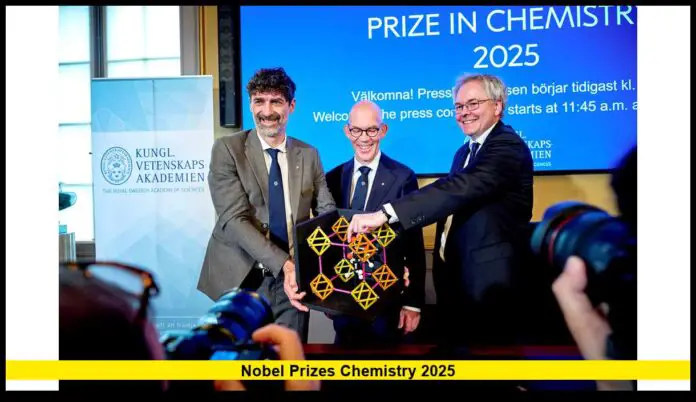
The 2025 Nobel Prize in Chemistry has been awarded to Susumu Kitagawa, Richard Robson, and Omar M. Yaghi for their pioneering work on metal-organic frameworks (MOFs)—a discovery that is transforming environmental science, energy innovation, and industrial chemistry. The Royal Swedish Academy of Sciences announced the award this week, marking one of the most significant recognitions in modern chemical research.
Their joint contribution focuses on creating porous crystalline structures capable of capturing, storing, and filtering gases and liquids with unprecedented precision. The decision reflects the Nobel Committee’s growing emphasis on science that addresses real-world problems such as climate change, water scarcity, and sustainable energy.
Table of Contents
The Science Behind Metal-Organic Frameworks
Metal-organic frameworks are materials built from metal ions linked together by organic molecules. This structure forms rigid networks full of microscopic pores. A single gram of some MOFs can contain as much surface area as an entire football field, allowing them to hold and separate enormous quantities of gases.
These frameworks can be engineered to:
- Capture carbon dioxide directly from air or industrial exhaust.
- Extract water from dry or desert air.
- Filter pollutants and “forever chemicals” from water supplies.
- Store hydrogen and other gases efficiently for clean energy use.
- Act as catalysts to accelerate industrial chemical reactions.
The Nobel Committee described this work as a “revolution in molecular architecture” with the potential to help solve some of humanity’s greatest challenges.
Profiles of the Laureates
Susumu Kitagawa, based in Japan, advanced the field by demonstrating how porous structures could be stabilized and used to absorb gases—a critical breakthrough that moved MOFs from theoretical ideas to practical applications.
Richard Robson, from Australia, laid the early conceptual foundation in the late 1980s by constructing novel porous crystals. Though initially unstable, his work opened the door to what would become a global research frontier.
Omar M. Yaghi, a chemistry professor at the University of California, Berkeley, refined the process by developing “reticular chemistry.” His method allowed scientists to design MOFs with modular precision, much like building molecular Lego sets. Yaghi’s U.S.-based laboratory became one of the epicenters of MOF research, giving the United States a leading role in this scientific revolution.
U.S. Impact and Global Recognition
For American science, this year’s Nobel Prize carries special significance. Omar Yaghi’s win marks UC Berkeley’s 28th Nobel laureate, strengthening its reputation as a global leader in scientific innovation. His journey—from his early studies in New York to his breakthroughs in California—reflects the strength of the U.S. academic system in nurturing transformative research.
Across the country, chemistry departments, research institutions, and energy startups have celebrated the recognition. The American Chemical Society hailed the award as “a triumph of creative chemistry that shows how molecular design can change the world.”
This Nobel Prize also highlights how international collaboration drives major discoveries. With laureates from Japan, Australia, and the United States, the award underscores the global nature of modern science.
Timeline of the Discovery
The road to this Nobel Prize was decades in the making:
- 1980s – Robson constructs early porous crystals, setting the stage for MOF development.
- 1990s – Kitagawa stabilizes these frameworks, proving their ability to trap gases.
- 2000s – Yaghi creates a systematic approach for designing MOFs, leading to an explosion of research worldwide.
- Today – Tens of thousands of different MOFs have been developed, each tailored to specific uses like gas separation, water harvesting, or catalysis.
This progression shows how incremental advances over time can lead to breakthroughs that reshape entire industries.
Applications Driving the Future
The recognition of MOFs isn’t just symbolic—it points to practical technologies that are rapidly gaining traction. Some of the most promising applications include:
| Application | Potential Impact |
|---|---|
| Carbon Capture | Trapping CO₂ directly from the atmosphere to combat climate change. |
| Water Harvesting | Pulling drinkable water from desert air, even at low humidity. |
| Industrial Gas Storage | Storing hydrogen and natural gas more efficiently and safely. |
| Pollution Control | Filtering dangerous “forever chemicals” and pharmaceutical waste. |
| Energy & Chemical Production | Acting as catalysts for cleaner and faster chemical processes. |
These applications align closely with global priorities like reducing greenhouse gas emissions, addressing water shortages, and developing sustainable energy systems.
Challenges Ahead
While the science behind MOFs is extraordinary, practical implementation on an industrial scale remains a work in progress. Key challenges include:
- Stability: Some MOFs can degrade under moisture, heat, or acidic conditions.
- Scalability: Producing them in large quantities at low cost is complex.
- Integration: Incorporating MOFs into real systems like filters or reactors requires engineering innovations.
Nevertheless, the momentum created by the Nobel recognition is expected to accelerate both research and commercial investment in these materials.
Looking Forward
The Nobel Prize in Chemistry will be formally awarded in Stockholm on December 10, 2025. Until then, the scientific community is buzzing with excitement. Many expect increased funding, new collaborations, and a surge of interest from industries seeking sustainable solutions.
For the United States, Yaghi’s win strengthens the nation’s leadership in materials science and environmental innovation. His work represents a bridge between fundamental chemistry and practical technologies that could reshape industries from energy to water treatment.
A Nobel Moment that Resonates
This year’s Nobel Prize in Chemistry is more than an academic honor—it’s a signal to the world that chemistry remains at the forefront of tackling global problems. The breakthroughs in metal-organic frameworks have opened doors to technologies that were once the stuff of imagination.
As the world faces mounting environmental and energy challenges, the work of Kitagawa, Robson, and Yaghi shows how deep scientific insight can translate into powerful real-world solutions.
What are your thoughts on this year’s Nobel Prize in Chemistry? Join the conversation and share your perspective below.

