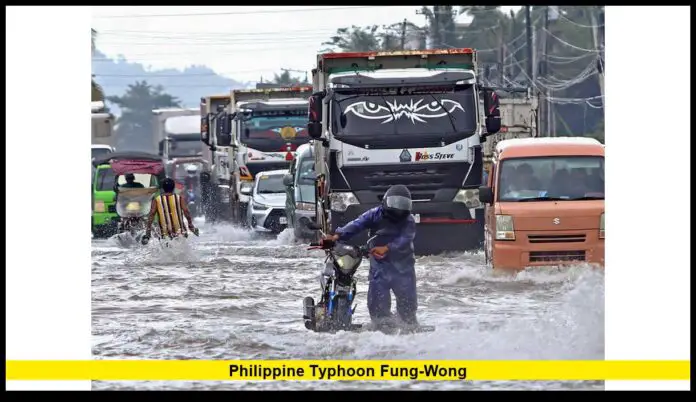
The Philippine Typhoon Fung-Wong has captured global attention as it continues to affect large parts of the Philippines in early November 2025. The powerful storm made landfall earlier this week, unleashing torrential rains, destructive winds, and severe flooding across several provinces. From northern Luzon to parts of the Visayas, communities are facing widespread devastation. As of today, thousands of families remain in evacuation centers, while recovery and relief efforts are being carried out nationwide.
Meteorologists report that Typhoon Fung-Wong reached peak intensity with winds of up to 150 kilometers per hour (93 mph) before slightly weakening as it crossed Luzon. Despite this, the storm’s vast rainbands have continued to bring relentless downpours, triggering flash floods and landslides in mountainous regions. Rivers have overflowed, and several towns are still submerged, especially in Cagayan, Isabela, and Aurora provinces.
In Metro Manila, commuters struggled through knee-deep floods, and classes were suspended for safety. Flights and ferry operations were also canceled as the government prioritized the protection of lives. Local disaster teams are working around the clock to restore access to isolated areas and provide essentials such as food, clean water, and power. While the typhoon has started to weaken, its aftermath is expected to leave lasting challenges for many Filipino communities.
Table of Contents
Current Situation and Weather Update
As of November 9, 2025, the Philippine weather agency PAGASA reports that Typhoon Fung-Wong has weakened slightly after moving across northern Luzon but is still bringing heavy rains and gusty winds. The typhoon currently packs sustained winds of 120 kilometers per hour (75 mph) and gusts reaching 150 km/h (93 mph).
The storm has affected several regions, including Cagayan, Isabela, Aurora, and Nueva Ecija, where strong winds uprooted trees and caused power interruptions. Metro Manila and nearby provinces experienced continuous rain overnight, resulting in flash floods and disrupted travel.
More than 40,000 people have been forced to evacuate to safer areas. Local authorities continue to monitor flood-prone zones as rivers overflow and landslides threaten mountainous areas. Despite weakening, Typhoon Fung-Wong remains dangerous, especially for residents living near coastal and low-lying communities.
How Typhoon Fung-Wong Developed
Here’s a quick look at the storm’s development over the past week:
| Date (2025) | Event |
|---|---|
| November 3 | A tropical depression forms east of Mindanao. |
| November 5 | Intensifies into a tropical storm and is named Fung-Wong. |
| November 7 | Strengthens into a typhoon over the Philippine Sea. |
| November 8 | Makes landfall in Aurora Province, bringing strong winds and heavy rainfall. |
| November 9 | Moves northwest across Luzon, gradually weakening but causing major flooding. |
Meteorologists note that Typhoon Fung-Wong followed a familiar path taken by previous destructive typhoons such as Noru (2022) and Doksuri (2023). These storms often enter the Philippines from the Pacific, gaining strength over warm waters before hitting land.
Damage and Affected Areas
The Philippine Typhoon Fung-Wong has caused significant damage in northern and central Luzon. Early reports indicate:
- 40,000+ residents evacuated to temporary shelters.
- 50 domestic flights canceled and ferry operations suspended nationwide.
- Widespread power outages in at least 10 provinces.
- $12 million worth of rice, corn, and vegetable crops damaged.
Many roads are still impassable due to landslides and fallen trees. The Department of Public Works and Highways (DPWH) is clearing highways leading to Cagayan Valley and the Cordillera region. In several towns, local rescue teams are delivering food, water, and medical aid using boats and military trucks.
In the capital region, Metro Manila, several streets were flooded overnight, especially in Quezon City, Pasig, and Marikina. Local governments have activated rescue units to assist stranded families.
Government and Relief Efforts
The National Disaster Risk Reduction and Management Council (NDRRMC) is coordinating nationwide response operations. Over 5,000 emergency workers, including police officers, soldiers, and Red Cross volunteers, are on the ground providing relief assistance.
President Ferdinand Marcos Jr. has instructed local officials to prioritize evacuation, rescue, and immediate relief. The Department of Social Welfare and Development (DSWD) has distributed more than 30,000 family food packs to affected residents.
International aid organizations have also responded. The Red Cross, UN Humanitarian Affairs Office, and USAID have pledged logistical and financial support. Neighboring countries such as Japan and South Korea have sent early assistance, including tents, generators, and water filters.
Weather Forecast and Expected Path
According to the latest PAGASA bulletin, Typhoon Fung-Wong is moving northwest at 18 kilometers per hour (11 mph). It is expected to exit the Philippine Area of Responsibility (PAR) by late November 10 or early November 11.
While the storm continues to weaken, it will still bring strong rains and rough seas to northern Luzon and parts of the Visayas. Once outside PAR, Fung-Wong is forecast to head toward southern China.
Even after its exit, the typhoon will enhance the northeast monsoon (amihan), bringing cooler temperatures and occasional rains across Luzon, including Metro Manila, over the next several days.
Comparison to Previous Typhoons
Typhoon Fung-Wong’s impact, while not the strongest in recent years, has been widespread. Its slow movement led to days of heavy rain and flooding—similar to what happened during Typhoon Ulysses (2020) and Typhoon Kammuri (2019).
The Philippines averages 20 typhoons every year, making it one of the most disaster-prone countries in the world. Experts continue to warn that climate change is intensifying tropical storms, leading to heavier rainfall and stronger winds.
This year’s storm season has already tested the country’s preparedness, but the coordinated response between national agencies and local communities has helped minimize casualties.
Agricultural and Economic Impact
Agriculture has suffered the biggest losses so far. Early estimates show over 50,000 hectares of farmland affected, particularly in rice-growing provinces. With harvest season approaching, this could temporarily affect local food supplies and raise prices in the coming weeks.
Power and telecommunications have also been disrupted in many northern towns, but restoration work is ongoing. The Department of Energy expects electricity to return to most areas within the next few days.
Health and Safety Concerns
Flooding increases the risk of waterborne diseases like leptospirosis and dengue fever. The Department of Health (DOH) has deployed mobile clinics to evacuation centers and distributed medicines, disinfectants, and hygiene kits.
Residents are being reminded to boil water before drinking and to avoid wading through floodwater when possible. Health officials are also ensuring that COVID-19 precautions remain in place inside crowded evacuation shelters.
International Response and Support
The U.S. Embassy in Manila expressed sympathy for the affected communities and stated that the U.S. government, through USAID, is closely monitoring the situation. Humanitarian support, including emergency supplies and funding, is being prepared in coordination with Philippine authorities.
Japan’s Meteorological Agency has also been assisting in tracking the storm, sharing satellite data to improve forecasting accuracy. International humanitarian agencies are now working with the Philippine Red Cross to assess longer-term recovery needs.
Community Resilience and Local Efforts
Despite the challenges, Filipino communities have once again shown remarkable resilience. Across social media, hashtags like #BangonLuzon (“Rise Luzon”) and #FungWongRelief have gone viral, encouraging donations and volunteer drives.
Ordinary citizens are opening their homes to evacuees, while local restaurants and businesses are providing free meals. In the hardest-hit areas, youth groups and church organizations are distributing clothes and relief packs.
These grassroots efforts highlight the unity and compassion of the Filipino spirit—qualities that continue to shine even during disasters.
Looking Ahead: Preparing for Future Storms
Experts emphasize the importance of improving disaster preparedness. This includes building stronger infrastructure, expanding flood control systems, and strengthening early warning communication.
Climate adaptation programs are also crucial. The Philippines’ geography makes it especially vulnerable to tropical storms, and sustainable land management could reduce the impact of future typhoons.
Final Thoughts
The Philippine Typhoon Fung-Wong has once again tested the resilience and cooperation of Filipino communities. While recovery will take time, the nation’s spirit of unity and the global support pouring in offer hope for a swift recovery.
What are your thoughts on the ongoing relief efforts for Typhoon Fung-Wong? Share your message of support or opinion in the comments below.

