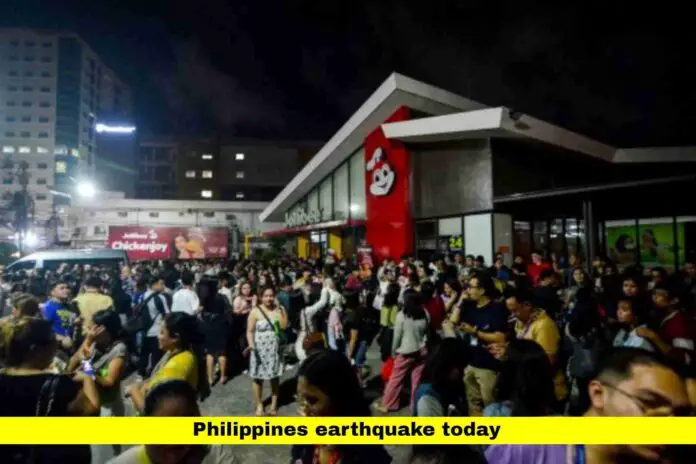
A deadly Philippines earthquake today has left at least 31 people dead and dozens more injured after a powerful magnitude 6.9 tremor struck off the coast of northern Cebu. The late-night quake caused widespread destruction, collapsing homes, damaging public facilities, and plunging entire communities into chaos. As rescue teams continue digging through the rubble, the scale of devastation is becoming clearer, with authorities warning that the death toll may rise.
Table of Contents
The Epicenter and Scale of the Quake
The tremor hit at 9:59 PM Philippine Standard Time, its epicenter located 19 kilometers northeast of Bogo City in northern Cebu. With a shallow depth, the earthquake’s force was felt strongly across Cebu province and neighboring islands.
Residents in Cebu City, Mandaue, and Lapu-Lapu reported violent shaking lasting nearly a minute, sending crowds fleeing into the streets. Authorities confirmed that aftershocks are continuing, raising fears of additional building collapses.
The earthquake has been classified as one of the strongest to strike Cebu in recent years, underscoring the island’s vulnerability despite not being as quake-prone as Mindanao or Luzon.
Casualties and Immediate Human Toll
Current reports confirm:
- 31 fatalities in northern Cebu municipalities, including Bogo, Medellin, and San Remigio.
- Dozens of injuries, ranging from fractures to head trauma.
- Children and elderly residents among the casualties.
- Entire families displaced, their homes reduced to rubble.
Hospitals in Cebu City are overflowing with patients. Many were treated outdoors in makeshift tents as aftershocks made residents fearful of staying inside medical facilities.
Local officials warn that numbers may climb as rescuers gain access to more remote barangays cut off by landslides.
Destruction of Homes and Infrastructure
The 6.9 quake left a trail of destruction across northern Cebu:
| Category | Damage Reported |
|---|---|
| Residential Homes | Thousands partially or completely collapsed |
| Public Buildings | Fire stations, schools, barangay halls damaged |
| Roads & Highways | Cracks, landslides, and collapsed sections |
| Power & Water Supply | Widespread blackouts and burst pipelines |
| Communications | Spotty service due to damaged towers |
Several barangays in San Remigio and Medellin remain isolated because landslides blocked mountain roads. Relief supplies are being airlifted to these areas as local governments struggle to clear debris.
Tsunami Alert and Aftershock Fears
A tsunami warning was initially issued by the Philippine Institute of Volcanology and Seismology (PHIVOLCS), sparking panic evacuations in coastal towns. The alert was later lifted when no unusual sea activity was detected.
Still, PHIVOLCS has urged residents to stay cautious, as dozens of aftershocks—some strong—are expected in the coming days. These could weaken already unstable structures and trigger further landslides.
Storm Disaster Compound Effect
The earthquake struck only days after Storm Bualoi (locally called “Opong”) swept across the Philippines, leaving more than 10 dead and thousands homeless.
This back-to-back disaster worsens the humanitarian crisis:
- Flood-damaged homes were further destroyed by the quake.
- Evacuation centers, already full of storm evacuees, are now sheltering earthquake survivors.
- Emergency responders stretched thin between storm-hit and quake-hit areas.
The timing has amplified suffering and delayed recovery, making relief coordination even more urgent.
Government Response and Rescue Operations
The National Disaster Risk Reduction and Management Council (NDRRMC) has dispatched military units, rescue dogs, and emergency medical teams to Cebu. Local government units have opened schools, gyms, and churches as temporary evacuation centers.
Key government actions include:
- Search & Rescue: Clearing rubble with heavy machinery while volunteers assist manually.
- Medical Assistance: Mobile hospitals deployed to treat patients outdoors.
- Relief Distribution: Food, clean water, and blankets are being delivered to affected barangays.
- Infrastructure Repair: Teams are restoring power and clearing highways to reconnect isolated towns.
The President has assured the public of “immediate relief and long-term rebuilding,” pledging national funds for Cebu’s recovery.
Stories from the Ground: Fear and Resilience
Eyewitness accounts bring the human dimension into focus:
- A mother in Bogo described clutching her children as their house crumbled: “We ran into the street barefoot. All we could hear were screams and sirens.”
- In Medellin, volunteers formed human chains to pull survivors from a collapsed chapel.
- Hospitals in Cebu City overflowed as doctors treated patients in parking lots under flashlights.
- Farmers reported losing livestock when barns collapsed, worsening their livelihood crisis.
Despite the chaos, Filipinos once again showed solidarity. Neighbors shared food, strangers helped dig through debris, and community groups organized relief drives.
Why the Philippines Is Highly Vulnerable
The Philippines sits on the Pacific Ring of Fire, making it one of the most disaster-prone countries in the world.
Key Risk Factors:
- Multiple active fault lines, including the Philippine Fault Zone.
- Frequent typhoons that weaken infrastructure before seismic events.
- High population density in urban areas with older, unsafe buildings.
Experts stress the importance of enforcing earthquake-resistant construction codes to reduce future casualties.
International Reactions and Aid Offers
The international community has begun responding with support:
- Japan has pledged to send search-and-rescue specialists experienced in earthquake zones.
- United States offered humanitarian aid through USAID, focusing on medical kits and food supplies.
- European Union expressed readiness to provide emergency funds for relief.
- Neighboring ASEAN nations have sent messages of solidarity, with offers of logistical assistance.
These partnerships will be crucial in sustaining long-term recovery and ensuring that relief reaches all affected areas.
Historical Comparisons: Deadly Philippine Quakes
Today’s disaster is a reminder of past tragedies:
- 2013 Bohol Earthquake (7.2 magnitude) – Killed more than 200 and destroyed historic churches.
- 1990 Luzon Earthquake (7.8 magnitude) – One of the deadliest, leaving over 1,600 dead.
- 2019 Cotabato Series (6.6–6.9 magnitude) – Killed dozens and displaced thousands in Mindanao.
While today’s Cebu quake was slightly weaker, its impact is magnified by the storm that struck days earlier, creating a dual disaster.
Challenges in the Days Ahead
The immediate focus is rescue and relief, but long-term challenges loom large:
- Rehousing displaced families in safe, earthquake-resilient shelters.
- Rebuilding infrastructure, including schools, hospitals, and bridges.
- Providing psychological support for traumatized survivors.
- Preparing for aftershocks, which may trigger secondary collapses.
- Strengthening disaster preparedness, including public drills and stricter building codes.
Recovery will be a test of resilience not only for Cebu but for the nation as a whole.
Community Spirit Amid Tragedy
If there is one constant in Philippine disasters, it is the strength of community spirit. Across Cebu, volunteers are cooking for evacuees, churches are opening their doors, and youth groups are organizing donation drives.
This resilience is why the Philippines continues to recover, no matter how many times it is shaken.
The Philippines earthquake today has taken lives, destroyed homes, and tested the nation’s strength once again. Yet even in tragedy, the Filipino spirit endures—strong, united, and determined to rebuild. As Cebu begins the difficult path to recovery, one truth stands clear: the courage of the people will always outshine the devastation of the disaster.
Met

