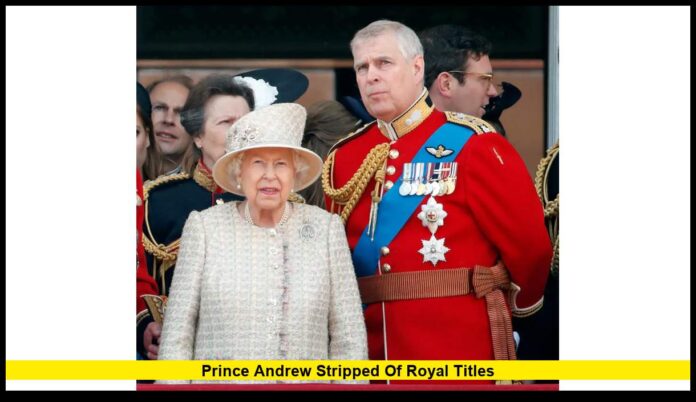
The announcement that Prince Andrew has been stripped of his royal titles marks one of the most dramatic moments in modern royal history. Once a respected member of the British royal family, the Duke of York’s reputation has been permanently tarnished by his connection to convicted sex offender Jeffrey Epstein and the sexual abuse allegations brought by Virginia Giuffre.
This decision is not only about Andrew’s personal downfall — it’s about the royal family’s effort to preserve its reputation, rebuild public trust, and prove that even the most powerful are not above accountability.
Table of Contents
A Landmark Decision by the Royal Family
For centuries, royal titles have symbolized honor, service, and prestige. But in 2025, Buckingham Palace made a bold and unprecedented move — announcing that Prince Andrew would no longer use his royal titles or military honors.
This means Andrew has been stripped of:
- The use of “His Royal Highness (HRH)” in any official capacity.
- All military affiliations and royal patronages.
- The right to represent the royal family at public or state events.
While Andrew still retains the title “Prince” by birth, he no longer performs royal duties or receives royal privileges. In the eyes of the public — and the institution — he is no longer a working royal.
The Scandal That Led to His Downfall
Prince Andrew’s troubles began with his long-standing friendship with Jeffrey Epstein, the American financier convicted of sex trafficking minors.
The two men met in the late 1990s through Ghislaine Maxwell, who was later convicted for her role in Epstein’s network. Over the years, Andrew attended Epstein’s private parties and was photographed at several of his properties — including Epstein’s Manhattan mansion, his private island, and Maxwell’s London residence.
Even after Epstein’s 2008 conviction for soliciting a minor, Andrew reportedly remained in contact with him. In 2010, they were photographed walking together in Central Park — an image that shocked the world and fueled speculation about their relationship.
Andrew later called the meeting “a mistake and a lapse in judgment,” but the damage was already done.
Virginia Giuffre’s Allegations
The turning point came when Virginia Giuffre, a survivor of Epstein’s trafficking network, accused Prince Andrew of sexual assault. She alleged that Epstein and Maxwell had trafficked her to Andrew when she was just 17 years old.
According to Giuffre, she was forced into sexual encounters with the Duke of York on three occasions:
- Once at Ghislaine Maxwell’s London townhouse
- Once at Epstein’s New York mansion
- And once on Epstein’s private island in the Caribbean
A now-famous photograph showing Prince Andrew with his arm around Giuffre’s waist — taken when she was a teenager — became central to her claims. Andrew has repeatedly denied the allegations, insisting he has “no recollection” of meeting her.
The Disastrous BBC Interview
In an attempt to defend himself, Prince Andrew appeared in a BBC Newsnight interview in 2019. What was meant to clear his name became a public relations disaster.
He made several statements that stunned viewers:
- He claimed the photo with Giuffre could have been “manipulated.”
- He said he couldn’t have been sweating at the time due to a “medical condition.”
- He called his friendship with Epstein “useful” because it introduced him to influential people.
The interview was widely condemned as arrogant and insensitive. Within days, Andrew was forced to step back from all royal duties, effectively ending his public career.
The U.S. Lawsuit and Settlement
In 2021, Virginia Giuffre filed a civil lawsuit against Prince Andrew in a U.S. court, accusing him of sexual assault and emotional distress.
Andrew’s legal team tried to have the case dismissed, citing a previous settlement Giuffre made with Epstein, but the judge rejected the motion. Facing the possibility of a public trial, Andrew agreed to settle out of court in early 2022.
The settlement amount was not officially disclosed but is believed to be around $12 million. The agreement included no admission of guilt. However, Andrew issued a statement expressing regret for his association with Epstein and commending Giuffre for her “bravery” in coming forward.
While the settlement ended the legal case, it did little to restore his reputation.
Why the Queen and King Charles Took Action
Following the scandal and the settlement, Queen Elizabeth II took decisive action to protect the monarchy’s image. In January 2022, the Palace confirmed that Andrew had been stripped of all military affiliations and royal patronages.
The Queen’s decision sent a clear message: the monarchy’s duty to the public outweighs family loyalty.
After her death in 2022, King Charles III reinforced that stance. Under his leadership, the royal family has focused on transparency and integrity. Charles made it clear that Prince Andrew would not return to public life or represent the monarchy in any capacity.
Insiders describe the decision as part of the King’s plan to modernize the royal family and distance it from scandal once and for all.
Titles and Honors Lost
The stripping of Prince Andrew’s titles and honors was comprehensive and symbolic.
| Title or Role | Status | Details |
|---|---|---|
| His Royal Highness (HRH) | Removed | No longer used in public or official settings. |
| Duke of York (duties) | Suspended | Retains title by name only. |
| Military Affiliations | Revoked | Lost roles such as Colonel of the Grenadier Guards. |
| Royal Patronages | Revoked | Removed from over 70 charities and organizations. |
| Public Duties | Ended | No longer represents the royal family. |
While Andrew retains the Duke of York title legally, he no longer performs the duties or responsibilities attached to it.
The Reaction from the Public
Public response to the decision was overwhelmingly supportive. Polls in the U.K. and the U.S. showed that most people believed Prince Andrew should never return to royal duties.
The majority agreed that the stripping of titles was a necessary step to protect the monarchy’s integrity. Many also praised King Charles III for his decisive handling of the issue, describing it as a long-overdue move to modernize the institution.
For royal watchers, this moment symbolized the end of the “untouchable” era — a time when status and privilege could shield members of the royal family from accountability.
Where Prince Andrew Stands Now
Today, Prince Andrew lives a quiet and reclusive life at Royal Lodge in Windsor. He rarely appears in public and remains largely isolated from the rest of the royal family.
He continues to firmly deny all allegations, and despite years of public scrutiny, he has voiced his wish to “move forward” with his life. However, there are still no indications that the royal family plans to reinstate him in any official capacity. Meanwhile, his daughters, Princess Beatrice and Princess Eugenie, remain supportive and maintain a loving relationship with their father. At the same time, they have carefully kept their distance from the ongoing controversy in order to protect their own public standing and royal responsibilities.
Financially, Andrew is believed to be under strain, relying on personal assets after losing royal funding. Reports suggest that King Charles has made it clear there will be no financial support from the Crown moving forward.
A Lesson in Accountability
The decision to strip Prince Andrew of his royal titles reflects a broader shift within the monarchy — one toward accountability and modern values. It also sends a message that no one, not even a prince, is above the law or public scrutiny.
For Americans, the case remains significant because it connects to the Epstein scandal, one of the most disturbing criminal networks uncovered in the United States. It shows how justice and public opinion can transcend borders, forcing even global figures to face consequences.
Final Thoughts
So, why was Prince Andrew stripped of royal titles?
Because his association with Jeffrey Epstein, the allegations of sexual misconduct, and the resulting public outrage left the royal family with no choice.
The monarchy’s decision wasn’t just about punishing one man — it was about preserving an institution that must now adapt to the standards of a more transparent and accountable world.
Prince Andrew’s story stands as a powerful reminder: privilege can’t erase responsibility, and reputation, once lost, is nearly impossible to reclaim.
What are your thoughts on the royal family’s decision to strip Prince Andrew of his titles? Share your views below and join the conversation.

