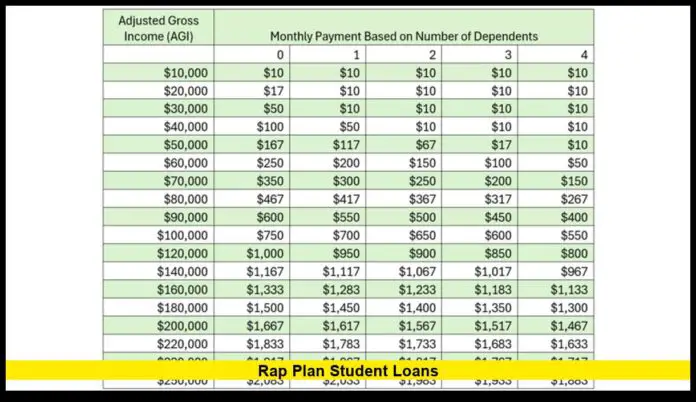
rap plan student loans are now at the center of a major transformation in how Americans repay federal student debt. The Repayment Assistance Plan, commonly called RAP, is no longer a proposal or temporary program. It is a confirmed federal repayment framework that will redefine income-based repayment for millions of borrowers across the United States. As implementation moves closer, understanding how RAP works, who it affects, and what changes borrowers should prepare for has become essential.
Table of Contents
How Rap Plan Student Loans Reshape Federal Repayment
For years, the federal student loan system relied on multiple income-driven repayment options. Each plan had its own formulas, eligibility requirements, and forgiveness timelines. While these plans aimed to protect borrowers, they often created confusion and administrative complexity.
The rap plan student loans framework was introduced to replace this fragmented structure with a single, standardized income-based system. RAP is designed to simplify repayment, reduce servicing errors, and ensure that all borrowers contribute something toward their debt while still maintaining long-term affordability.
This shift represents a structural change, not a temporary adjustment. RAP is embedded in federal policy and scheduled for phased implementation, making it a defining feature of the future student loan system.
Why the Repayment Assistance Plan Was Created
The creation of RAP reflects long-standing challenges in student loan administration. Borrowers often struggled to understand which repayment plan suited them, how payments were calculated, and whether they were making progress toward forgiveness.
Key issues that led to RAP include:
- Overlapping repayment options with inconsistent rules
- Complicated income calculations that varied by plan
- Borrowers remaining in repayment for decades without reducing balances
- Administrative backlogs and servicing mistakes
- Uncertainty around forgiveness eligibility
RAP was designed to address these problems by offering one consistent income-based approach that applies broadly across federal loans.
Implementation Timeline for Rap Plan Student Loans
The rollout of RAP follows a clear schedule that affects both new and existing borrowers.
- July 1, 2026: RAP becomes the primary income-based repayment option for new federal student loans
- 2026 to 2028: Transition period for borrowers currently enrolled in older income-driven plans
- July 1, 2028: Most legacy income-based repayment plans are phased out
Borrowers with loans issued before July 2026 have a limited window to decide whether to remain in older plans temporarily or prepare for a shift into RAP.
How Payments Are Calculated Under RAP
One of the most important changes under rap plan student loans is the method used to calculate monthly payments.
Income-Based Structure Using AGI
RAP bases payments on a borrower’s adjusted gross income. Unlike previous plans that relied on discretionary income calculations, RAP applies a percentage directly to total reported income.
This approach creates a clearer link between income and payment size, making repayment more predictable over time.
The Sliding Scale Payment Model
RAP uses a tiered structure that adjusts payment percentages as income increases.
General structure includes:
- Very low income borrowers pay a minimum required amount
- Lower-income borrowers pay a small percentage of income
- Middle-income borrowers contribute a moderate share
- Higher-income borrowers pay up to a capped percentage
This sliding model ensures that payments rise gradually with income rather than jumping abruptly.
The Mandatory Minimum Payment Rule
A defining feature of rap plan student loans is the introduction of a required minimum payment.
Under RAP:
- Borrowers with income must make at least a $10 monthly payment
- Zero-dollar required payments are eliminated
This change ensures continuous participation in repayment while still keeping payments manageable for those with limited earnings.
Dependent-Based Adjustments
RAP accounts for borrowers who support dependents.
Key points include:
- Monthly payment reductions for qualifying dependents
- Adjustments applied before enforcing the minimum payment
- Payments never drop below the minimum threshold
This structure balances family responsibilities with repayment expectations.
Interest Treatment Under Rap Plan Student Loans
Interest growth has historically been a major burden for borrowers. RAP introduces safeguards to limit balance inflation.
Interest Protection Features
When a borrower’s payment does not cover full monthly interest:
- Excess interest is not added to the loan balance
- Balances are protected from uncontrolled growth
This approach prevents borrowers from seeing their debt increase simply because payments are low.
Progress Toward Principal Reduction
RAP includes mechanisms that help borrowers reduce principal even when payments are modest. This prevents long-term stagnation and supports meaningful progress over time.
Forgiveness Under RAP
Forgiveness remains a core component of rap plan student loans.
30-Year Forgiveness Timeline
Borrowers who:
- Remain enrolled in RAP
- Make required payments consistently
- Complete 360 qualifying monthly payments
May qualify for forgiveness of any remaining loan balance.
This forgiveness includes both unpaid principal and accrued interest, provided all program conditions are met.
Who Is Required to Use Rap Plan Student Loans
Eligibility for RAP depends largely on when a borrower’s loans were issued.
New Borrowers After July 2026
For borrowers taking out federal student loans after July 1, 2026:
- RAP is the primary income-based repayment option
- Standard repayment remains available as a non-income-based alternative
Existing Borrowers
Borrowers with older loans:
- May remain temporarily in legacy plans
- Must transition by the end of the phase-out period
Planning ahead during this transition window is critical.
Parent Borrowers and RAP
Parent borrowers face distinct rules under RAP.
Important considerations include:
- Parent PLUS loans issued after July 2026 generally do not qualify for RAP
- Consolidation decisions can affect repayment options
- Standard repayment remains the default for many parent borrowers
These rules make early planning especially important for families using parent-based loans.
How Rap Plan Student Loans Compare to Older Plans
RAP Compared to SAVE
SAVE allowed many borrowers to make no required monthly payments. RAP replaces that approach with mandatory participation and income-based contributions.
While this may increase payments for some borrowers, it also improves long-term balance stability.
RAP Compared to Traditional Income-Based Repayment
Older income-based plans relied on hardship tests and varied forgiveness timelines. RAP removes hardship requirements and standardizes repayment expectations across income levels.
Budgeting Impacts for Borrowers
The transition to rap plan student loans may require adjustments to household budgets.
Borrowers most likely to see higher payments include:
- Those previously making zero-dollar payments
- Borrowers with stable but modest incomes
- Households transitioning from discontinued plans
Others may benefit from predictable payment limits and interest protections.
Administrative Changes Under RAP
RAP is designed to streamline loan servicing.
Expected improvements include:
- Simpler annual income updates
- Fewer plan switches
- Clearer payment tracking
Borrowers should still monitor accounts closely, especially during the transition period.
Default, Delinquency, and RAP Enrollment
RAP does not automatically resolve defaulted loans.
Borrowers in default must:
- Rehabilitate or consolidate loans
- Restore loans to good standing
Once enrolled, RAP can help prevent future delinquency by aligning payments with income.
Long-Term Effects of Rap Plan Student Loans
RAP represents a broader shift in federal student loan policy.
Long-term outcomes may include:
- Fewer repayment options but clearer rules
- More consistent borrower participation
- Reduced administrative confusion
- Greater predictability for both borrowers and servicers
While RAP is not a universal cost reduction, it aims to create a more stable repayment environment.
Preparing for the RAP Transition
Borrowers can reduce stress by preparing early.
Practical steps include:
- Reviewing current repayment status
- Estimating future payments under RAP
- Planning for minimum payment requirements
- Staying informed about transition deadlines
Preparation allows borrowers to adapt gradually rather than react under pressure.
Clearing Up Common Misunderstandings
Some misconceptions continue to circulate.
- RAP does not eliminate forgiveness
- RAP is not optional for most future borrowers
- RAP does not guarantee lower payments for everyone
Understanding these realities helps borrowers make informed decisions.
What Rap Plan Student Loans Mean for Future Students
Students borrowing in the coming years will enter a system built entirely around RAP.
This means:
- Clear income-based repayment expectations
- Fewer plan choices
- Long-term repayment planning becomes essential
Financial literacy before borrowing becomes more important than ever.
Final Perspective on Rap Plan Student Loans
The rap plan student loans framework marks a pivotal shift in how the United States manages federal student debt. By standardizing income-based repayment and emphasizing consistent participation, RAP reshapes both borrower responsibility and long-term affordability.
Some borrowers will face higher payments, while others will benefit from stability and balance protection. What matters most is awareness, preparation, and engagement as this new system becomes the national standard.
How do you think RAP will affect your financial future? Share your thoughts and stay connected as the student loan system continues to evolve.

