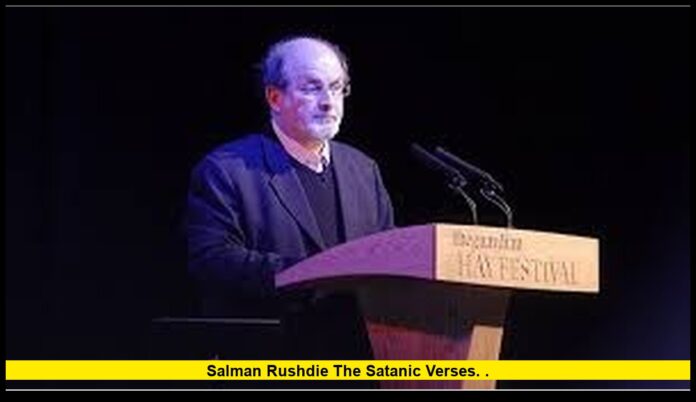
Few novels in modern history have left an imprint as powerful and polarizing as Salman Rushdie The Satanic Verses. Published in 1988, this book did more than earn literary acclaim — it ignited a global debate on freedom of speech, religion, and the boundaries of artistic expression. Decades later, in 2025, The Satanic Verses continues to make headlines, shape discussions, and influence both literature and global culture.
Table of Contents
A Controversial Masterpiece That Redefined Modern Fiction
When Salman Rushdie The Satanic Verses first hit bookstores in September 1988, it was immediately recognized as a daring and imaginative work. Blending magical realism with historical and religious themes, the novel tells the story of two Indian expatriates who survive a plane explosion and find their lives intertwined with surreal, dreamlike visions.
Rushdie’s use of allegory and symbolism made the book a landmark in postcolonial literature. However, parts of the novel were interpreted by some as offensive to Islam, triggering outrage, protests, and eventually, an international crisis.
The Fatwa and Its Aftermath
In 1989, Iran’s then-Supreme Leader Ayatollah Ruhollah Khomeini issued a fatwa calling for Rushdie’s death, claiming that The Satanic Verses insulted Islam and the Prophet Muhammad. This decree forced Rushdie into years of hiding under constant police protection.
The fatwa had far-reaching consequences:
- Bookstores around the world faced attacks and threats.
- Translators and publishers associated with the novel were targeted — some even killed.
- Rushdie spent nearly a decade under government protection, moving from one safehouse to another.
Despite the fear and global tension, the novel gained immense international attention and sold millions of copies. Rushdie, at great personal risk, continued to write and advocate for freedom of expression, cementing his reputation as one of the bravest literary voices of his generation.
The Satanic Verses and Its Literary Impact
While controversy defined its early years, The Satanic Verses remains a brilliant piece of literature admired by critics and scholars. The book explores themes of faith, identity, exile, and transformation, making it a key text in global literature.
Its lasting influence can be seen in how it:
- Challenged censorship and reshaped global discussions on artistic freedom.
- Inspired new generations of writers to push creative and cultural boundaries.
- Sparked academic debates in universities worldwide about religion in literature.
Even today, 37 years after publication, The Satanic Verses remains a must-read for anyone interested in understanding the balance between art and belief.
Renewed Interest and Public Discussion in 2025
As of 2025, The Satanic Verses continues to generate headlines. The book has recently returned to bookstores in India after decades of restriction. The original ban, issued in 1988, was effectively nullified when authorities could not locate the original notification. This quiet re-entry has reignited both enthusiasm and criticism.
Many literary figures hailed the move as a victory for free expression, while some religious organizations expressed concern, urging renewed restrictions. The renewed sales and online discussions demonstrate that the story still resonates — perhaps now more than ever.
In the United States, the novel gained renewed attention as Rushdie testified in early 2025 during the trial of the man who attacked him in 2022. The attack, motivated partly by anger over The Satanic Verses, left the author blind in one eye and with severe injuries. His courtroom appearance served as both a personal and symbolic stand for artistic freedom.
A Novel That Survived Violence and Censorship
Over three decades after its publication, The Satanic Verses stands as a powerful reminder that literature can challenge societies and provoke necessary conversations. Despite censorship, threats, and attempts to silence it, the novel’s endurance proves that ideas cannot be erased by fear.
Rushdie himself has said that he does not regret writing the book — even after everything that followed. To him, it was not an act of defiance but an act of imagination. His persistence reflects a writer’s belief that stories must be told, no matter the cost.
The Global Response in 2025
As the book reappears in Indian stores and regains public visibility, reactions have poured in from around the world.
- Readers have rushed to buy copies, many out of curiosity about the book that “changed everything.”
- Writers and free-speech advocates have praised its return, calling it a victory against censorship.
- Religious groups, however, maintain their objections, calling for continued respect for religious sensitivities.
The renewed conversation shows that The Satanic Verses still serves as a cultural mirror, reflecting how far societies have — or haven’t — come in balancing respect and free thought.
Salman Rushdie’s Enduring Message Through the Novel
At its heart, The Satanic Verses isn’t about provocation — it’s about identity, migration, and the human struggle to reconcile faith and modernity. Rushdie’s complex storytelling forces readers to confront uncomfortable questions about belief, freedom, and belonging.
At 77 years old, Rushdie continues to speak about the power of storytelling. He has made it clear that The Satanic Verses should not be seen solely as a “controversial” book but as a work of art that explores human complexity.
He once said, “The real subject of The Satanic Verses is love and loss, not religion.” That statement captures the misunderstanding at the heart of the decades-long debate — and underscores why the book still matters.
The Satanic Verses in Literature and Culture
Few novels have influenced modern literature and freedom of expression as much as The Satanic Verses. It paved the way for writers to explore religious and cultural subjects without fear. The book’s reappearance and continued relevance in 2025 prove its timeless power.
In universities, it is still studied for its:
- Masterful narrative structure
- Complex use of magical realism
- Exploration of postcolonial identity
- Commentary on exile and transformation
Its presence in academia ensures that new generations of readers engage with the novel not as a scandal but as a cornerstone of literary art.
Final Thoughts
The legacy of Salman Rushdie The Satanic Verses goes far beyond its pages. It is not just a novel; it is a global conversation that continues across decades. In 2025, its message feels as urgent as ever — defending creativity, questioning dogma, and celebrating freedom.
What do you think about The Satanic Verses’ lasting impact? Share your perspective below and join the discussion on one of history’s most powerful books.

