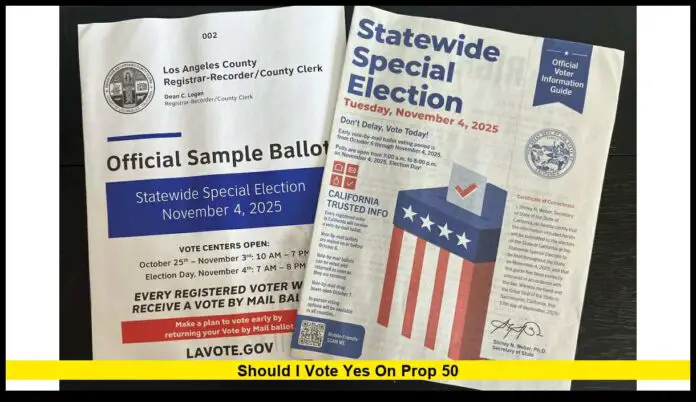
With California’s 2025 special election approaching, many voters are asking one big question: should I vote yes on Prop 50? This measure will appear on the November 4, 2025 ballot, and it could reshape California’s role in U.S. congressional politics for the rest of the decade.
This in-depth breakdown explains what Prop 50 does, what’s at stake, and what a “yes” or “no” vote would actually mean for California voters.
Table of Contents
What Is Prop 50?
Proposition 50 is a statewide constitutional amendment that would allow California’s Legislature to temporarily redraw U.S. congressional district maps—replacing the maps created by the independent California Citizens Redistricting Commission.
If passed, the new Legislature-drawn maps would be used for the 2026, 2028, and 2030 congressional elections, before reverting back to the independent process after the 2030 Census.
Here’s what Prop 50 includes:
- Suspension of the current redistricting maps for federal elections only (state legislative and local maps remain unchanged).
- New maps drawn by the Legislature that take effect for the next three election cycles.
- A return to the independent redistricting process after the 2030 Census.
- One-time implementation costs for updating election materials across California counties.
In essence, Prop 50 temporarily shifts redistricting power from an independent body to elected lawmakers, sparking intense debate across the state.
Why Is Prop 50 on the Ballot Now?
The push for Proposition 50 began after several other states, including Texas, redrew their congressional maps mid-decade in ways viewed as politically motivated.
California leaders argued that these changes elsewhere in the country could reduce California’s influence in Washington. Supporters of Prop 50 believe the state should “level the playing field” by adjusting its maps to reflect shifting national political conditions rather than waiting until 2031.
Governor Gavin Newsom and several top California Democrats back the proposal, saying it ensures fair representation for California voters and protects the state’s voice in Congress.
Opponents, however, claim Prop 50 is a political maneuver designed to increase Democratic control in Washington by changing the balance of California’s 52 congressional seats.
Where Voters Stand Right Now
As of early November 2025, millions of Californians have already cast their ballots by mail. Turnout has been high for a special election, with voter enthusiasm driven by strong opinions on both sides.
Polling conducted throughout October showed roughly 60% of likely voters supporting Prop 50, while about 35% were opposed and the rest undecided.
Campaign spending has been intense. The “Yes on 50” campaign—funded largely by Democratic donors—has spent tens of millions of dollars on TV ads and digital outreach. Meanwhile, the “No on 50” campaign, backed by some Republican organizations and independent watchdogs, warns voters that passing Prop 50 could undermine trust in California’s independent redistricting process.
Arguments in Favor of Voting Yes on Prop 50
Supporters of Prop 50 argue that:
- California needs to respond to partisan map changes in other states. They believe it’s unfair for California to stick with current maps while other states manipulate theirs to gain advantage.
- A “yes” vote would strengthen California’s representation in Congress. New maps could potentially add Democratic-leaning districts, giving the state more influence in shaping federal policy.
- The measure is temporary. The Legislature’s authority would end after the 2030 Census, restoring the independent commission’s full control.
- Costs are minimal compared to benefits. The state’s nonpartisan budget analysts estimate only modest, one-time costs to counties for updating election systems and materials.
- Prop 50 includes accountability provisions. New maps must still meet population equality, Voting Rights Act, and transparency requirements.
For many voters, a “yes” vote is seen as a way to counteract national gerrymandering and ensure California’s voice remains strong in Washington.
Arguments Against Voting Yes on Prop 50
Critics of Proposition 50 believe that it opens the door to partisan manipulation and weakens California’s model of independent redistricting, which has been hailed as one of the fairest in the nation.
Their key concerns include:
- Erosion of public trust. Handing map-drawing power to legislators—even temporarily—risks politicizing the process.
- A dangerous precedent. If California can change maps mid-decade for partisan reasons, other states could follow suit.
- Fairness and transparency concerns. Critics worry legislative control may reduce public participation and transparency in the redistricting process.
- Potential gerrymandering. While backers say it’s about fairness, opponents argue it’s an effort to solidify one party’s power.
- Short-term gain, long-term loss. Once independence is compromised, it may be difficult to restore full trust in future commissions.
Those opposed to Prop 50 say that a “no” vote protects California’s reputation for fair and impartial elections and ensures redistricting remains free from direct political influence.
What Happens If You Vote Yes on Prop 50
If the measure passes:
- The Legislature will draw new congressional district maps in early 2026.
- Those maps will be used for the 2026, 2028, and 2030 elections.
- After the 2030 Census, redistricting authority returns to the independent California Citizens Redistricting Commission.
- Counties will update voter registration materials, polling station maps, and ballot layouts.
Supporters say this approach gives California flexibility to respond to national political shifts without permanently changing the system.
What Happens If You Vote No on Prop 50
If voters reject Prop 50:
- The current independent commission maps remain in place through 2030.
- California’s districts will not change until after the 2030 Census.
- Lawmakers will have no authority to alter congressional boundaries mid-decade.
- The state maintains its independent, nonpartisan redistricting process with no political interference.
A “no” vote essentially means preserving the current structure and preventing legislative redistricting until 2031.
Should You Vote Yes on Prop 50?
Here’s how to evaluate your choice:
You might consider voting YES if:
- You believe California should act to offset partisan gerrymandering in other states.
- You trust the Legislature to fairly redraw districts.
- You prioritize national political influence and believe California’s voice in Congress is at risk.
You might consider voting NO if:
- You want to preserve independent redistricting as a principle of fair elections.
- You believe that changing maps mid-cycle undermines democratic stability.
- You’re concerned about the potential for future political abuse of this process.
Ultimately, the decision comes down to whether you value strategic political balance or institutional independence more. Both positions have strong arguments and long-term implications for how California’s democracy functions.
The Bottom Line
So, should I vote yes on Prop 50? If you believe California should take a stand against partisan redistricting elsewhere and temporarily redraw congressional maps, a “yes” vote aligns with that goal. If you prefer to uphold the independent redistricting model and avoid mid-decade changes, a “no” vote is the safer path.
Regardless of your position, your vote will help shape the future of California’s representation in Congress for the rest of the decade.
Share your thoughts below — how do you feel about Prop 50 and the future of redistricting in California?

