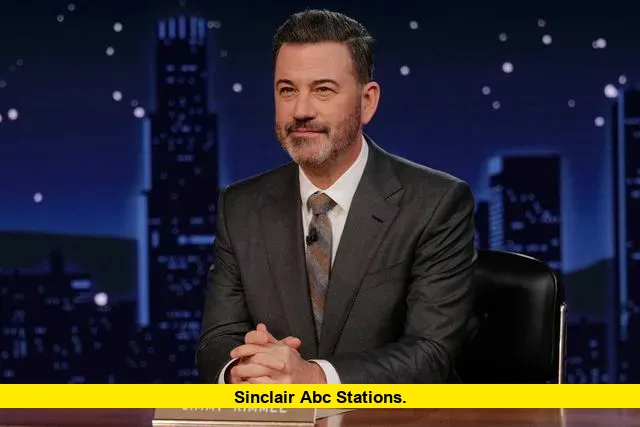
Sinclair ABC stations are making headlines across the country after the company confirmed that its affiliates will not broadcast Jimmy Kimmel Live! even though ABC and Disney have officially returned the show to their late-night lineup. This clash between one of the nation’s largest station owners and a major broadcast network is shaping up to be one of the most high-profile disputes in years, with millions of viewers left in the middle.
Table of Contents
What Triggered the Controversy
The situation erupted on September 15 when Jimmy Kimmel made remarks during his monologue about the assassination of conservative activist Charlie Kirk. The comments, seen by critics as deeply inappropriate, immediately sparked outrage. Political figures condemned the monologue, advocacy groups demanded accountability, and regulators weighed in on whether such commentary belonged on public airwaves.
In response to the uproar, ABC suspended Jimmy Kimmel Live! on September 17. The suspension signaled that Disney, which owns ABC, was taking the matter seriously. For nearly a week, viewers tuning in after the nightly news were greeted with replacement programming while executives deliberated behind the scenes.
By September 23, ABC announced the show’s reinstatement, returning it to the network’s schedule nationwide. However, that decision did not automatically guarantee the show’s return to local screens. Affiliates such as Sinclair still had the power to decide whether to carry the program — and Sinclair made its position crystal clear.
Sinclair’s Response: Firm Conditions
Sinclair Broadcast Group, which owns or operates 38 ABC affiliates, said it would not put Jimmy Kimmel Live! back on the air unless certain requirements were met. Instead, Sinclair ABC stations would air expanded news programming or other alternatives in the late-night slot.
According to company leaders, ABC’s suspension was insufficient. They argued that accountability should go beyond temporary removal and should include concrete steps to repair the damage caused. To that end, Sinclair issued three demands:
- A public apology from Jimmy Kimmel directly to the family of Charlie Kirk.
- A personal financial donation from Kimmel to the Kirk family and to Turning Point USA, the organization Kirk founded.
- Formal discussions with ABC to ensure that future programming adheres to higher standards of professionalism and accountability.
Executives have emphasized that these conditions are non-negotiable. Until they are satisfied, Sinclair ABC stations will not return Jimmy Kimmel Live! to their schedules.
The Reach of Sinclair ABC Stations
The blackout has a major impact because Sinclair is one of the most influential station groups in the country. Its ABC affiliates cover large and mid-sized markets, ensuring that millions of Americans depend on them for network programming.
Markets affected include:
- Washington, D.C. – a politically significant area where network decisions are closely scrutinized.
- Seattle, Washington – a large West Coast market with a diverse viewership.
- Portland, Oregon – another major Pacific Northwest city impacted by the decision.
- Birmingham, Alabama – representing Sinclair’s influence across southern markets.
- Smaller regional markets in the Midwest and South that rely heavily on Sinclair-owned ABC affiliates for local news and entertainment.
In total, Sinclair’s ABC stations represent a substantial slice of ABC’s national reach. When combined with Nexstar Media Group, which has also chosen to keep Jimmy Kimmel Live! off its affiliates, nearly one-quarter of the network’s U.S. household coverage is affected. That makes this dispute more than a local issue — it is a nationwide broadcast battle.
Viewer Reactions and Frustrations
Audiences in Sinclair markets were expecting to see Jimmy Kimmel Live! return after ABC’s announcement. Instead, they were met with local news segments or replacement shows. The result has been widespread frustration, particularly among longtime fans of Kimmel.
Viewers have taken to social media platforms to express confusion and anger. Many complain that they are caught between corporate disputes and have little say in the matter. Others question why they should miss out on network programming simply because their local affiliate refuses to broadcast it.
Sinclair has defended its decision by citing community standards. Executives argue that viewers deserve sensitivity and respect, especially when commentary touches on tragic events. They say the replacement of Jimmy Kimmel Live! with news content better reflects their responsibility to the communities they serve.
Broader Industry and Regulatory Issues
The fight between Sinclair and ABC goes beyond one show. It highlights the power dynamics between national networks and local affiliates.
Network vs. Affiliate Power
ABC, like other major networks, produces content intended for nationwide audiences. But affiliates are not required to carry every program. They can preempt shows if they believe the content violates local standards or conflicts with community expectations.
This autonomy allows affiliates to tailor programming to their markets. However, it also creates conflicts when local values clash with national decisions. The current dispute demonstrates just how disruptive those conflicts can be, especially when they involve a show as high-profile as Jimmy Kimmel Live!.
Regulatory Concerns
The Federal Communications Commission has been watching closely. Its chair has publicly signaled that broadcasters could face scrutiny for airing content deemed offensive. Sinclair has used this as part of its justification, arguing that affiliates need clearer regulatory authority to decide whether to carry controversial programming.
The episode raises broader questions: How much freedom should networks have in setting national content? How much power should affiliates wield in deciding what airs locally? And what role should federal regulators play in overseeing these disputes?
What Comes Next
The immediate question is whether Jimmy Kimmel will respond to Sinclair’s demands. If he issues an apology and makes the requested donations, the company may reconsider its stance. However, Kimmel’s decision carries risks, as any public statement could be seen as setting a precedent for future controversies.
At the same time, ABC and Disney must decide how to handle their relationship with affiliates. Will they pressure Sinclair to fall in line with the network’s programming? Or will they allow affiliates to chart their own course, even if it fractures national viewership?
The FCC may also become more involved if the standoff continues. If regulators decide that preemptions undermine public access to network programming, new rules could be introduced to limit affiliate autonomy in cases like this.
Why This Matters to Viewers
The dispute may feel distant to some, but for viewers in affected markets, the impact is immediate and tangible. Instead of the network’s regular late-night programming, they are receiving a different schedule determined by local affiliates.
It also illustrates a bigger truth about American broadcasting: what viewers see on their screens often depends as much on local station owners as on the networks themselves. Even in a digital age where streaming offers alternatives, millions still rely on their local ABC affiliate for programming.
Final Perspective
The ongoing conflict between Sinclair ABC stations and Jimmy Kimmel Live! is more than a dispute over one late-night show. It is a case study in how local affiliates, national networks, and regulators all intersect in shaping American media.
Until there is a resolution, viewers in Sinclair markets will continue to miss the show, highlighting just how much influence station groups hold over the national television experience. Whether this ends with an apology, a policy shift, or a prolonged standoff, the outcome will likely set precedent for how future conflicts between affiliates and networks are handled.
Do you think Sinclair ABC stations are right to keep the show off the air, or should viewers have the final say? Share your thoughts below.

