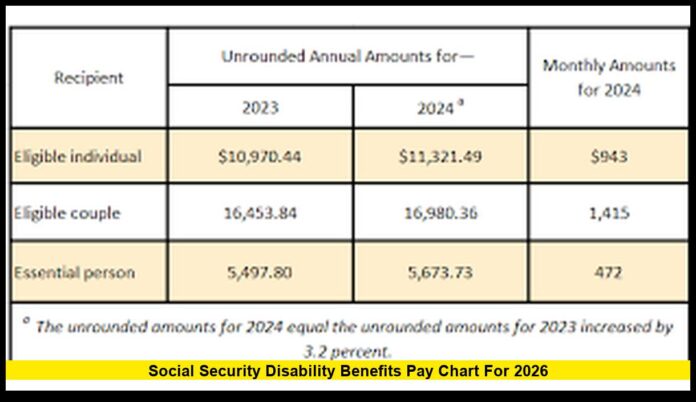
Social Security disability benefits pay chart figures have been updated for 2026, reflecting the 2.5% cost-of-living adjustment that took effect in January. These new amounts affect both Social Security Disability Insurance (SSDI) and Supplemental Security Income (SSI) recipients across the United States.
If you receive disability benefits or plan to apply this year, understanding the current payment structure is essential. While Social Security does not publish a simple flat-rate chart for SSDI because payments depend on work history, there are clear maximums, averages, and federal SSI limits in place as of February 2026.
Here is a complete, accurate breakdown of what disability beneficiaries can expect this year.
Table of Contents
2026 Cost-of-Living Adjustment (COLA)
In January 2026, Social Security beneficiaries received a 2.5% COLA increase.
This adjustment applies to:
- SSDI beneficiaries
- SSI recipients
- Retired workers
- Survivor beneficiaries
The COLA ensures that monthly payments keep pace with inflation trends measured in the prior year.
All payment figures below reflect the 2026 updated amounts.
SSDI Payment Amounts in 2026
SSDI payments vary based on your earnings record before becoming disabled. The Social Security Administration calculates benefits using your average indexed monthly earnings.
Maximum SSDI Benefit in 2026
- Maximum monthly SSDI benefit: $3,822
Only individuals with a long history of high earnings reach this maximum.
Average SSDI Payment in 2026
- Average monthly SSDI benefit: Approximately $1,550
Actual payments vary widely depending on lifetime earnings.
How SSDI Is Calculated
SSDI is not a needs-based program. It is an insurance benefit funded through payroll taxes.
The SSA calculates benefits by:
- Reviewing your highest-earning years.
- Applying a formula to determine your Primary Insurance Amount (PIA).
- Adjusting for cost-of-living increases.
Your payment amount depends entirely on your work record.
Two people with different earnings histories will receive different SSDI amounts.
SSDI Payment Examples
Here are sample scenarios to illustrate the range:
| Work History Level | Estimated Monthly Benefit (2026) |
|---|---|
| Low lifetime earnings | $900–$1,200 |
| Moderate earnings | $1,300–$1,800 |
| High earnings | $2,000–$3,000+ |
| Maximum qualifying earnings | Up to $3,822 |
These examples reflect typical outcomes but vary by individual record.
SSI Payment Amounts in 2026
SSI differs from SSDI. It is a needs-based program for individuals who are disabled, blind, or age 65+ with limited income and resources.
Federal SSI Payment Limits for 2026
- Individual: $967 per month
- Eligible couple: $1,450 per month
These are federal base rates.
Some states provide additional supplemental payments.
Key Differences Between SSDI and SSI
| Feature | SSDI | SSI |
|---|---|---|
| Based on work history | Yes | No |
| Income/resource limits | No | Yes |
| Funded by payroll taxes | Yes | No |
| Federal maximum (2026) | $3,822 | $967 individual |
Understanding this difference is critical when reviewing the social security disability benefits pay chart for 2026.
Substantial Gainful Activity (SGA) Limits for 2026
Disability eligibility also depends on income from work.
For 2026:
- Non-blind individuals: $1,620 per month
- Blind individuals: $2,700 per month
If you earn more than the SGA limit, you generally do not qualify for disability benefits unless you are in a trial work period.
These limits increased with wage growth.
Trial Work Period in 2026
SSDI recipients may test their ability to work through a Trial Work Period (TWP).
For 2026:
- Any month with earnings above $1,160 counts as a trial work month.
- You can have up to nine trial work months within a rolling 60-month period.
During the trial work period, you continue receiving full SSDI benefits regardless of earnings.
After completing the trial period, different rules apply.
Family Benefits for SSDI Recipients
Family members may also qualify for benefits based on a disabled worker’s record.
Eligible family members can include:
- Spouses
- Minor children
- Adult children disabled before age 22
Total family benefits typically cannot exceed:
- 150% to 180% of the disabled worker’s benefit amount
The exact percentage depends on SSA calculations.
Medicare Eligibility for SSDI
SSDI recipients become eligible for Medicare after:
- 24 months of disability benefit payments
This waiting period remains in effect in 2026.
Once eligible, beneficiaries enroll in:
- Medicare Part A automatically
- Medicare Part B optionally
Medicare coverage is separate from payment amounts.
How State Supplements Affect SSI
Some states provide additional SSI payments beyond the federal base.
State supplements vary by:
- State of residence
- Living arrangement
- Marital status
Not all states provide additional SSI funds.
Beneficiaries should check their state’s specific supplement rules.
Back Pay and Retroactive Benefits
If approved for disability benefits, you may receive back pay.
For SSDI:
- Benefits begin after a five-month waiting period.
- Retroactive payments may cover up to 12 months prior to application, depending on eligibility.
For SSI:
- Payments begin the month after application approval.
- No retroactive payments apply before the application date.
Back pay can be significant depending on processing time.
Taxes on SSDI Benefits
SSDI benefits may be taxable if your combined income exceeds certain thresholds.
SSI benefits are not taxable.
Combined income includes:
- Adjusted gross income
- Nontaxable interest
- Half of Social Security benefits
Tax rules remain separate from the disability pay chart.
2026 Disability Pay Chart Overview
Here is a simplified summary of key figures:
| Category | 2026 Amount |
|---|---|
| Maximum SSDI | $3,822/month |
| Average SSDI | ~$1,550/month |
| SSI Individual | $967/month |
| SSI Couple | $1,450/month |
| SGA (Non-blind) | $1,620/month |
| SGA (Blind) | $2,700/month |
| Trial Work Threshold | $1,160/month |
These figures reflect current SSA updates.
How to Estimate Your Benefit
You can estimate SSDI benefits by:
- Reviewing your Social Security earnings statement.
- Creating an online SSA account.
- Reviewing your estimated Primary Insurance Amount.
The SSA calculates SSDI using the same formula as retirement benefits, adjusted for disability status.
SSI estimates require reviewing income and resource limits.
Why Payments Differ from Person to Person
There is no universal flat-rate SSDI chart.
Payments differ because:
- Earnings history varies.
- Work credits differ.
- Family members may qualify for auxiliary benefits.
- Some beneficiaries receive state supplements.
The SSA uses individualized calculations for each claim.
Current Status as of February 2026
As of today:
- The 2.5% COLA increase is in effect.
- SSDI maximum benefits are $3,822 per month.
- SSI federal base payments are $967 for individuals.
- SGA limits reflect current wage adjustments.
No additional midyear changes have been announced.
Social Security disability benefits provide critical financial support for millions of Americans. Understanding the updated pay chart helps beneficiaries plan their monthly budgets and evaluate eligibility.
Do you receive SSDI or SSI benefits? Share your experience and stay informed about future Social Security updates.

