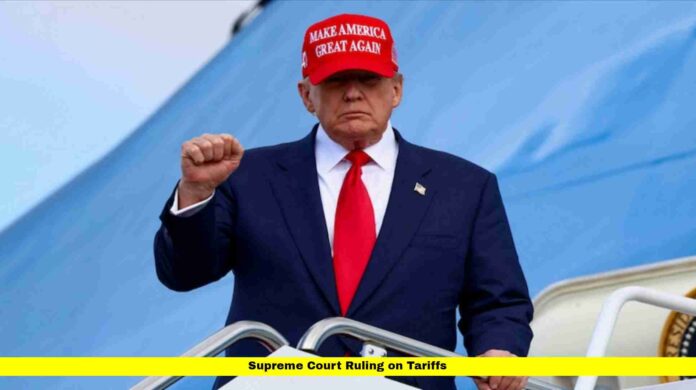
The Supreme Court ruling on tariffs has become one of the most closely watched legal events of 2025. On November 5, 2025, the U.S. Supreme Court heard oral arguments questioning whether the president has the constitutional authority to impose sweeping tariffs on imported goods without direct approval from Congress. The case revolves around the use of the International Emergency Economic Powers Act (IEEPA), which past administrations have cited to justify broad trade actions. The Court’s decision could redefine presidential powers over trade and reshape the future of U.S. economic policy.
Table of Contents
Legal Arguments and Courtroom Dynamics
Inside the Supreme Court, the justices from both conservative and liberal wings voiced strong concerns about the limits of executive authority. Chief Justice John Roberts and Justice Sonia Sotomayor both questioned whether the president could rely on emergency powers to impose tariffs that traditionally fall under Congress’s authority to regulate commerce and taxation.
The administration’s legal team argued that these tariffs were not meant to generate revenue but to serve as regulatory tools for national security and economic balance. However, several justices noted that tariffs, by nature, involve taxation and revenue generation — making them subject to congressional oversight. The debate also touched upon the “major questions doctrine,” a principle suggesting that significant policy decisions with national consequences should come from explicit congressional authorization rather than executive interpretation.
This legal battle has therefore become not only about trade policy but also about the broader balance of power between the executive and legislative branches. If the Court rules that the president exceeded authority, it could place new limits on future administrations seeking to act unilaterally in economic matters.
Economic and Trade Implications
The outcome of the Supreme Court’s decision will have far-reaching implications for both the American economy and global trade. If the tariffs are struck down, the federal government may face pressure to refund billions of dollars collected from importers. The refund process could create logistical chaos and uncertainty across industries that have relied on existing tariff structures.
For importers and manufacturers, a ruling against the tariffs could lead to short-term financial relief. Prices on imported goods might fall, easing inflationary pressures on consumers. However, it could also disrupt long-term contracts and trade strategies developed under the assumption that the tariffs would remain in place.
Conversely, if the Court upholds the tariffs, future presidents may feel emboldened to use emergency powers to impose economic restrictions at will. Such a precedent could destabilize global supply chains and introduce unpredictability into international trade relationships. Companies that depend on stable import and export frameworks may need to prepare for more volatile policy shifts in the years ahead.
Timeline of Key Developments
The case leading to the current Supreme Court hearing has unfolded over several years:
- In May 2025, a federal trade court ruled that the tariffs imposed under IEEPA exceeded presidential authority, declaring parts of the policy unconstitutional.
- By August 2025, the appeals court partially upheld that decision but deferred final enforcement pending Supreme Court review.
- On November 5, 2025, the Supreme Court heard oral arguments, signaling skepticism toward the broad interpretation of executive tariff powers.
- The final ruling is expected by mid-2026 and will likely set a historic precedent for future trade policy.
This timeline highlights how the case has evolved from a dispute between businesses and the federal government into a full-scale constitutional debate that could reshape how the U.S. handles global commerce.
Constitutional Questions Under Review
At the heart of the case are fundamental constitutional issues that determine the boundaries of executive power. The U.S. Constitution explicitly grants Congress the authority to regulate commerce with foreign nations and impose taxes. By invoking IEEPA to impose tariffs, the administration effectively bypassed congressional approval, raising questions about separation of powers.
Another point under review is the interpretation of “national emergency” within the IEEPA framework. The administration claimed that unfair trade practices and global market imbalances constituted an emergency requiring swift executive action. Critics argue that such reasoning stretches the definition of “emergency” beyond its intended scope, allowing the president to bypass normal legislative processes.
If the Court finds that IEEPA does not authorize tariff imposition, it could significantly curtail presidential flexibility in responding to economic threats. On the other hand, a ruling supporting executive discretion could expand presidential power, setting a precedent for future administrations to use similar justifications in unrelated areas like energy, technology, or health care.
Possible Outcomes and Their Impact
If the Supreme Court rules against the tariffs, the federal government may be required to refund billions in collected duties. That would not only strain administrative resources but also force Congress to revisit trade laws to prevent similar overreach in the future. Importers and multinational corporations might seek legal recourse to recover funds, triggering a wave of lawsuits.
From an economic standpoint, striking down the tariffs could temporarily stabilize global markets by reaffirming predictability in U.S. trade policy. However, it may weaken the president’s leverage in trade negotiations, as foreign nations would know that future tariffs require congressional approval.
If the Court upholds the tariffs, the decision would affirm a broad interpretation of presidential authority. This could strengthen the executive branch’s hand in managing trade disputes, allowing faster responses to economic challenges. However, it would also introduce long-term uncertainty for businesses, as future presidents could use the same authority to impose tariffs based on shifting political priorities.
How Businesses and Consumers Are Preparing
Businesses across sectors are closely monitoring the Supreme Court proceedings. Importers, retailers, and manufacturers are conducting impact assessments to prepare for any potential ruling. Some companies have already begun adjusting their supply chains in anticipation of a tariff rollback or continuation.
Consumers, too, could feel the effects. A ruling that eliminates tariffs could lower prices on imported goods such as electronics, clothing, and automobiles. Conversely, maintaining tariffs may continue to drive higher prices in some sectors but could protect domestic industries from foreign competition.
Financial analysts predict short-term market volatility surrounding the Court’s decision. Industries heavily dependent on imports—like automotive, technology, and consumer electronics—may experience stock fluctuations as investors assess how the ruling will affect corporate earnings and trade costs.
Political and International Reactions
The political response to the case has been intense. Lawmakers from both parties are watching closely, as the ruling could influence how Congress approaches future trade legislation. Supporters of strong executive authority argue that presidents need flexibility to act swiftly in defense of national economic interests. Critics counter that unchecked power undermines democratic oversight and risks turning trade policy into a political weapon.
Internationally, the case is being closely followed by major trading partners such as China, Canada, and the European Union. These nations have experienced firsthand the effects of U.S. tariffs and are preparing to recalibrate their trade policies depending on the outcome. A ruling limiting presidential power may restore predictability in global markets, while one expanding it could lead to renewed trade tensions.
Why This Case Matters for the Future
The Supreme Court ruling on tariffs goes far beyond trade policy. It’s about the structure of American governance and how power is balanced between branches of government. The case could redefine the limits of executive action not only in trade but across all areas where the president claims emergency authority.
For business leaders, investors, and citizens, the ruling will clarify how economic emergencies are defined and who ultimately holds the power to shape U.S. trade strategy. It’s a defining test of constitutional interpretation in a modern, interconnected global economy.
Final Thoughts
The nation now awaits the Supreme Court’s landmark decision on presidential tariff authority. Whatever the outcome, the ruling will echo across the worlds of law, politics, and business. It may alter how the United States engages in global commerce and how future presidents exercise power.
The implications stretch far beyond Washington—they affect the cost of everyday goods, the strength of domestic industries, and the stability of international trade. As the Court’s decision approaches, one thing is certain: this ruling will leave a lasting mark on the balance between executive authority and congressional control.
What are your thoughts on this historic case? Share your opinions and discuss how you think the Court’s decision will shape the nation’s future.

