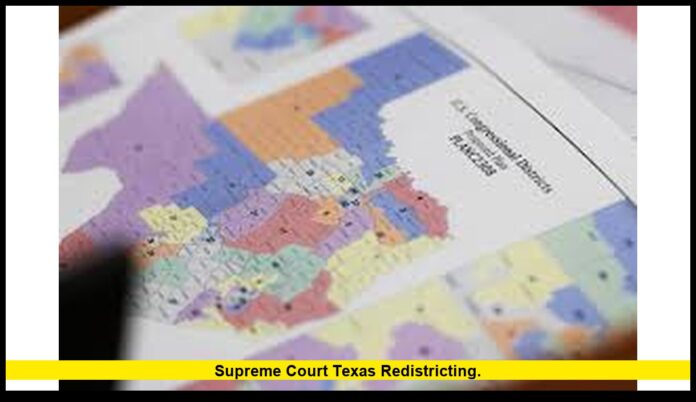
The supreme court texas redistricting battle continues to shape the national conversation as new legal moves from the high court influence how Texas prepares for the 2026 elections. Recent actions have shifted the trajectory of the case, and the political stakes remain intense as voters, lawmakers, and advocacy groups watch closely for the next ruling.
Texas is currently defending its 2025 congressional map, which has drawn major scrutiny after a federal court initially blocked it. A short-term order from the Supreme Court has altered that course, placing the map back into effect while the justices consider next steps. This development has quickly become one of the most consequential election-law stories of the year.
Table of Contents
Background on the Redistricting Dispute
Texas lawmakers approved a new congressional map in 2025 during a special legislative session focused on redrawing district boundaries. The map was designed following updated demographic trends and political data, creating new configurations in metropolitan regions such as Houston, Dallas–Fort Worth, and San Antonio.
Soon after the map’s approval, multiple plaintiffs filed legal challenges, arguing that the plan weakened the voting strength of minority communities. Civil-rights groups claimed the map dismantled coalition districts and reduced electoral opportunities for Black and Hispanic voters. These arguments centered on constitutional protections and federal voting-rights laws.
A three-judge federal panel later issued a preliminary injunction that blocked Texas from using the 2025 map. The court expressed strong concerns over racial gerrymandering and ordered the state to revert temporarily to the 2021 district lines.
Texas, however, immediately appealed the ruling, setting the stage for high-stakes emergency action before the Supreme Court.
Supreme Court’s Emergency Involvement
The Supreme Court became involved after Texas asked the justices to pause the lower-court ruling. A single justice issued a brief administrative stay, restoring the 2025 map while the Court reviews the state’s request in full.
This kind of stay does not indicate how the Supreme Court will ultimately rule. Instead, it serves as a short-term measure to stabilize the election timeline while the Court decides whether to continue pausing the injunction, hear the dispute more formally, or leave the lower-court ruling in place.
For now, the administrative stay means:
- Texas can proceed with preparations using the 2025 map.
- Election administrators must adjust timelines for candidate filings, precinct alignments, and ballot designs.
- Plaintiffs continue preparing additional filings in anticipation of the Court’s next step.
The legal path remains active and far from final, making clarity essential for both voters and state officials.
Why the Map Was Challenged
The disputes around the map focus on major demographic and political shifts across Texas. Plaintiffs argue that specific districts were redrawn in ways that dilute minority voting power. They point to patterns such as:
- Consolidation of minority-majority areas into districts with reduced influence.
- Splitting fast-growing communities to alter likely election outcomes.
- Reducing the number of districts where minority voters historically built successful coalitions.
Texas officials, on the other hand, maintain that the map reflects partisan considerations—something federal courts have limited authority to regulate—and that race did not dominate the design process.
The conflict lies at the intersection of political strategy, demographic change, and long-standing legal standards for discriminatory redistricting.
Implications for the 2026 Elections
The Court’s temporary action carries major implications, especially as the 2026 election cycle approaches:
- Campaigns must adapt fast. Candidates may start organizing donor outreach, volunteer recruitment, and district-based messaging under either the 2025 or 2021 lines depending on upcoming legal shifts.
- Voter education becomes more complex. Changes in district boundaries can move local communities into entirely new political landscapes.
- Local governments must rework logistics. County officials may need to adjust voting-location plans, ballot layouts, and precinct boundaries.
The uncertainty makes planning harder for both major political parties. Shifting district boundaries can influence congressional balance, voter engagement, and campaign strategy.
Legal Questions the Court Must Address
The Supreme Court will consider several legal issues as it decides whether to extend or dissolve the stay:
1. Did race play a predominant role in drawing the 2025 map?
This is the central question in racial-gerrymandering cases. Courts look at demographic data, district shapes, legislative records, and the impact on minority voting ability.
2. How should partisan and racial motives be distinguished?
Texas argues that partisan goals drove the map. Plaintiffs contend race was used intentionally to weaken minority influence. The Court will need to evaluate which factor dominated.
3. Is the preliminary injunction justified?
The justices will weigh whether the lower court had sufficient evidence to block the map before a full trial.
4. How does timing affect the ruling?
With the 2026 elections approaching, the Court often considers whether voters and administrators can manage changes without confusion or disruption.
These questions will guide the justices as they determine whether to expand their intervention or allow the lower-court decision to take effect once again.
Political Landscape and National Influence
Texas continues to shape national politics due to its size, population growth, and expanding representation in Congress. The outcome of the redistricting dispute could influence:
- How many competitive seats each party has in the upcoming elections
- Minority representation in key metropolitan regions
- Long-term strategies for both major political parties
Because Texas adds seats with each census period, legal disputes around its districts often foreshadow similar conflicts in other states. National observers view this case as a critical marker for how the courts treat racial-gerrymandering claims in evolving demographic environments.
What Comes Next
In the coming weeks, the Supreme Court will either extend the administrative stay, lift it, or choose yet another option such as requesting more briefing. Any decision will immediately influence election preparation across Texas.
The case will continue to develop as both sides submit additional filings, gather evidence, and prepare for further judicial review. While the legal path remains uncertain, the stakes for voters, campaigns, and communities across Texas remain extremely high.
The supreme court texas redistricting issue will stay at the center of national attention, shaping election planning and sparking debate on how districts should reflect the state’s changing population.
Share your thoughts below and tell us how these developments affect your expectations for the 2026 elections.

