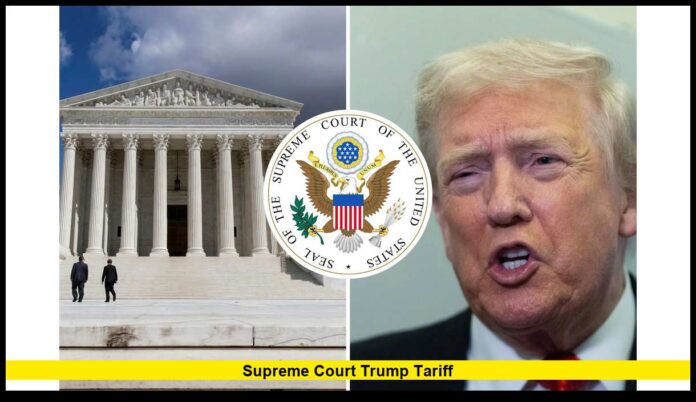
The Supreme Court Trump Tariff case has captured national attention as the justices deliberate on whether former President Donald Trump lawfully imposed sweeping global tariffs under the International Emergency Economic Powers Act (IEEPA) without congressional approval. The outcome of this case could reshape how much power presidents hold in making unilateral trade decisions.
Table of Contents
Background of the Case
President Trump invoked the IEEPA, a law passed in 1977 to manage national emergencies involving foreign threats, to justify broad tariffs on imported goods. His administration imposed a baseline 10% tariff on most imports, arguing that persistent trade deficits posed a national security threat.
Later, additional tariffs were levied on countries such as China, Mexico, and Canada, with the administration citing national emergencies related to illegal drug trafficking and economic imbalances. These tariffs generated billions in revenue but drew strong criticism from trade groups, economists, and political leaders across both parties.
Lower courts had ruled that Trump’s use of IEEPA in this manner exceeded presidential authority. The courts found that the law did not give presidents the power to impose new tariffs on such a global scale without explicit congressional authorization. The case eventually reached the Supreme Court, now consolidated under Learning Resources v. Trump, where it is being reviewed in the 2025–26 term.
Key Legal Questions
The Supreme Court is now considering several constitutional and statutory questions that go to the heart of presidential authority:
- Does IEEPA authorize the president to impose tariffs?
The statute allows the president to regulate importation during emergencies, but it never explicitly mentions tariffs. The question is whether this “regulation” includes setting new taxes on imports. - Does IEEPA grant too much power to the executive branch?
Critics argue that such a broad interpretation of IEEPA violates the “non-delegation doctrine,” which holds that Congress cannot transfer its core legislative functions — such as taxation and trade — to the executive branch without clear limits. - What counts as a legitimate national emergency?
Another major issue is whether economic imbalances or drug trafficking qualify as an “unusual and extraordinary threat,” which is required for an IEEPA declaration.
Why the Case Matters
This case is one of the most important tests of executive power in decades. Its implications extend far beyond trade policy and could affect how presidents respond to future crises.
- Presidential Power:
A ruling upholding Trump’s tariffs would dramatically expand the president’s authority to act unilaterally in economic matters, potentially allowing future administrations to impose tariffs or other economic restrictions without Congress. - Congressional Oversight:
If the Court rules against Trump’s interpretation, it could reaffirm Congress’s central role in trade and tax policy, reinforcing the balance of powers between the branches of government. - Economic Impact:
The tariffs in question have generated roughly $89 billion in revenue but have also raised costs for American consumers and businesses. Many analysts estimate the measures increased household expenses by thousands of dollars annually through higher prices on imported goods. - Global Trade Relations:
The case also carries major international implications. A decision supporting Trump could encourage similar moves by other countries and escalate trade tensions. Conversely, a ruling limiting presidential power might reassure global partners that U.S. trade policy remains predictable and rooted in legislative authority.
Current Status and Timeline
The Supreme Court heard oral arguments on November 5, 2025. During the session, several justices expressed skepticism about granting presidents unlimited trade powers. Questions from the bench focused on whether Trump’s emergency declarations stretched IEEPA beyond its intended scope.
Chief Justice John Roberts and Justice Amy Coney Barrett both raised concerns about the lack of limiting principles in Trump’s approach, while Justice Sonia Sotomayor questioned whether trade deficits could ever constitute a national emergency.
A final decision is expected by summer 2026, and its impact is anticipated to ripple across the political, legal, and economic landscape.
Implications for U.S. Families and Businesses
- Household Costs:
The tariffs have driven up prices on everyday items — from electronics and clothing to automobiles and food products. Studies estimate that the average U.S. household could be paying an additional $2,000 to $2,400 annually due to tariff-related price increases. - Business Uncertainty:
Many small businesses, particularly importers and retailers, have struggled with unpredictable price swings and supply-chain complications. Larger corporations have largely adapted but warn that the uncertainty surrounding trade policy makes long-term planning difficult. - Employment and Manufacturing:
While some manufacturing sectors benefited temporarily from the tariffs, many others saw production costs rise due to higher prices on imported components. Economists note that job gains in protected industries were often offset by losses elsewhere. - Foreign Relations:
Countries affected by the tariffs, including China, the European Union, and Mexico, have implemented retaliatory measures. The Supreme Court’s ruling will influence how these nations approach future trade negotiations with the United States.
What to Watch For Next
As the Court deliberates, key developments to monitor include:
- Whether the justices uphold IEEPA as a valid legal foundation for tariffs.
- How the Court applies doctrines like “major questions” or “non-delegation” to limit executive authority.
- Whether the ruling includes financial remedies, such as refunding tariffs or invalidating certain orders.
- The potential for Congress to revise trade laws to clarify limits on presidential power.
- Market reactions and international responses once the verdict is announced.
Summary Table
| Issue | Description |
|---|---|
| Law in Question | International Emergency Economic Powers Act (IEEPA, 1977) |
| President Involved | Donald Trump |
| Primary Action | Imposition of 10% global tariff + country-specific measures |
| Legal Principles Tested | Non-delegation doctrine, major questions doctrine, separation of powers |
| Economic Scale | Estimated $89 billion in tariff revenue |
| Current Stage | Oral arguments heard; ruling expected summer 2026 |
Broader Significance
Beyond its immediate trade implications, the Supreme Court Trump Tariff case will likely influence how the courts interpret executive emergency powers across multiple areas — including national security, technology, and energy policy.
If the Court limits presidential authority, future administrations may need Congress’s explicit consent for major economic actions. If it upholds Trump’s tariffs, it could grant presidents a powerful tool to reshape the U.S. economy through emergency declarations alone.
This decision will define the boundaries of executive power for years to come — stay tuned and share your thoughts below on how it could impact America’s future.

