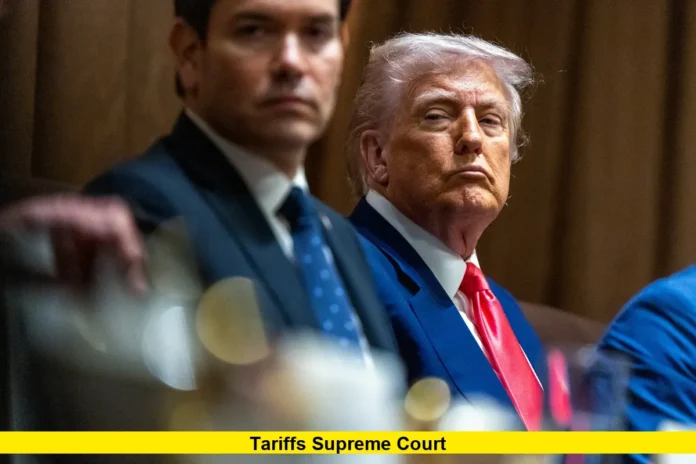
The tariffs supreme court showdown is reaching its climax as the highest court in the United States prepares to issue a pivotal decision this week on the legality of sweeping import taxes imposed by former President Donald Trump under a controversial interpretation of emergency powers. This ruling, expected as early as today, stands to alter the balance of executive authority over trade, affect global commerce, impact billions in federal revenues, and potentially trigger massive tariff refunds.
As Americans, businesses, and international markets watch with mounting anticipation, the stakes could not be higher. The case has crystallized into a defining constitutional question of presidential power and statutory limits — and its ramifications extend far beyond Wall Street and Capitol Hill.
Table of Contents
What the Supreme Court Is Deciding
At the center of the dispute is whether the president had constitutional and statutory authority to impose broad tariffs without explicit congressional approval. The tariffs were enacted under the International Emergency Economic Powers Act (IEEPA), a 1977 law originally intended for national security emergencies. The Trump administration argued that persistent trade imbalances and other economic concerns, including drug trafficking, justified use of IEEPA to impose tariffs on imports from nearly all trade partners.
Lower courts have ruled that the president exceeded his authority by employing IEEPA for trade tariffs. Now, the Supreme Court must decide whether those rulings will stand. Justices heard oral arguments in November 2025 and showed skepticism from across ideological lines about the breadth of presidential power invoked. The court scheduled an opinion day this week, signaling that a decision could be released imminently.
This case is not merely technical; it strikes at the core of how U.S. trade policy is conducted and who controls that authority — the executive branch or Congress.
Why This Ruling Matters to Every American
Impact on Federal Revenue and the Economy
The tariffs in question have already generated tens of billions of dollars in revenue. Treasury officials noted that monthly customs duties surged dramatically following the tariffs’ implementation, quadrupling compared with early 2025 figures. If the court rules these tariffs unlawful, the government could be on the hook for refunding up to $150 billion to affected importers.
To prepare for this possibility, U.S. Customs and Border Protection has shifted to a fully electronic tariff refund system, moving away from paper checks to handle potential high-volume reimbursements. This change aims to streamline processing and reduce fraud, though trade lawyers warn that even with digital systems in place, refund claims may take years to resolve.
Who Is Challenging the Tariffs
The legal challenges are sweeping and widespread:
- Over 1,000 companies, including major firms across sectors, have sued to recover tariffs they were compelled to pay under the contested regime.
- Lawsuits were also brought by coalition groups of states and businesses claiming injury from lost market access and increased supply chain costs due to the tariffs.
If the Supreme Court upholds the lower courts’ judgments, these companies could see significant financial relief. However, procedural complexities such as who qualifies for refunds and how payments are made remain unresolved and likely to trigger further legal disputes.
Market Reaction and Financial Stakes
Financial markets are already pricing in possible outcomes:
- Betting markets and prediction platforms indicate a high probability that the Supreme Court will rule against maintaining the tariffs.
- Retail and consumer stocks have climbed in anticipation of tariff removal, as lower import duties could reduce costs for major retailers and benefit consumer spending.
- Conversely, stocks in sectors dependent on tariff protections could face volatility if the tariffs are struck down.
Investors are monitoring the situation closely, with traders reacting not just to the legal questions but to projections of fiscal impact and policy shifts.
Government and Administration Responses
Officials in the Trump administration have defended the tariffs as an essential tool for negotiating trade advantages and protecting U.S. interests. Treasury leadership has stressed that even if the court limits emergency tariff powers, alternative mechanisms exist for imposing trade duties, though these might require different procedures and timelines.
The administration’s broader economic strategy has leaned heavily on tariff-generated revenue, with proposals to use such income for initiatives like tax rebates to citizens. A ruling against the tariffs could therefore force a reevaluation of fiscal planning and trade enforcement strategies.
International Implications
The global trade landscape has already felt the impact of these tariffs:
- Several countries and trading blocs, including major partners in Europe and Asia, entered negotiations with the United States for tariff reductions in exchange for investment or market access.
- Some trading nations have instituted reciprocal measures or challenged U.S. tariffs in international forums.
A Supreme Court decision invalidating the tariffs could alter these dynamics, potentially opening the door for renewed negotiation and more stable trade relationships.
What Happens Next
Depending on how the Supreme Court rules:
- If the tariffs are upheld, the executive branch would retain broad discretion under IEEPA to impose similar trade measures in the future, with significant political and economic consequences.
- If struck down, the decision would likely limit executive authority in trade matters and potentially shift power back to Congress for setting tariff policy.
Either outcome is expected to trigger further legal and legislative developments, as policymakers, companies, and courts navigate the aftermath of this landmark ruling.
The Broader Constitutional Question
Beyond trade and economics, the case is a major test of the separation of powers. By weighing in on the scope of presidential authority under a decades-old statute, the Supreme Court could establish a precedent that shapes American governance and executive action for years to come.
The nation’s highest court has rarely tackled a question with such sweeping implications for economic and foreign policy, making this decision one of the most consequential in recent memory.
What do you think this Supreme Court decision will mean for American trade and presidential power? Share your thoughts below and stay tuned for updates as the events unfold.

