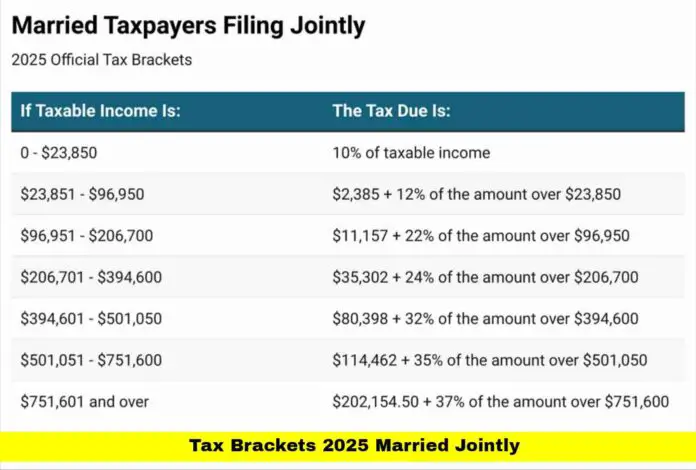
For the 2026 tax year, married couples filing jointly benefit from higher federal income tax bracket thresholds and a larger standard deduction, both adjusted for inflation to reduce the impact of bracket creep. While the seven marginal tax rates remain unchanged, more income can now be earned before moving into each higher bracket, allowing a greater portion of household earnings to be taxed at lower rates and improving overall tax efficiency compared with the prior year.
Table of Contents
LATEST CHANGES TO TAX BRACKETS FOR MARRIED FILING JOINTLY IN 2026
Federal income tax in 2026 continues to operate under the same seven marginal tax rates—10%, 12%, 22%, 24%, 32%, 35%, and 37%—but the income ranges attached to each bracket have again been increased for inflation, helping taxpayers avoid paying higher rates simply because of cost-of-living wage increases rather than real gains in income. For married couples filing jointly, all income thresholds are higher in 2026 than they were in 2025, meaning more income is taxed at lower rates before moving into higher brackets.
In 2026, the 10% rate now applies to taxable income up to $24,800 for joint filers, the 12% rate stretches up to $100,800, and the 22% rate extends to $211,400. Above these amounts, the 24% bracket reaches $403,550, the 32% bracket goes up to $512,450, and the 35% bracket covers income up to $768,700 before the top rate applies.
One of the most notable changes for this tax year is the top 37% marginal rate, which doesn’t begin until taxable income exceeds $768,700 for married couples filing jointly, a higher threshold than in the prior year and one that allows more of a couple’s income to be taxed at the 35% rate before hitting the highest bracket.
Although the tax rate percentages themselves remain unchanged, the expanded thresholds in 2026 mean that couples filing jointly can earn more income before facing higher marginal tax rates, reducing the effect of “bracket creep” and helping preserve real purchasing power.
KEY POINTS SUMMARY
⚡ Quick Snapshot for Fast Readers
- 💰 Seven federal tax brackets stay the same, but income ranges increased
- 📈 Higher income thresholds mean less income taxed at top rates
- 💡 Standard deduction increased to $30,000 for joint filers
- 📊 Top 37% bracket now starts at $751,600
- 🧮 Most families will see lower effective tax rates
2026 Tax Brackets — Married Filing Jointly
| Tax Rate | Taxable Income (Married Filing Jointly) |
|---|---|
| 10% | $0 to $24,800 |
| 12% | $24,801 to $100,800 |
| 22% | $100,801 to $211,400 |
| 24% | $211,401 to $403,550 |
| 32% | $403,551 to $512,450 |
| 35% | $512,451 to $768,700 |
| 37% | Over $768,700 |
Each bracket applies only to the portion of income that falls within that range, not to your entire taxable income.
HOW TAXABLE INCOME IS CALCULATED IN 2026
Taxable income is the figure the IRS uses to determine which federal tax brackets apply to your household for the 2026 tax year. It represents the portion of your total earnings that is actually subject to federal income tax after permitted deductions and adjustments are taken into account.
The process begins with your gross income, which includes all sources of earnings such as wages and salaries, self-employment income, bonuses, interest, dividends, rental income, and certain capital gains. This is your total income before any reductions.
From there, the IRS allows specific adjustments to income, often called “above-the-line” deductions, to arrive at your Adjusted Gross Income (AGI). These may include contributions to retirement accounts, student loan interest, health savings account contributions, and qualifying business expenses. AGI is a critical benchmark because eligibility for many credits and deductions is based on this number.
After calculating AGI, you subtract either the standard deduction or your itemized deductions, whichever is larger. Most married couples filing jointly use the standard deduction because it is higher and simpler than itemizing.
For the 2026 tax year, the standard deduction for married couples filing jointly is $31,200 (reflecting inflation adjustments). This means the first $31,200 of income is not subject to federal income tax. Only income above this amount moves on to the tax-bracket calculation.
Once these steps are completed, the remaining amount is your taxable income. This final figure is what gets applied to the federal marginal tax brackets, with portions of income taxed progressively at increasing rates as your income rises.
STANDARD DEDUCTION IMPACT FOR MARRIED JOINTLY FILERS IN 2026
The standard deduction continues to play a major role in reducing taxable income for married couples filing jointly, and its higher level in 2026 further increases the amount of income shielded from federal taxes. By automatically excluding a significant portion of earnings from taxation, the standard deduction lowers the starting point at which federal tax brackets begin to apply.
For the 2026 tax year, married couples filing jointly receive a $31,200 standard deduction without needing to itemize expenses. This deduction is applied before any tax brackets are considered, meaning the first $31,200 of income is not subject to federal income tax at all. Only income above this level is treated as taxable and exposed to marginal tax rates.
This larger deduction is particularly valuable for couples whose household income falls near the edge of a higher tax bracket. Because taxable income is reduced upfront, some families may remain in a lower marginal bracket even if their gross income has risen from the previous year. In effect, the higher standard deduction helps prevent inflation-driven pay increases from pushing income into higher tax rates.
Beyond its tax-saving impact, the standard deduction also simplifies the filing process while delivering meaningful financial benefit. For many married couples, it exceeds the value of itemized deductions and remains one of the most effective tools for lowering taxable income. When combined with the inflation-adjusted tax brackets for 2026, the increased standard deduction allows couples to keep more of their earnings and reduces the portion of income exposed to higher federal tax rates.
2025 vs. 2026 Federal Tax Brackets Comparison — Married Filing Jointly
| Tax Rate | 2025 Income Range | 2026 Income Range | Increase |
|---|---|---|---|
| 10% | $0 – $23,850 | $0 – $24,800 | +$950 |
| 12% | $23,851 – $96,950 | $24,801 – $100,800 | +$3,850 |
| 22% | $96,951 – $206,700 | $100,801 – $211,400 | +$4,700 |
| 24% | $206,701 – $394,600 | $211,401 – $403,550 | +$8,950 |
| 32% | $394,601 – $501,050 | $403,551 – $512,450 | +$11,400 |
| 35% | $501,051 – $751,600 | $512,451 – $768,700 | +$17,100 |
| 37% | Over $751,600 | Over $768,700 | +$17,100 |
This comparison shows how inflation adjustments for 2026 pushed every bracket threshold higher than in 2025, allowing married couples filing jointly to earn more income at lower tax rates before moving into the next marginal bracket and further reducing the impact of bracket creep.
WHY THESE CHANGES MATTER FOR COUPLES IN 2026
The 2026 inflation-adjusted tax brackets and higher standard deduction provide greater predictability, reduce the risk of surprise tax increases, and support more effective long-term financial planning for married households.
Because income thresholds are higher than in 2025, a larger share of your household earnings is taxed at lower marginal rates, even if your pay rose slightly due to cost-of-living adjustments or career growth. This helps prevent “bracket creep,” where inflation alone pushes income into higher tax rates.
With less income exposed to the upper brackets, many married couples may see a modest but meaningful reduction in their overall federal tax liability. The benefit is especially noticeable for households with incomes near major bracket cutoffs, where even small shifts in thresholds can keep thousands of dollars taxed at lower rates.
Couples earning in the upper-middle and higher-income ranges often gain the most from these adjustments, as expanded brackets allow more income to remain below the 32%, 35%, or 37% marginal rates. At the same time, middle-income households can also benefit, as the combined effect of higher bracket limits and a larger standard deduction can translate into several hundred dollars in tax savings.
These changes help offset the impact of inflation, ensuring that routine raises or cost-of-living increases do not automatically lead to higher taxes. Knowing where your taxable income falls within the updated 2026 brackets also allows for smarter planning around bonuses, capital gains, retirement contributions, and the timing of income and deductions, helping couples manage their tax burden more strategically.
STRATEGIES TO LOWER TAXES AS MARRIED FILING JOINTLY IN 2026
Smart tax planning becomes even more valuable under the updated 2026 tax brackets and higher standard deduction. By using deductions, credits, and timing strategies effectively, married couples can reduce taxable income and keep more of their earnings taxed at lower marginal rates.
Defer income when possible
If your household income is close to crossing into a higher tax bracket, postponing bonuses, commissions, or self-employment income until the following year can help keep that income from being taxed at a higher rate.
Maximize retirement contributions
Contributing the maximum allowed to tax-advantaged accounts such as 401(k)s, traditional IRAs, and SEP IRAs lowers taxable income dollar for dollar. These contributions not only reduce exposure to higher tax brackets but also strengthen long-term retirement savings.
Take full advantage of tax credits
Credits like the Child Tax Credit and other family-related credits directly reduce the tax you owe, not just your taxable income. For eligible couples, credits can result in substantial savings even if gross income remains the same.
Deduct eligible expenses
If itemizing exceeds the standard deduction, expenses such as mortgage interest, property taxes, state and local taxes, medical costs, education expenses, and charitable donations can further reduce taxable income and help keep earnings in lower brackets.
Coordinate income between spouses
When one spouse has variable or self-employment income, careful planning of when income is received and when deductions are claimed can smooth total household income and reduce exposure to higher marginal rates.
Monitor bracket thresholds before year-end
Tracking taxable income throughout the year allows couples to adjust retirement contributions, charitable giving, or income timing before December 31, rather than discovering missed opportunities during tax season.
Even modest planning moves can have a meaningful impact. By keeping more income within lower tax brackets and fully using available deductions and credits, married couples filing jointly can reduce overall federal tax liability and improve their financial position under the 2026 tax rules.
HOW THE BRACKETS ACTUALLY APPLY TO YOUR INCOME (2026)
Federal income tax brackets are progressive, meaning your income is taxed in layers rather than at one single flat rate. Different portions of your taxable income are taxed at different rates as they move upward through the brackets.
For married couples filing jointly in 2026, the first portion of taxable income is taxed at the 10% rate.
After that range is filled, the next portion is taxed at 12%.
Income above that level moves into the 22% bracket, followed by higher rates only as income continues to increase through the remaining brackets.
This pattern continues across all seven tax brackets, but only the income that falls inside each specific range is taxed at that bracket’s rate.
For example, if a married couple filing jointly has $150,000 in taxable income in 2026, they do not pay 22% on the full amount. Only the portion of income above $100,800 (the top of the 12% bracket for 2026) is taxed at the 22% rate. The earlier portions are taxed at 10% and 12%, respectively.
This is why most households end up with an effective tax rate that is lower than their highest marginal tax rate. Even when part of your income reaches a higher bracket, most of your earnings are still taxed at lower rates, keeping the overall tax burden lower than many people expect.
LEGISLATIVE BACKGROUND FOR THE 2025 TAX BRACKETS
The federal income tax system in place for 2025 is rooted in the Tax Cuts and Jobs Act (TCJA), which established the current seven-bracket structure with marginal rates of 10%, 12%, 22%, 24%, 32%, 35%, and 37%. Under existing law, these individual income tax provisions are temporary and are scheduled to expire after the end of 2025.
If Congress does not act, the tax code will revert in 2026 to the pre-TCJA rate structure, which features different bracket thresholds and generally higher marginal rates for many taxpayers. This potential shift is one of the most significant upcoming changes in U.S. tax policy and creates uncertainty for households planning beyond 2025.
While the rate structure itself remains unchanged for 2025, the income thresholds for each bracket continue to be adjusted annually for inflation. These adjustments are intended to prevent “bracket creep,” ensuring that taxpayers are not pushed into higher marginal rates solely due to cost-of-living increases.
For married couples filing jointly, the temporary nature of the current system makes long-term planning especially important. Retirement contributions, investment strategies, income timing, and major financial decisions must be considered with the possibility that marginal rates could rise beginning in 2026 if the current law sunsets.
Overall, the 2025 tax brackets represent the final year—under current legislation—of the TCJA rate structure. While inflation adjustments provide short-term relief and stability, the scheduled expiration of these provisions means that future tax policy decisions by Congress could significantly reshape how married couples’ income is taxed in the years ahead.
EXAMPLES OF TAX BILLS FOR DIFFERENT INCOME LEVELS (2026, MARRIED FILING JOINTLY)
These examples illustrate how taxable income is spread across multiple marginal brackets rather than being taxed at a single flat rate.
Example 1: Couple with $120,000 in taxable income
First $24,800 taxed at 10%
$24,801–$100,800 taxed at 12%
$100,801–$120,000 taxed at 22%
Result: Approximately $13,800–$14,100 in federal income tax before credits.
Even though part of their income reaches the 22% bracket, most of it is still taxed at 10% and 12%, keeping the overall effective rate much lower than 22%.
Example 2: Couple with $450,000 in taxable income
Portions of income are taxed at:
10%, 12%, 22%, 24%, 32%, and part of the 35% bracket
Effective tax rate: roughly 22%–23%
Result: Approximately $100,000–$105,000 in federal income tax before deductions and credits.
TTIPS TO AVOID TAX SURPRISES
Avoiding unexpected tax bills starts with staying informed and proactive throughout the year, especially as income and tax rules change.
Track your taxable income, not just gross income
Gross income doesn’t account for deductions, adjustments, or retirement contributions. Monitoring your taxable income gives a clearer picture of where you actually fall within the tax brackets and helps prevent surprises at filing time.
Adjust tax withholdings when income changes
If you receive a raise, bonus, side income, or experience a change in household earnings, updating your withholding can help ensure enough tax is paid during the year. This is particularly important for couples with uneven or variable income.
Estimate your taxes early using current-year brackets
Running projections with the latest tax brackets allows you to see your potential tax liability before the year ends. Early estimates give you time to increase retirement contributions, defer income, or make other adjustments.
Pay attention to bracket thresholds
When your taxable income is close to entering a higher bracket, small planning moves—such as timing bonuses, capital gains, or deductible expenses—can influence how much of your income is taxed at higher rates.
Consider professional guidance when needed
Couples with complex finances or income near major bracket cutoffs may benefit from working with a tax professional. Expert advice can help identify planning opportunities and avoid costly mistakes.
Being proactive rather than reactive can make a significant difference. Regular check-ins throughout the year help ensure that tax season arrives without unpleasant surprises.
OTHER FACTORS THAT AFFECT YOUR TAX BILL
While federal income tax brackets are a major driver of what you owe, they are only one piece of the overall tax picture. Several additional factors can significantly influence your final tax liability.
Capital gains are taxed under separate rules
Long-term capital gains from assets such as stocks, mutual funds, or real estate are taxed using their own rate structure—typically 0%, 15%, or 20% depending on your taxable income. These rates are often lower than ordinary income tax rates, but large gains can still materially increase your total tax bill.
The Alternative Minimum Tax (AMT) can apply
The AMT operates as a parallel tax system to ensure higher-income households pay at least a minimum level of tax. Certain deductions, exemptions, and types of income can trigger AMT, potentially raising taxes for some married couples even if they fall into lower brackets under the regular system.
State income taxes affect your take-home pay
State tax rates and rules vary widely. In higher-tax states, state income taxes can significantly reduce the benefit of federal deductions and credits, while in lower- or no-tax states, households may retain more of their earnings.
Credits and deductions can reduce overall tax exposure
Tax deductions lower taxable income, while credits reduce the tax owed directly. Both can keep more income in lower brackets, reduce effective tax rates, and substantially shrink the final tax bill.
Your total tax liability reflects multiple interacting factors
Federal brackets, capital gains treatment, AMT exposure, deductions, credits, and state taxes all work together to determine what you ultimately owe. Looking at any single element in isolation can give an incomplete picture.
Because your final tax bill is shaped by more than just your marginal federal rate, taking a comprehensive approach to planning helps improve decision-making, reduce surprises, and optimize overall financial outcomes.
BOTTOM LINE
The 2026 tax brackets for married couples filing jointly feature higher income thresholds across every bracket along with a larger standard deduction. For most households, this means more income is taxed at lower rates and a smaller portion is pushed into higher brackets compared with the prior year.
Planning your deductions, credits, and the timing of income now can help you take full advantage of these inflation-adjusted changes. Understanding exactly where your taxable income falls within the updated bracket structure is the first step toward minimizing your tax bill and keeping more of what you earn.
If you have questions about how the 2026 brackets may affect your situation, feel free to share your thoughts in the comments.
FAQ
Q: What income starts the 35% bracket for married filing jointly in 2026?
A: For the 2026 tax year, the 35% bracket begins at $512,451 of taxable income for married couples filing jointly.
Q: What is the standard deduction for married filing jointly in 2026?
A: The standard deduction for joint filers in 2026 is $31,200.
Q: Are the seven tax brackets permanent?
A: The current seven-bracket structure (10% through 37%) remains in place, with the income thresholds adjusted each year for inflation. However, under current law, the individual tax provisions are scheduled to change after 2025 unless Congress extends them.
Disclaimer: This content is for informational purposes only and is not tax or legal advice. Always consult a qualified tax professional for guidance specific to your situation.

