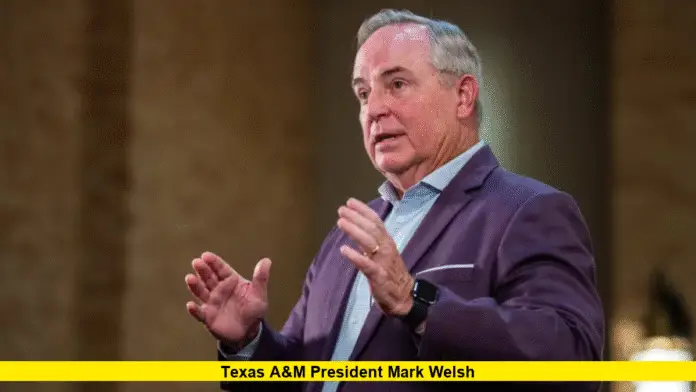
Texas A&M President Mark Welsh has stepped down from his position following a wave of public criticism and political scrutiny tied to a highly charged classroom dispute. His resignation, effective September 19, 2025, closes a turbulent chapter for the nation’s largest university in Texas and opens a new debate over the balance of leadership, academic freedom, and political influence in higher education.
The announcement from the Texas A&M University System came on Friday afternoon, confirming that Mark A. Welsh III, who had been serving as president since late 2023, would leave his post at 5 p.m. An interim leader will be named while the Board of Regents launches a national search for a permanent successor.
Table of Contents
The Classroom Confrontation That Sparked Debate
The controversy surrounding Texas A&M President Mark Welsh originated in early September when a viral video from a children’s literature class began circulating online. The footage showed a student objecting to a section of the course that discussed gender identity. The student argued that the content conflicted with religious beliefs and accused the lecturer of including material not aligned with the official course catalog.
Within hours, the video ignited debates far beyond the classroom. For many, the confrontation symbolized the growing tensions on college campuses over what is taught in the classroom, how much academic freedom instructors should have, and what boundaries students can expect in relation to personal or religious beliefs.
Mark Welsh was thrust into the center of this storm. His handling of the situation—removing the dean, demoting the head of the English Department, and ultimately dismissing the lecturer—set off an intense series of reactions that quickly escalated into calls for his resignation.
Political Pressure Builds
While some faculty and students defended Welsh’s decisions as an attempt to stabilize a volatile situation, political leaders in Texas criticized his response as inconsistent. High-ranking state officials argued that his actions either did not go far enough or revealed a failure to uphold Texas values in public education.
The debate quickly moved from campus hallways to the statehouse, with conservative lawmakers demanding accountability from the president of one of Texas’s flagship universities. By the second week of September, pressure mounted on the Board of Regents and system leadership to take decisive action.
Welsh, recognizing the growing divide and the impact it could have on the university’s reputation, chose to resign. In his statement, he emphasized his commitment to the institution and his belief that stepping aside would allow Texas A&M to refocus on its mission without distraction.
A Career of Service and Leadership
The resignation of Texas A&M President Mark Welsh marks a dramatic end to a distinguished career. Before arriving at Texas A&M, Welsh served as a four-star general in the United States Air Force, where he held one of the most prestigious roles in the military: Chief of Staff. His decades of service earned him a reputation for discipline, leadership, and strategic vision.
When he was named interim president of Texas A&M in early 2023 and later appointed permanently in December of that year, many within the Aggie community saw him as a unifying figure. He was admired for his calm demeanor, his ability to listen, and his long-standing connection to the university as a former dean of the Bush School of Government and Public Service.
Welsh’s presidency was marked by initiatives aimed at expanding research funding, strengthening student services, and maintaining Texas A&M’s reputation as one of the top public universities in the nation. His resignation, however, underscores how even leaders with strong records can be overtaken by cultural and political disputes.
Divided Reactions on Campus
Reactions to the resignation of Texas A&M President Mark Welsh have been mixed across the university community.
- Faculty: Some professors expressed sadness at his departure, praising his leadership and steady approach to administration. Others voiced concern that his handling of the classroom incident undermined academic freedom and faculty rights.
- Students: Opinions among the student body have been equally divided. Some believe Welsh’s resignation was unnecessary and feared it could create instability during the academic year. Others welcomed the change, hoping it would restore confidence in the university’s leadership.
- Alumni and Donors: Alumni groups, always influential at Texas A&M, are also weighing in. While many praised Welsh for his service, others echoed the political critiques and called for stronger alignment between the university and state leadership.
Next Steps for Texas A&M
The Board of Regents has confirmed that an interim president will be appointed in the coming days. While no names have been officially floated, speculation suggests that university leaders with administrative experience may temporarily step into the role while the board conducts a nationwide search for Welsh’s permanent replacement.
At the same time, Texas A&M is undertaking a system-wide audit of course materials. The goal of the review is to ensure that syllabi, catalogs, and teaching content remain consistent with university guidelines and state expectations. This review could have long-term implications for faculty autonomy and how controversial subjects are addressed in the classroom.
Broader Impact on Higher Education
The resignation of Texas A&M President Mark Welsh is not just a local story—it reflects a broader national conversation about higher education in the United States. Across the country, colleges and universities are increasingly caught in the crossfire of political battles over curriculum, diversity, and academic freedom.
At Texas A&M, the controversy underscores the delicate balance between protecting student concerns, supporting faculty expertise, and responding to political leaders who fund and oversee public institutions. The case raises key questions:
- Should universities shield faculty from political backlash, or hold them accountable to public expectations?
- How much influence should lawmakers exert on curriculum decisions at state-funded schools?
- Can leaders like Mark Welsh navigate both the academic community’s demand for freedom and the state’s demand for accountability?
These questions will continue to resonate far beyond College Station.
Legacy of Mark Welsh at Texas A&M
Though his presidency ended abruptly, Mark Welsh leaves behind a record of significant contributions. He prioritized student well-being, expanded opportunities for research collaboration, and sought to maintain Texas A&M’s place among the top-tier universities in the nation. His military background shaped his leadership style—structured, mission-driven, and service-oriented.
For many in the Aggie community, his departure is bittersweet. While some focus on the controversy, others remember the stability and respect he brought to the position during a challenging period for higher education.
Looking Forward
Texas A&M now stands at a crossroads. The university must navigate leadership changes, manage the fallout from the classroom dispute, and reassure students, faculty, and alumni that its values remain intact. The upcoming presidential search will be critical, not only in selecting a leader but also in defining what direction the institution will take in an era of heightened political scrutiny.
The resignation of Texas A&M President Mark Welsh serves as a reminder of how quickly leadership can shift under external pressure. It also highlights the need for universities to adapt to the evolving dynamics of society while holding true to their academic missions.
Final Thoughts
The end of Mark Welsh’s presidency at Texas A&M is a watershed moment for the university. It represents the clash of politics, education, and culture in today’s America. As the institution prepares for its next chapter, the legacy of this transition will shape conversations about academic freedom, leadership accountability, and the role of universities in reflecting—or resisting—the values of the states they serve.
What do you think about the resignation of Texas A&M President Mark Welsh? Share your thoughts and join the conversation about the future of higher education.

