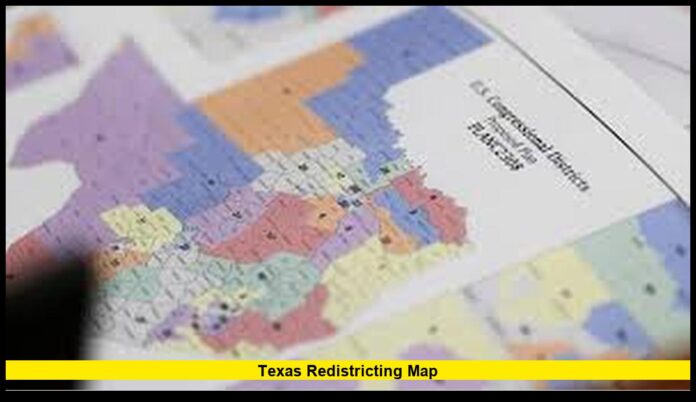
The Texas redistricting map is once again under intense scrutiny as federal judges review whether the state’s political boundaries weaken minority voting power. As of November 2025, the U.S. Court of Appeals for the Fifth Circuit is hearing challenges that could decide how millions of Texans are represented in upcoming elections. The ruling, expected in early 2026, may reshape the political balance in one of America’s most influential states.
Table of Contents
How the Current Map Came to Be
After the 2020 Census, Texas gained two new congressional seats because of rapid population growth—driven largely by Latino, Black, and Asian American communities. Yet when the Republican-controlled legislature approved new maps in 2021, those new seats favored GOP candidates rather than reflecting the state’s changing demographics.
Civil rights organizations, including the Mexican American Legal Defense and Educational Fund (MALDEF) and the NAACP Legal Defense Fund, filed lawsuits claiming the maps violated the Voting Rights Act. They argue that the lines intentionally split or concentrated minority communities, a tactic known as “cracking and packing,” to reduce their voting influence.
The Legal Battle in 2025
This month, a three-judge panel of the Fifth Circuit Court in New Orleans heard oral arguments from both sides. The central issue: whether Texas’s redistricting process unlawfully diluted minority voting strength for partisan gain.
- The state’s defense: Texas Attorney General Ken Paxton’s office insists the maps are race-neutral and drawn for political—not racial—reasons, which is generally legal under U.S. law.
- The challengers’ claim: Voting rights groups argue that race and partisanship are inseparable in Texas politics, and that minority voters were systematically disadvantaged.
A final decision could arrive in early 2026. However, legal experts believe the case might reach the U.S. Supreme Court, where similar redistricting disputes from Alabama, Georgia, and Louisiana are already being considered.
Key Areas of Contention
Several regions of Texas are at the heart of the dispute:
- Dallas–Fort Worth: Critics say the new boundaries split urban voters of color among several districts, weakening their political impact.
- Houston: Despite major population growth among Latino and Black Texans, the city saw no new minority-majority districts created.
- South Texas: This region, historically Democratic but increasingly competitive, could see dramatic changes if courts order new district lines.
Political Impact and Representation
Under the current Texas redistricting map, Republicans hold 25 of 38 congressional seats. Before redistricting, they held 23 of 36. That shift strengthened the GOP’s control even as Texas’s population became more diverse.
If courts require a redraw, several seats—especially around Houston and Dallas—could become more competitive in 2026. Because Texas sends one of the largest delegations to Congress, any changes could influence which party controls the U.S. House of Representatives.
Reactions from State Leaders
Governor Greg Abbott and Attorney General Ken Paxton continue to defend the maps, saying they comply fully with federal law. Paxton recently stated that “Texas followed the Constitution at every step of the redistricting process.”
Democratic leaders, however, argue that the maps ignore Texas’s evolving population. State Senator Carol Alvarado (D-Houston) said, “Our state is changing, but these maps don’t reflect who we are. They silence voices that deserve to be heard.”
Meanwhile, community organizations are encouraging Texans to stay informed and involved as court decisions approach. Many have launched voter education drives to explain how district boundaries affect representation.
What the Court Is Deciding
The judges are weighing several important legal questions:
- Does the map violate the Voting Rights Act by limiting opportunities for minority voters?
- Were districts drawn with racial intent or purely for partisan advantage?
- Should Texas be required to create more minority-majority districts before the next election?
The answers could redefine how much leeway states have to use partisanship as a defense in redistricting cases.
Wider National Context
Texas is part of a broader national debate over fair representation. Courts in Alabama, Georgia, and Louisiana have recently ruled that similar maps violated the Voting Rights Act, forcing those states to redraw their boundaries.
Because Texas is the second-most-populous state, its outcome carries national weight. A ruling against the state could encourage stricter oversight of redistricting elsewhere, while a ruling in its favor might strengthen states’ power to design partisan maps.
Public Response in Texas
Texans are paying closer attention to redistricting than ever before. Across the state, civic groups are hosting town halls, community meetings, and workshops to help residents understand how political boundaries influence elections.
Polls suggest most Texans—Republicans and Democrats alike—support a more transparent process, possibly led by an independent commission. For now, though, redistricting remains firmly in the hands of lawmakers.
What’s Next for the Texas Redistricting Map
The Fifth Circuit’s decision will determine whether the current districts remain through 2030 or if new maps must be drawn ahead of the 2026 election cycle. If new boundaries are ordered, they could reshape congressional and legislative representation within months.
Either way, the fight over Texas’s political lines highlights a growing truth: representation in America’s largest states depends not just on votes—but on how those votes are mapped.
As Texans wait for the court’s decision, one thing is clear: the redistricting debate is far from over, and its outcome will shape the state’s political future for years to come.

