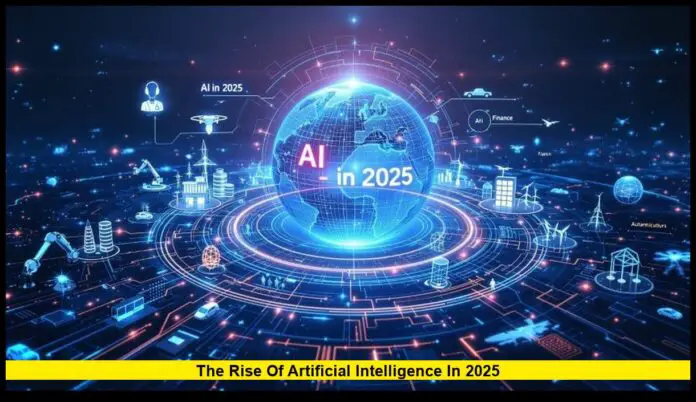
Artificial intelligence (AI) has become the defining technology of our time. As of December 2025, AI tools, automation systems, and machine learning models are transforming every major U.S. industry — from healthcare and finance to entertainment and logistics. The pace of adoption has accelerated dramatically since 2023, driven by major advancements in generative AI, robotics, and data analytics.
What was once a niche technology for tech startups is now powering Fortune 500 companies, reshaping the labor market, and even influencing U.S. economic policy. This year, AI has not only improved productivity but also created new challenges in ethics, employment, and regulation.
Table of Contents
AI Market Overview in 2025
The global AI market reached $1.2 trillion in valuation this year, with the United States leading both in innovation and investment. U.S.-based companies account for roughly 40% of all global AI spending, and the technology is now deeply embedded in everyday American life.
Here’s a quick breakdown of key 2025 AI statistics:
| Metric | Value (2025) | Change YoY |
|---|---|---|
| U.S. AI Market Size | $510 billion | +32% |
| Global AI Market Size | $1.2 trillion | +28% |
| AI Startups Funded in the U.S. | 2,800 | +14% |
| Estimated AI-related Jobs | 2.3 million | +19% |
| AI Adoption by Large Enterprises | 92% | +11% |
These numbers confirm that AI is no longer experimental — it’s now a core operational tool across industries.
Top U.S. Companies Leading the AI Revolution
Several American corporations have taken the lead in developing and deploying advanced AI technologies. As of late 2025, the following companies dominate the AI space:
1. OpenAI
With its GPT-5 and Codex Pro platforms, OpenAI continues to drive the conversational and generative AI revolution. Millions of U.S. workers use OpenAI-powered systems for writing, programming, and creative design.
2. Google DeepMind
Google has integrated AI across all its services, from Search to YouTube recommendations. DeepMind’s latest Alpha series is now being tested in medical imaging and climate modeling.
3. Microsoft
Through partnerships and internal development, Microsoft has embedded AI tools into its software ecosystem — including Copilot in Office 365 and Azure AI services, used by major corporations.
4. NVIDIA
The company dominates the AI hardware market. Its GPUs power nearly every major AI model, including those used in cloud computing, autonomous vehicles, and research.
5. Amazon
Amazon’s use of AI in logistics, retail, and cloud services continues to set industry standards. Its Bedrock platform has expanded into financial and healthcare analytics.
How AI Is Transforming Major Industries
AI’s influence now reaches every key sector of the U.S. economy. Let’s break down where its impact is most visible:
Healthcare
AI systems are now diagnosing diseases, optimizing treatment plans, and improving patient outcomes. Hospitals in New York, California, and Texas are using AI-assisted imaging tools that detect early signs of cancer with over 96% accuracy.
In 2025, the FDA approved the first AI-only diagnostic tool, capable of reading retinal scans and detecting diabetic eye disease without human oversight.
AI chatbots are also improving healthcare access by providing 24/7 medical guidance, especially in rural areas where doctor shortages remain severe.
Finance
The financial sector has rapidly embraced AI for fraud detection, algorithmic trading, and customer service automation.
U.S. banks now use machine learning to analyze billions of transactions in real time. These systems have reduced false fraud alerts by 45% and increased detection accuracy by over 70%.
Meanwhile, AI-driven investment platforms such as Betterment and Wealthfront use predictive models to optimize portfolios, giving retail investors institutional-level insights.
Education
AI has entered classrooms nationwide. Schools and universities are using adaptive learning tools that personalize lessons based on student progress.
In 2025, over 62% of U.S. K–12 schools report using AI tools to assist teachers. At the university level, AI grading systems and research assistants have improved administrative efficiency and learning outcomes.
However, educators continue to debate the ethical implications of AI — especially concerns over plagiarism, data privacy, and bias in assessment algorithms.
Manufacturing and Logistics
Automation driven by AI and robotics is redefining American manufacturing. From Detroit auto plants to Texas semiconductor facilities, AI is helping optimize production lines, predict maintenance needs, and improve safety.
AI-enabled predictive analytics systems have reduced machine downtime by nearly 30% in large factories this year. Logistics companies like FedEx and UPS now rely on AI-powered route optimization to cut delivery times and fuel costs.
Entertainment and Media
The entertainment industry has been reshaped by AI tools that create, edit, and distribute content.
Major studios are using AI for:
- Script generation and storyboarding
- Deepfake detection and editing
- Audience data analysis for streaming recommendations
AI-generated films, songs, and digital art are now common, sparking both excitement and debate about creativity and authenticity.
Energy and Environment
AI is becoming critical in managing America’s renewable energy grid. Advanced models predict energy demand, optimize wind turbine performance, and track carbon emissions.
In 2025, California deployed a statewide AI-powered energy management system that cut grid waste by 12%, the largest efficiency gain in over a decade.
AI also supports climate modeling — helping scientists forecast extreme weather events and improve disaster response readiness.
AI’s Impact on the U.S. Labor Market
AI’s expansion has created millions of new jobs while transforming existing ones.
The U.S. Bureau of Labor Statistics estimates that AI-related occupations grew by 19% this year, primarily in software development, data analysis, and cybersecurity. However, automation continues to replace certain repetitive roles in manufacturing, retail, and customer support. The Rise of Artificial Intelligence in 2025
Top AI Job Sectors (2025):
| Sector | Growth Rate (%) |
|---|---|
| Software & Data Science | 23 |
| Cybersecurity | 19 |
| Healthcare Analytics | 18 |
| Robotics Maintenance | 15 |
| AI Ethics & Governance | 14 |
AI has shifted the employment landscape — replacing some jobs but creating new ones that require advanced digital and analytical skills. The biggest challenge now lies in retraining the existing workforce to thrive in this AI-driven economy.
Regulation and AI Policy in the U.S.
In 2025, the U.S. government introduced new guidelines for AI transparency and accountability. The AI Responsibility and Safety Act (ARSA), passed in September 2025, requires companies to disclose data sources and testing methods for high-risk AI systems.
The Federal Trade Commission (FTC) also expanded oversight to prevent deceptive use of AI in advertising, while the Department of Labor began assessing automation’s impact on employment.
The Biden administration’s National AI Research Resource (NAIRR) program now funds public-private projects aimed at developing ethical and accessible AI applications.
Public Opinion: How Americans View AI in 2025
Surveys show a complex but evolving relationship between Americans and AI technology.
| Question | Agree (%) | Disagree (%) |
|---|---|---|
| AI improves productivity | 72 | 18 |
| AI poses job risks | 67 | 22 |
| AI should be regulated more | 81 | 10 |
| AI makes life easier | 69 | 20 |
| AI threatens privacy | 63 | 25 |
While most Americans acknowledge AI’s benefits, concerns remain about data privacy, security, and the ethical use of technology in decision-making.
AI in Small Businesses
AI adoption is no longer limited to large corporations. In 2025, over 58% of small and medium-sized U.S. businesses report using some form of AI technology.
Small firms use AI tools for:
- Automated marketing and customer engagement
- Inventory and sales forecasting
- Financial reporting and fraud prevention
- Chatbots and support automation
Affordable AI platforms like ChatGPT, Jasper, and Midjourney have allowed startups and entrepreneurs to compete on a larger scale with limited resources. The Rise of Artificial Intelligence in 2025
Future Trends: Where AI Is Headed Next
As the AI revolution continues, experts predict five major developments for 2026 and beyond:
- AI-Generated Media Normalization: Widespread use of synthetic voices, virtual influencers, and AI-assisted journalism.
- AI in Legal and Government Services: Courts and public offices adopting document review bots and case analysis tools.
- Quantum AI Integration: Early-stage quantum computing combining with AI for faster model training.
- AI-Powered Sustainability: More accurate climate prediction and agricultural yield optimization.
- Universal AI Assistants: Personal AI systems that manage schedules, finances, and even health monitoring seamlessly.
These developments point toward a future where AI becomes as indispensable as electricity or the internet.
Ethical and Social Implications
As AI evolves, so does the debate over its ethical use. Issues like data bias, deepfakes, and misinformation are top concerns.
Tech leaders are calling for stronger oversight and public education to prevent misuse. Ethical AI frameworks are being adopted by corporations, emphasizing transparency, fairness, and accountability.
Human-AI collaboration is emerging as a central theme — not replacing people, but empowering them with smarter tools to make better decisions. The Rise of Artificial Intelligence in 2025
Investment and Stock Market Impact
AI stocks remain among the best performers in 2025. The Nasdaq AI Index has surged 28% year-to-date, outperforming broader markets.
Leading AI-linked stocks:
- NVIDIA (NVDA): +35% YTD
- Microsoft (MSFT): +22% YTD
- Alphabet (GOOGL): +19% YTD
- Palantir (PLTR): +41% YTD
Analysts expect continued growth into 2026 as AI becomes essential to both public and private sectors.
Conclusion
Artificial intelligence has moved from niche innovation to national infrastructure. From healthcare breakthroughs to climate forecasting and finance, AI defines the direction of American progress in 2025. The Rise of Artificial Intelligence in 2025
While challenges remain — including job disruption, ethics, and regulation — the U.S. stands at the forefront of this global transformation.
How do you see AI shaping your daily life in 2026? Share your thoughts in the comments below!
FAQ
1. What is the current state of AI in 2025?
AI is fully integrated into most U.S. industries, driving automation, analytics, and digital transformation nationwide.
2. Which sectors are benefiting most from AI?
Healthcare, finance, manufacturing, and education are the top sectors adopting AI for efficiency and innovation.
3. Are AI jobs growing in the U.S.?
Yes. Over 2.3 million Americans now work in AI-related roles — a 19% increase from 2024.
4. What laws regulate AI in the U.S.?
The AI Responsibility and Safety Act (ARSA) introduced in 2025 governs AI transparency and accountability.
5. Is AI a threat to employment?
AI automates repetitive tasks but also creates high-skill jobs in data science, robotics, and ethical governance.
Disclaimer :-This article is for informational purposes only and reflects verified developments as of December 9, 2025. It does not constitute financial or legal advice. The Rise of Artificial Intelligence in 2025

