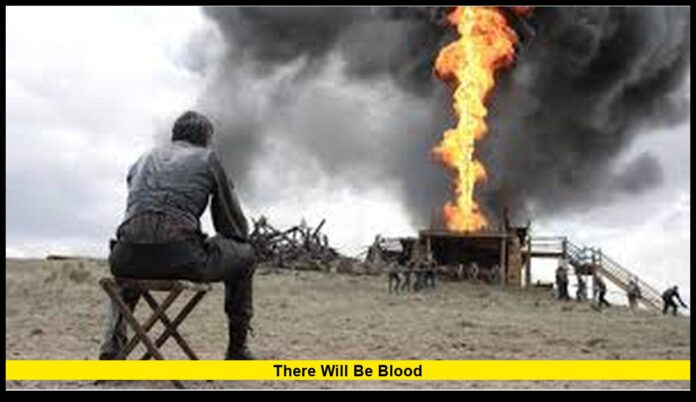
There Will Be Blood isn’t just a movie — it’s an experience that changed American filmmaking. Nearly two decades after its release, Paul Thomas Anderson’s 2007 masterpiece remains one of the most powerful portraits of greed, ambition, and moral decay ever put on screen.
From Daniel Day-Lewis’s legendary performance to Jonny Greenwood’s haunting score, every part of the film continues to influence how audiences and filmmakers think about storytelling. As of 2025, There Will Be Blood still sits among the most discussed and studied films in modern history.
Table of Contents
A Masterpiece Born from American History
There Will Be Blood was written and directed by Paul Thomas Anderson, who loosely based the story on Upton Sinclair’s 1927 novel “Oil!” While the book explored the corruption of California’s early oil industry, Anderson shifted the focus to a single man’s descent into obsession.
Filming took place in Marfa, Texas, a location chosen for its vast, barren landscapes. The setting wasn’t just scenery — it symbolized the emptiness at the heart of its main character, Daniel Plainview, a man consumed by ambition.
The film premiered in December 2007, earning immediate critical acclaim. Reviewers praised its ambition, visual power, and moral weight, comparing it to cinematic classics like Citizen Kane and The Treasure of the Sierra Madre.
Daniel Day-Lewis: The Performance That Made History
At the center of There Will Be Blood is Daniel Day-Lewis, who delivers one of the most unforgettable performances in film history. Playing oilman Daniel Plainview, Day-Lewis transformed into a symbol of ruthless determination and moral collapse.
He spent months developing the character, adopting a deep, gravelly voice inspired by classic film director John Huston. Every gesture, every line of dialogue radiates controlled intensity.
Plainview begins as a hardworking prospector, but as his wealth grows, so does his isolation and hatred. By the film’s shocking conclusion, his pursuit of power has destroyed everyone — and everything — around him.
Day-Lewis’s performance earned him the Academy Award for Best Actor in 2008, one of three Oscars in his legendary career. Even now, acting schools and critics reference his work as the gold standard of character transformation.
Paul Dano’s Breakout Role
Opposite Day-Lewis, Paul Dano gave a stunning dual performance as twin brothers Eli and Paul Sunday. His portrayal of Eli, a manipulative young preacher who clashes with Plainview, adds spiritual tension to the story’s material greed.
Dano’s emotional intensity in scenes like the baptism and final confrontation made him one of the most talked-about young actors of the decade. In later interviews, he revealed how physically and emotionally demanding those scenes were — especially acting opposite someone as deeply committed as Day-Lewis.
Today, Paul Dano is recognized as one of Hollywood’s most respected performers and filmmakers. His work in There Will Be Blood remains a cornerstone of his career.
Jonny Greenwood’s Haunting Music
The film’s score, composed by Jonny Greenwood of Radiohead, is unlike any other. His music pulses with tension — strings screech, rhythms clash, and silence lingers. Rather than soothing the audience, the score keeps them on edge, reflecting Plainview’s internal chaos.
At the time of release, Greenwood’s music broke the rules of what a film score could be. Instead of traditional orchestration, he used experimental techniques that mirrored the industrial age the movie depicts.
Nearly twenty years later, his work is still studied in film music courses and is regularly featured in symphonic performances celebrating 21st-century cinema.
Themes That Still Feel Relevant
The reason There Will Be Blood endures is simple — its themes remain timeless. The film explores the dark side of ambition and how the thirst for power can consume everything in its path.
Core themes include:
- Greed and Corruption: Plainview’s success in the oil business mirrors how unchecked ambition can lead to moral destruction.
- Faith and Hypocrisy: His feud with preacher Eli Sunday exposes the ways religion can be manipulated for personal gain.
- Isolation: In his relentless pursuit of dominance, Plainview ends up rich but utterly alone.
Even in 2025, as society continues to debate wealth inequality, corporate power, and the cost of progress, these themes feel just as sharp as they did in 2007.
A Technical and Artistic Triumph
Visually, There Will Be Blood is stunning. Cinematographer Robert Elswit won an Oscar for capturing the sweeping, sun-scorched beauty of early 1900s California. Every frame feels carefully crafted — both grand and intimate.
Anderson shot many scenes using natural light and long takes, giving the film a grounded, realistic tone. The opening sequence — nearly 15 minutes with no dialogue — demonstrates his confidence in pure visual storytelling.
The result is a film that feels epic in scope yet deeply personal in emotion.
Awards and Recognition
When There Will Be Blood hit theaters, it earned eight Academy Award nominations and won two:
- Best Actor (Daniel Day-Lewis)
- Best Cinematography (Robert Elswit)
It also competed for Best Picture, Best Director, and Best Screenplay, among others.
Over the years, its reputation has only grown. Major film publications and institutions, including the BBC, The Guardian, and Sight & Sound, consistently rank it among the best films of the 21st century.
In 2022, the Library of Congress added There Will Be Blood to the National Film Registry, recognizing its lasting cultural and artistic importance.
Renewed Interest in 2025
The film experienced a major resurgence in 2024 when Paramount Pictures released a 4K Ultra HD restoration supervised by Paul Thomas Anderson. The remastered version includes enhanced visuals, rebalanced sound, and behind-the-scenes insights into its creation.
Streaming platforms like Netflix, Apple TV+, and Amazon Prime Video report continued strong viewership for There Will Be Blood, especially among younger audiences discovering it for the first time.
Film festivals and repertory cinemas across the U.S. have also hosted anniversary screenings this year, sparking renewed discussion about its meaning and relevance.
The Legacy of Paul Thomas Anderson
Director Paul Thomas Anderson is known for his ability to balance scale and intimacy, and There Will Be Blood stands as his most profound achievement.
His other films — Boogie Nights, Magnolia, The Master, and Licorice Pizza — showcase his range, but There Will Be Blood remains his defining statement on ambition and the American dream.
Anderson’s influence is visible in a new generation of filmmakers who cite his visual precision and emotional honesty as key inspirations.
A Film That Still Feels Alive
Seventeen years after its release, There Will Be Blood continues to resonate because it speaks to something eternal — human desire.
It’s a story about building, destroying, and the price we pay for success. Its power lies in how it refuses to offer easy answers. The final line, “I’m finished,” still sends chills because it captures the emptiness of a life consumed by ambition.
Every viewing feels different — sometimes tragic, sometimes thrilling, but always unforgettable.
There Will Be Blood remains one of America’s greatest films — a haunting masterpiece that still challenges, disturbs, and inspires every generation that watches it.

