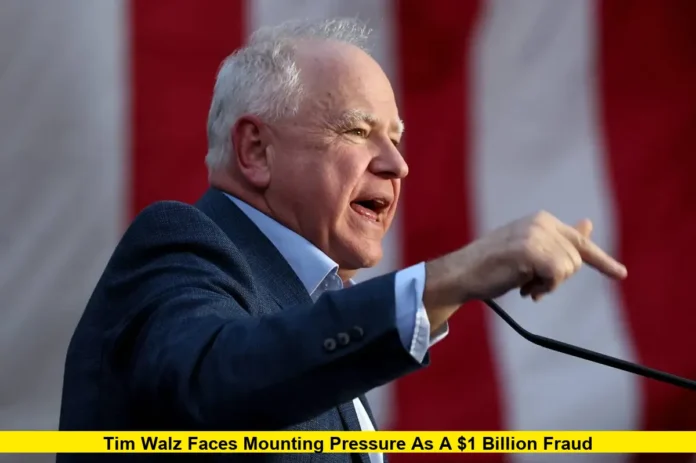
Minnesota Gov. Tim Walz finds himself at the center of a political firestorm as multiple scandals and controversies converge. Federal investigations into the largest COVID-era welfare fraud scheme in U.S. history, allegations of mismanagement under his watch, increasingly harsh rhetoric from national political figures, and mounting pressure from lawmakers have placed his leadership under intense scrutiny — and thrown into doubt his bid for a third gubernatorial term in 2026.
Table of Contents
Fraud Scandal Rocks Minnesota: $1 Billion Alleged Losses
In recent months, federal prosecutors and state audits revealed massive abuse within Minnesota’s social services programs. The scandal centers around a nonprofit, Feeding Our Future (FOF), accused of exploiting child-nutrition programs and other COVID-related aid to divert as much as $1 billion in taxpayer funds.
More than 70 individuals tied to FOF have been charged in what prosecutors describe as the largest pandemic fraud case in the nation.
State officials acknowledge that warning signs appeared years ago — some as early as 2019 — yet oversight failed to prevent the fraud from blossoming.
As the scandal unfolded, some critics and political opponents claimed that under Walz’s administration, control mechanisms broke down — and the consequences are coming home to him.
Walz’s Response: “I Take Responsibility,” But How Much?
During a recent appearance on national television, Governor Walz said, “I take responsibility for putting people in jail.”
But fact-checkers and reporting detail a harder truth: those prosecutions were spearheaded by federal agencies, not state authorities under Walz’s direct control.
Still, Walz pledged cooperation with a congressional oversight request — even as he described the inquiry as a “distraction.”
Republican state lawmakers, including House Speaker Lisa Demuth, have pounced on the scandal, calling it merely “the tip of the iceberg.” They argue Walz bears ultimate responsibility for the oversight failures that enabled the fraud.
Political Fallout: Tension, Accusations, and a Tumultuous Campaign Season
The scandal erupted against the backdrop of Walz’s push for a third term. His 2026 re-election campaign, once considered a foregone conclusion, now faces serious headwinds.
Republican challengers — most notably former gubernatorial runoff candidate and physician Scott Jensen — have sharply criticized Walz. Jensen called the scandal a “cover up worse than Watergate,” claiming the timeline of wrongdoing and delayed response demonstrated “derelict leadership.”
Compounding political damage, a federal investigation is now underway under the scrutiny of the U.S. Treasury Department and the Department of Homeland Security, as officials examine whether state funds may have ended up tied to foreign militant organizations — a serious allegation that could escalate into national security concerns.
Racial and Community Fallout: Somali Minnesotans in the Crosshairs
Much of the fraud involved nonprofits linked to Minnesota’s Somali-American community. This has triggered a broader political and social backlash that extends beyond financial wrongdoing to questions of race, religion, and identity.
The tension reached a boiling point when national political figures used incendiary and derogatory language to describe Somali Minnesotans. This rhetoric has drawn condemnation from Walz, civil-rights activists, and community leaders, who warn of the danger of collective blame.
Governor Walz denounced blanket labels and sweeping generalizations about the Somali community, saying the remarks were “unprecedented” and deeply harmful — especially for children who heard their president insult their identity.
Personal Impact: Walz Family Under Attack
The scandal and surrounding rhetoric have escalated into personal attacks against Governor Walz and his family. His daughter, Hope Walz, publicly condemned the hateful backlash after a social-media post by a national political leader used a derogatory slur against her father. She described a wave of harassment that included verbal abuse directed at her younger brother, who has a nonverbal learning disorder. Hope characterized the harassment as a “s***-storm” that upended her family’s life.
Many see the personal consequences as emblematic of a larger problem: when allegations of fraud intersect with identity and immigration, the costs reverberate beyond courtrooms and balance sheets — they strike at communities and families.
Walz’s Broader Record Under a New Spotlight
Until now, much of Governor Walz’s record has centered on progressive policies, labor protections, environmental reforms, and support for reproductive and civil-rights issues.
He spearheaded legislation phasing out fossil-fuel reliance, pushed for clean energy investments, reformed transportation infrastructure spending, backed expanded workers’ rights, and signed laws protecting LGBTQ+ rights and access to reproductive health care.
These achievements, once central to Walz’s appeal, now compete for attention against a scandal that many Minnesotans view as a failure of oversight and leadership — a tension that may define the governor’s legacy.
What Comes Next: Investigations, Elections, and Accountability
— Federal investigations continue: DHS and the Treasury Department are still examining whether any misused funds were diverted to illicit networks. The final report and possible legal consequences remain uncertain.
— State audits in motion: Walz’s administration says it will comply with congressional requests for information — though critics call the effort too little, too late.
— Political pressure mounts: Republican lawmakers and primary challengers are mobilizing heavily ahead of the 2026 election, portraying Walz as out of touch and apologizing after oversight failures.
At the same time, Walz continues to defend his broader record, emphasizing social justice, infrastructure improvements, and environmental protections — arguing that the fraud scandal does not erase his administration’s positive impact.
Minnesota sits at a crossroads. The fallout from one of the nation’s largest fraud scandals in decades now threatens to redefine political allegiances, shift public trust, and reshape the state’s leadership narrative. For Governor Walz, the coming months will determine whether he can reclaim authority and restore confidence — or whether this scandal becomes the defining moment of his career.
What do you think? Did the scope of mismanagement under Walz justify the outrage — or is the backlash overblown? Share your thoughts below as the story continues.

