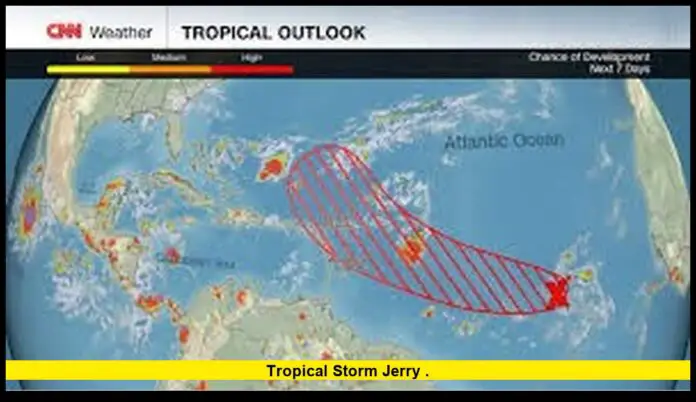
Tropical Storm Jerry has officially formed over the Atlantic Ocean, becoming the 10th named storm of the 2025 Atlantic hurricane season. As of October 7, meteorologists report that Jerry is gaining strength while moving westward at a rapid pace. With sustained winds of 45 mph and favorable atmospheric conditions ahead, the storm has the potential to intensify further in the coming days.
Although there are currently no coastal watches or warnings in effect for the United States, Jerry’s development is being closely monitored due to its possible interaction with coastal waters later this week.
Table of Contents
Current Position and Strength
As of Tuesday morning, Tropical Storm Jerry is located approximately 1,315 miles east-southeast of the northern Leeward Islands. The storm is moving west at around 24 mph, bringing it steadily closer to the Caribbean region.
- Maximum sustained winds: 45 mph
- Movement: West at 24 mph
- Minimum central pressure: Estimated at 1003 mb
- Storm classification: Tropical Storm (expected to strengthen)
While Jerry remains far from land, its westward motion and forecasted strengthening make it an important system to watch over the next several days, especially for the Leeward Islands, Bermuda, and the U.S. East Coast.
Projected Path of Tropical Storm Jerry
Forecasters expect Tropical Storm Jerry to continue on its west-northwest trajectory before gradually turning northward by the end of the week. Most forecast models currently indicate that Jerry will stay east of the U.S. mainland, reducing the risk of a direct landfall.
However, Jerry is forecast to pass near or north of the Leeward Islands later this week, bringing increasing swells and potentially hazardous marine conditions to the region. By the weekend, the storm is expected to strengthen further, possibly reaching hurricane intensity if environmental conditions remain favorable.
There is also a possibility that Jerry could approach the vicinity of Bermuda early next week. Although the storm is currently expected to stay offshore, even systems that don’t make direct landfall can affect U.S. coastal waters through dangerous rip currents and elevated surf.
Key Forecast Highlights
| Feature | Details |
|---|---|
| Current status | Tropical Storm with 45 mph winds |
| Location | 1,315 miles ESE of Leeward Islands |
| Projected track | West-northwest, then turning north |
| Potential strength | Likely to reach hurricane status in 2–3 days |
| U.S. impact | No direct landfall expected; possible coastal effects |
This path highlights why coastal communities along the U.S. East Coast should continue to monitor Jerry’s evolution, especially as steering patterns can shift unexpectedly during the storm’s development.
Favorable Conditions for Strengthening
Jerry is currently moving over warm Atlantic waters, a key ingredient for intensification. Sea surface temperatures are sufficiently high, and upper-level wind shear is low — two conditions that often allow tropical storms to strengthen into hurricanes.
Meteorologists are watching closely for signs of rapid intensification over the next 48–72 hours. If Jerry maintains its current structure and environmental conditions remain favorable, it could become the next hurricane of the season by midweek.
Potential Effects on U.S. Coastal Areas
Even if Jerry remains offshore, its impact could still be felt along parts of the U.S. East Coast, particularly through:
- Increased swells and rough surf: Strong waves generated by the storm may reach coastal areas late this week.
- Dangerous rip currents: Beachgoers from Florida to the Carolinas should remain cautious, as rip current risks typically rise several days before a storm’s closest approach.
- Marine hazards: Jerry’s wind field may affect shipping lanes and offshore operations, especially if the storm intensifies into a hurricane.
- Potential track shifts: Long-range forecasts are subject to change, so any unexpected deviation could alter U.S. impacts.
For now, the primary threat remains to open waters and potentially Bermuda, but U.S. coastal residents should keep a close eye on forecast updates.
Tropical Storm Jerry in Context of the 2025 Atlantic Season
Jerry’s formation marks the 10th named storm of the 2025 season, which has been busier than average. Meteorologists attribute this active season to warmer ocean temperatures, a lack of inhibiting wind shear, and atmospheric conditions favorable for storm formation.
This year’s Atlantic hurricane season has already seen multiple systems forming in quick succession. Jerry’s development, following recent storms in the Caribbean and Atlantic, underscores the persistent activity typical of October — a month when late-season storms often develop far out at sea and track toward the Caribbean or the U.S. East Coast.
Safety Recommendations for Coastal Residents
While there is no immediate threat of landfall in the U.S., residents along the East Coast should adopt a “stay aware, not alarmed” approach. Here are a few practical steps:
- Monitor forecasts daily: Check the National Hurricane Center’s advisories for updated storm tracks and intensity forecasts.
- Use caution at beaches: Pay attention to local advisories on rip currents and surf conditions.
- Boat and shipping operators: Prepare for possible rough offshore waters and adjust travel plans accordingly.
- Stay flexible: Storm tracks can shift, so remain prepared to adjust if the cone of uncertainty changes in the coming days.
What to Watch Over the Next Few Days
Over the next 72 hours, forecasters will be watching for:
- Signs of intensification as Jerry moves over warm waters.
- A possible northward turn, which could determine whether the storm approaches Bermuda.
- Shifts in steering currents, which could subtly alter its projected path relative to the U.S. East Coast.
- Impacts on marine conditions, including swells and rip currents reaching U.S. shorelines.
These updates will help determine Jerry’s long-term threat potential and clarify any changes to expected impacts.
Final Thoughts
Tropical Storm Jerry is gaining attention as it strengthens over the Atlantic Ocean. While it currently poses no direct threat to the U.S. mainland, its future track and intensity warrant close observation. For coastal communities, Jerry serves as a reminder that tropical systems can influence weather and marine conditions even from a distance.
What are your thoughts on the development of Tropical Storm Jerry? Share your views and stay connected as we continue to track this system’s path and impact.

