
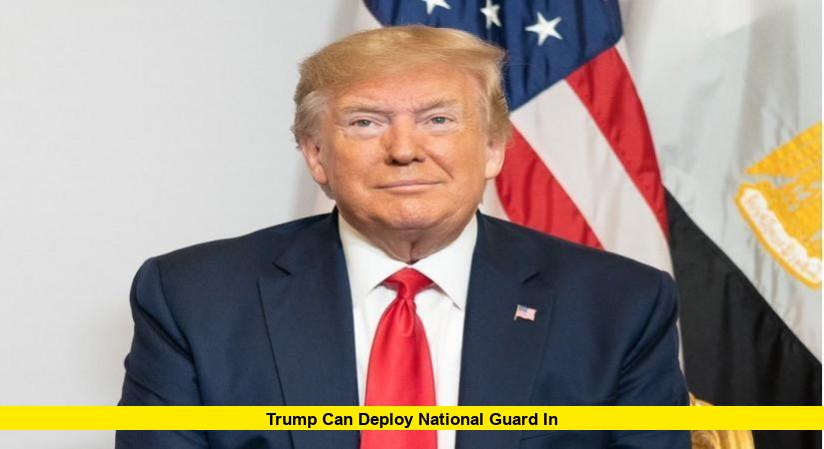
In a dramatic turn of events, a federal appeals court has ruled that Trump can deploy National Guard in Portland, clearing a path for the former president to federalize Oregon’s Guard troops despite the state’s firm opposition. The decision, delivered by a three-judge panel of the Ninth U.S. Circuit Court of Appeals, marks a powerful affirmation of presidential authority and signals a shift in the legal balance between state sovereignty and federal power.
The court’s 2–1 ruling effectively lifts a key restriction that had blocked Trump’s order to federalize members of the Oregon National Guard. Although another restraining order still prevents the physical deployment of troops into Portland, the decision represents a crucial win for the former president as he continues to assert federal authority over domestic disturbances.
Table of Contents
Understanding the Court’s Decision
The Ninth Circuit’s ruling focused on one fundamental question: whether the president has the legal right to take control of a state’s National Guard during periods of civil unrest without the governor’s approval. The majority found that the president’s powers, as defined by federal law, allow such actions when state and local forces are “unable or unwilling” to maintain public order.
The judges determined that the lower court erred by second-guessing the president’s judgment on the seriousness of the unrest in Portland. According to the ruling, the president is entitled to broad discretion in assessing threats and acting swiftly to restore stability.
In simple terms, the decision means that Trump’s September 2025 order to federalize roughly 200 Oregon National Guard troops can move forward — at least on paper. The only remaining obstacle is a separate court order that temporarily bars those troops from physically entering Portland until further legal review.
What Led to This Moment
The legal battle began after months of intense protests in Portland. Demonstrations around federal buildings and immigration enforcement facilities had reignited debates over policing, immigration, and executive power. The Trump administration argued that local officials had lost control and that federal intervention was necessary to protect federal property and enforce the law.
On the other side, Oregon’s leaders — including Governor Tina Kotek — rejected that claim, calling the federalization order unconstitutional and unnecessary. They filed suit, saying the city was under control and that the federal government was exaggerating the extent of unrest to justify its actions.
Initially, a federal district court sided with the state, issuing a restraining order to block the president’s move. That decision, however, has now been partially overturned by the appellate court, which found that the president’s authority under federal law gives him “wide latitude” to act in situations involving threats to federal interests.
The Legal Reasoning
The appeals court’s majority opinion leaned heavily on long-standing legal precedents that grant the president broad powers under federal statutes governing the National Guard. These laws allow the president to assume control of state Guard units when local enforcement efforts are deemed insufficient to enforce federal law or protect federal facilities.
The majority concluded that:
- The president’s assessment of a national security or public safety threat should be given deference.
- Courts should avoid substituting their judgment for the president’s on questions involving public safety.
- The decision to federalize troops falls squarely within the executive’s constitutional authority.
In dissent, one judge strongly disagreed, warning that the ruling sets a dangerous precedent that could erode the balance of power between states and Washington, D.C. The dissent argued that no clear evidence existed that Oregon had failed to maintain order and that the federalization move risked politicizing the National Guard.
How Oregon Officials Responded
Oregon’s political leadership reacted swiftly and sharply. Governor Tina Kotek denounced the ruling as a “direct threat to state sovereignty,” announcing plans to seek a review by the full Ninth Circuit. She argued that allowing any president to override a governor’s control over the Guard “without clear necessity” could fundamentally weaken the structure of American federalism.
Portland Mayor Ted Wheeler echoed those sentiments, emphasizing that the city had not requested military assistance and did not view federal deployment as necessary. State Attorney General Dan Rayfield went further, saying that the decision “opens the door for presidents to misuse the Guard for political purposes under the guise of law enforcement.”
Meanwhile, supporters of the ruling hailed it as a return to strong executive leadership, contending that the federal government must have the tools to respond to breakdowns in public order when state leaders hesitate to act.
Implications for Presidential Power
The case has now become a focal point in the ongoing debate over presidential authority and state rights. The Ninth Circuit’s ruling is likely to shape how future administrations interpret their power to federalize Guard units.
Here are the key implications:
- Expanded Presidential Authority: The ruling reinforces the idea that the president can act unilaterally to deploy National Guard troops without a governor’s consent under certain conditions.
- Weakened State Control: Governors may have less practical power to block federal intervention during protests, riots, or emergencies.
- Potential for Future Conflicts: The precedent could invite similar disputes if future presidents use federalized forces in politically contentious situations.
Legal experts note that while the decision supports executive flexibility, it also raises concerns about the erosion of the traditional checks and balances that define state-federal relations.
Impact on Portland
For Portland itself, the decision has both symbolic and practical importance. On one hand, it highlights the city’s long-running tensions between local leadership and federal authorities. On the other, it brings renewed uncertainty about whether troops might eventually appear on its streets if the remaining court order is lifted.
If the full deployment proceeds, the Oregon National Guard—under federal command—would likely assist in securing federal properties and managing large public gatherings. Officials in the city have expressed concerns that this could escalate tensions rather than calm them.
Residents, too, remain divided. Some see the move as a necessary step toward restoring peace and stability. Others fear it represents federal overreach into local governance and a potential infringement on the right to protest.
What Happens Next
The legal saga isn’t over. Oregon officials have already filed a motion requesting that the full Ninth Circuit review the panel’s decision. If the full court agrees to take up the case, the ruling could be stayed once again pending further consideration.
Beyond that, the issue could make its way to the U.S. Supreme Court, which has not yet directly ruled on the limits of a president’s power to federalize state National Guard units in domestic contexts.
Meanwhile, Trump’s legal team views the decision as validation of their interpretation of executive authority. They argue that the president’s duty to protect federal interests supersedes state objections when those interests are at risk.
The Broader National Context
This decision arrives at a time when the nation continues to grapple with deep divisions over law enforcement, public protest, and the role of federal power. It underscores the challenge of balancing state independence with federal responsibility during moments of national tension.
If the ruling stands, it could embolden future presidents—of any party—to use the National Guard as a tool for domestic intervention in ways that have not been seen in modern times. Critics fear that this could set a precedent where political motivations influence when and where federal troops are deployed.
Supporters counter that strong executive action is sometimes necessary to prevent chaos and protect the rule of law when state authorities fail to act decisively.
Key Takeaways
- The Ninth Circuit ruled 2–1 that Trump acted within his authority to federalize the Oregon National Guard.
- A separate restraining order still prevents deployment of troops into Portland.
- The decision could reshape the balance of power between the federal government and the states.
- Oregon leaders are preparing to challenge the ruling in higher courts.
- The issue could eventually reach the Supreme Court, setting a precedent for decades to come.
The Bigger Picture
The decision that Trump can deploy National Guard in Portland represents more than a single policy victory—it marks a defining moment in America’s ongoing debate over federal power. It draws attention to the delicate equilibrium between a president’s constitutional duties and a state’s right to self-governance.
For now, Portland remains the focal point of a national conversation about authority, accountability, and civil rights. Whether this ruling leads to actual troop deployment or ends up reshaping constitutional law, one thing is certain: its impact will resonate across the country.
The story of Portland’s legal battle has only begun. What do you think about the court’s decision? Share your views below and stay informed as this historic case unfolds.