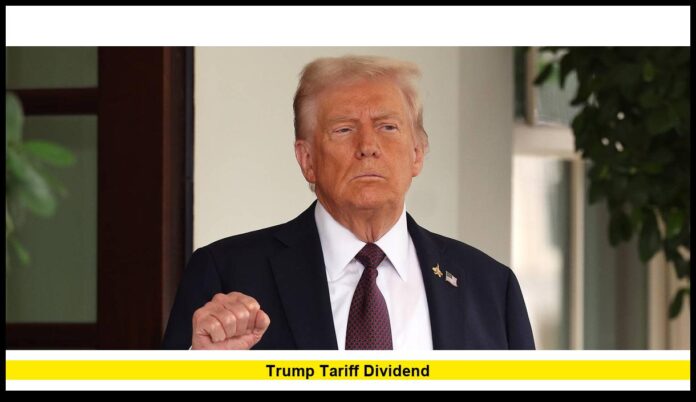
The Trump tariff dividend has become one of the most discussed economic proposals in the United States this November. Former President Donald J. Trump has announced plans to issue a “dividend” of at least $2,000 to most Americans, funded directly by revenue collected from tariffs on imported goods. The proposal is drawing national attention for its potential to reshape U.S. trade and fiscal policy — and for the legal and economic hurdles it faces.
Table of Contents
What the Tariff Dividend Proposal Entails
Trump’s proposed “tariff dividend” centers on the idea that the money the U.S. government collects from import tariffs should be redistributed to American citizens. He announced that “a dividend of at least $2,000 per person” would be paid to most Americans, excluding high-income earners.
He emphasized that this payout would be made possible through tariff collections from goods imported into the United States. The plan ties directly to his “America First” trade approach, which raises duties on a broad range of products to encourage domestic manufacturing and generate revenue.
While Trump claimed that the dividend could reach every eligible American, he did not specify the exact eligibility thresholds, income limits, or the distribution timeline. However, he described it as a “reward for the hardworking people of America” who bear the brunt of global trade imbalances.
Why the Trump Tariff Dividend Matters
The announcement has significant implications across several fronts — economic, political, and legal.
- For the economy: If implemented, the dividend could provide short-term cash relief to millions of households, especially amid ongoing inflation and elevated living costs.
- For trade policy: It reinforces Trump’s stance that foreign countries — not American taxpayers — should “pay for America’s prosperity” through import tariffs.
- For politics: The proposal strengthens his populist messaging, aligning with earlier campaign promises to ensure that “everyday Americans” benefit directly from government revenue, rather than corporations or foreign interests.
Economists, however, caution that the overall math may not yet add up. The federal government collected roughly $195 billion in customs duties during the last fiscal year. A $2,000 payment to around 200 million Americans would require $400 billion — more than double the total tariff revenue. That means either the government would need to find other funding sources or significantly expand tariffs to meet the promised amount.
Legal and Fiscal Hurdles Ahead
A major challenge for the Trump tariff dividend is its legal foundation. The tariffs underpinning the funding plan are currently facing scrutiny in the U.S. Supreme Court. Several justices — both conservative and liberal — have questioned whether the president has authority under the International Emergency Economic Powers Act (IEEPA) to impose sweeping tariffs on a global scale.
Lower courts have previously found that parts of Trump’s tariff policies exceeded presidential authority. If the Supreme Court rules that the tariffs are unconstitutional or must be rolled back, the funding mechanism for the dividend could collapse entirely.
There are also fiscal questions. Even if the tariffs remain in place, economists point out that distributing all tariff revenue directly to citizens would leave little room for the federal government to fund customs operations, trade enforcement, or offset potential consumer price increases that result from higher import costs.
Timeline of Key Developments
| Date | Event |
|---|---|
| April 2025 | Trump introduces new “Liberation Day” tariffs — a 10% universal import duty with potential reciprocal surcharges. |
| August 2025 | Treasury officials state tariff revenues are rising and could contribute to debt reduction. |
| October 2025 | The U.S. Senate votes to remove the national emergency justification for global tariffs, citing overreach. |
| November 2025 | The Supreme Court hears oral arguments questioning the legality of Trump’s tariffs. |
| November 2025 | Trump announces his “tariff dividend” proposal, promising $2,000 per eligible American. |
How It Could Affect U.S. Households
If the Trump tariff dividend is implemented, it could have mixed effects on American households:
- Short-term benefits: A $2,000 payout would provide a meaningful boost for many families struggling with inflation, rent, or debt.
- Long-term costs: Tariffs generally raise the price of imported goods, which can increase overall living costs. That means consumers could end up paying more for essentials like electronics, clothing, and cars — possibly offsetting the value of the dividend.
- Eligibility concerns: While Trump mentioned excluding “high-income people,” he did not clarify income thresholds or whether dependents, retirees, or non-tax filers would qualify.
- Timing and delivery: There is no timeline yet for when or how payments might be distributed. Treasury officials have not issued formal guidance, and the plan would likely require congressional involvement.
What Americans Should Watch Next
- Supreme Court Decision: The Court’s upcoming ruling on the legality of Trump’s tariffs could determine whether the revenue stream for the dividend survives.
- Congressional Action: Lawmakers may need to pass a bill authorizing the dividend’s structure, eligibility rules, and payment system.
- Economic Indicators: Inflation and import costs will influence whether the dividend has a net positive or negative effect on household budgets.
- Treasury Revenue Reports: Actual tariff collections will reveal whether the U.S. has the financial capacity to support widespread payments.
The Bigger Picture
The Trump tariff dividend is an unprecedented proposal — one that attempts to link trade policy directly to household income. If successful, it could mark the first time tariff revenues are redistributed as direct payments to citizens. However, its success depends on multiple uncertain factors: the legal status of the tariffs, the volume of tariff revenue collected, and congressional approval for distributing funds.
Economically, the proposal highlights the tension between protectionist trade policies and consumer welfare. While the idea of “making foreign producers pay” is politically appealing, the ultimate cost of tariffs often falls on U.S. consumers through higher prices.
As of now, the plan remains a promise rather than an actionable policy. Still, it has reignited national debate about how the government should use tariff revenues — and whether direct dividends could become part of future U.S. economic policy.
As the debate continues, one key question remains: Will the Trump tariff dividend ever reach Americans’ wallets, or will it remain a political talking point? Share your thoughts and stay informed as the story unfolds.

