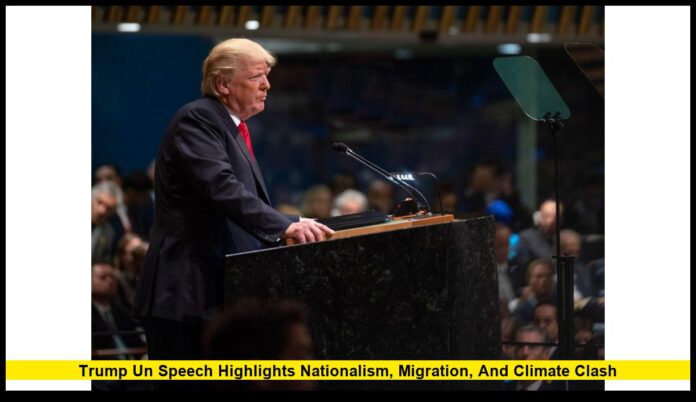
The highly anticipated Trump UN speech delivered on September 23, 2025, drew global attention as former President Donald Trump used the world stage to challenge international policies on migration, climate, and sovereignty. His remarks were unapologetically direct, sending a message to both allies and critics that his vision for the United States—and for the world—remains firmly rooted in nationalism and self-reliance.
Table of Contents
A Fiery Start at the UN General Assembly
Speaking at the 80th session of the United Nations General Assembly in New York, Trump wasted no time addressing what he views as global failures. He criticized international institutions for focusing on what he called “globalist projects” rather than protecting the interests of individual nations.
With sharp words, he warned that countries failing to protect their borders and energy independence risked collapsing under the weight of their own policies. His opening line, declaring that “Your countries are going to hell,” set the tone for a confrontational yet calculated address.
Immigration Takes Center Stage
One of the central themes of the Trump UN speech was immigration. Trump urged nations to clamp down on illegal migration, claiming that open borders weaken national identity, threaten public safety, and drain economic resources.
He praised the U.S. approach under his leadership, highlighting border security as a model for the world. According to Trump, sovereignty begins with secure borders, and no country can thrive if it cannot control who enters and who stays.
His words resonated with supporters who share concerns about rising migration but drew sharp reactions from those who favor more open international policies.
Climate Change Rejected as ‘Con Job’
Another major headline from the speech was Trump’s outright dismissal of global climate initiatives. He called climate change a “con job,” arguing that carbon-reduction targets and green energy programs were tools to control economies and strip away freedoms.
Instead, Trump called for energy independence based on fossil fuels, emphasizing that oil, gas, and coal remain the backbone of strong national economies. He warned Europe in particular that its pursuit of green energy was leaving it vulnerable, both economically and strategically, to competitors who do not follow climate rules.
This stance sparked heated debate among delegates but reinforced his longstanding rejection of global climate agreements.
Ukraine and Russia: A Stronger Position
Perhaps the most surprising part of the Trump UN speech was his position on the war in Ukraine. For years criticized for being too soft on Russia, Trump took a firmer stance, saying that Ukraine should reclaim all of its territory, including Crimea.
He described Russia as a “paper tiger” and warned that NATO should respond more aggressively if Russian aircraft entered alliance airspace. He also suggested that heavy tariffs could be imposed on Russia until peace is reached.
This shift marked a notable change from his previous rhetoric and signaled to European partners that he was ready to take a harder line against Russian aggression.
A Rebuke of Europe’s Policies
Europe was another major focus of the speech. Trump accused European nations of destroying their heritage through open borders and weakening their economies by embracing green energy. He argued that the U.S. model of energy independence and border enforcement should be copied abroad.
These remarks sparked tension in the assembly hall, but they underscored Trump’s broader theme: nations must prioritize their own people over international agreements or outside pressures.
Tense Moments with the UN
In classic Trump style, the speech included moments of tension and theatrics. He complained about equipment malfunctions during his address, blaming the U.N. for a faulty teleprompter and even joking about a broken escalator. While these side comments drew laughs from some, they also added drama to an already fiery appearance.
The U.N. leadership, meanwhile, emphasized the importance of global cooperation, standing in contrast to Trump’s nationalistic tone. The split highlighted the ongoing divide between multilateral governance and sovereign-first policies.
Key Takeaways from Trump’s UN Address
Trump’s remarks were filled with memorable lines and bold claims. Among the biggest takeaways:
- Nationalism over globalism: Sovereignty must come before international cooperation.
- Migration control is non-negotiable: Nations without borders cannot survive.
- Climate change initiatives rejected: Fossil fuels remain essential to national strength.
- Stronger support for Ukraine: A new, tougher stance against Russia emerged.
- Criticism of Europe: Open borders and green energy were labeled destructive policies.
Impact on U.S. Diplomacy
The Trump UN speech carries significant weight for U.S. diplomacy. It signals to allies that the U.S. will not bend to global consensus on issues like migration and climate. It also suggests a stronger, more confrontational approach toward Russia, while maintaining skepticism toward multilateral institutions.
At home, the address reinforces Trump’s familiar themes of sovereignty, security, and strength. For his supporters, the speech was a reaffirmation of “America First” principles. For his critics, it was another sign of U.S. isolationism under his leadership.
Global Reactions and Domestic Response
World leaders offered mixed reactions. Some applauded his directness, while others criticized his rejection of cooperative solutions to shared problems. In Europe, his climate and migration comments drew pushback, while in the U.S., the speech immediately became a flashpoint for political debate.
Domestically, his supporters praised the tough talk on sovereignty and borders. His critics argued that dismissing climate concerns and attacking allies risks weakening America’s global influence.
Conclusion
The Trump UN speech was anything but ordinary. Bold, confrontational, and filled with unmistakable nationalist themes, it reaffirmed Trump’s belief that sovereignty and national strength must come before global cooperation. His rejection of climate change policies, his hardline stance on migration, and his surprising shift on Ukraine left both supporters and critics with much to consider.
For Americans, the speech was a reminder that Trump’s approach to international diplomacy remains as uncompromising as ever. Whether viewed as visionary leadership or divisive rhetoric, one thing is certain: the world is still listening closely when Donald Trump takes the U.N. stage.
What are your thoughts on Trump’s speech? Share your views in the comments below.

