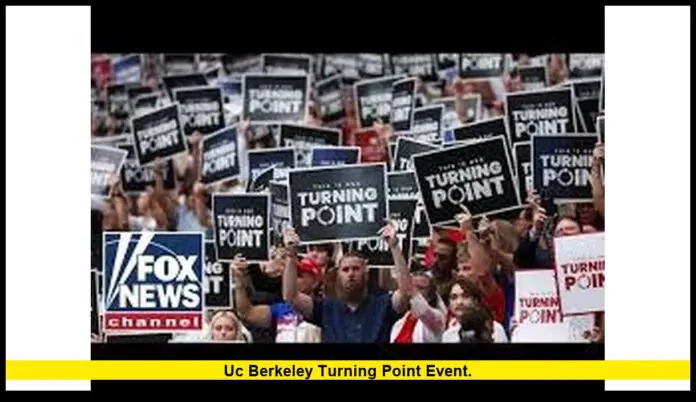
The UC Berkeley Turning Point event, held on Monday, November 10, 2025, became a focal point of national attention as protests erupted across the campus. The event marked the final stop of Turning Point USA’s (TPUSA) “American Comeback” campus tour and was one of the most contentious gatherings in UC Berkeley’s recent history.
Table of Contents
A Contentious Finale for Turning Point USA
The UC Berkeley Turning Point event carried deep symbolic weight. It was the last stop of TPUSA’s nationwide campus tour — and the first since the death of its founder, Charlie Kirk, who was fatally shot earlier this year at another university event.
Despite the tragedy, TPUSA chose to complete its tour, framing the Berkeley appearance as a tribute to Kirk’s legacy and commitment to free speech on college campuses. The lineup included actor and conservative commentator Rob Schneider and Christian apologist Frank Turek, who both delivered speeches urging students to “stand firm for truth and liberty.”
Inside the venue, speakers emphasized conservative values, criticized cancel culture, and celebrated Kirk’s influence on young conservatives nationwide. Turek, during his remarks, said he believed Kirk was “in heaven” and praised his courage to “speak truth on campuses that often reject it.”
Protests and Heavy Security at UC Berkeley
Hours before the event began, large crowds of students and activists gathered near Zellerbach Hall, where the rally was being held. Protesters carried banners reading “No platform for hate” and “Fascists out of Berkeley.”
Campus authorities anticipated unrest and deployed an extensive security presence, including officers from the Berkeley Police Department, Alameda County Sheriff’s Office, and California Highway Patrol. Police barriers were placed around Sproul Plaza and key entrances to prevent clashes between demonstrators and attendees.
Despite these precautions, tensions flared throughout the afternoon. Several confrontations broke out near the venue:
- A physical altercation occurred between a TPUSA supporter selling merchandise and a protester.
- At least two individuals were detained following scuffles.
- Witnesses reported panic when a nearby car emitted what sounded like gunfire, though it was later determined to be an audio recording.
The incident intensified fears on campus, with some students sheltering inside nearby buildings as police rushed to secure the area. Officers made multiple arrests before the event concluded without further violence.
Inside the Turning Point Event
Inside the hall, the tone was defiant but emotional. The program opened with a moment of silence in memory of Charlie Kirk, followed by video tributes celebrating his work with young conservatives across America.
Rob Schneider, known for his outspoken conservative views, delivered an impassioned speech condemning censorship and encouraging students to “think for themselves, not through filters imposed by the media or academia.”
Frank Turek followed with remarks that mixed faith, philosophy, and politics. He referenced Berkeley’s reputation for protest culture, stating, “This is the perfect place for dialogue — the birthplace of free speech, now reclaiming it from those who want to silence opposing views.”
The event concluded with students standing for a collective prayer and the words “Freedom is not free” projected on the main screen.
The Campus Divide Deepens
UC Berkeley has long been known as the heart of progressive student activism and free-speech history, dating back to the 1964–65 Free Speech Movement. Yet in recent years, it has also become a recurring flashpoint for confrontations between conservative speakers and left-leaning student groups.
The UC Berkeley Turning Point event underscored this ideological divide:
- Supporters viewed the gathering as a stand for open dialogue and intellectual diversity.
- Opponents saw it as a provocation designed to inflame tensions and spread harmful rhetoric.
University officials, while defending the group’s right to speak, urged both sides to engage peacefully. The administration later released a statement reaffirming its “commitment to free expression, balanced with community safety.”
Police and Campus Response
In the aftermath of the event, UC Berkeley officials praised law enforcement for maintaining control under difficult circumstances. The Berkeley Police Department confirmed several arrests connected to physical altercations and disturbances.
Authorities noted that most demonstrations remained nonviolent, though tensions were “high and sustained.” Officers stayed on campus until late evening to prevent post-event clashes.
The incident reignited a familiar debate over how universities should handle controversial speakers. Critics argue that excessive security costs strain campus resources, while supporters insist that restricting events like TPUSA’s would undermine First Amendment rights.
Why This Event Matters
The significance of the UC Berkeley Turning Point event extends far beyond the campus:
- It highlighted ongoing national divisions around free speech, political identity, and college activism.
- It demonstrated the persistence of TPUSA’s influence even after the loss of its founder.
- It showed that campuses remain central arenas in America’s cultural and political debates.
For many observers, Berkeley’s response — balancing safety, protest rights, and speech freedoms — will likely serve as a model for how universities handle politically charged gatherings in 2026 and beyond.
What Happens Next
As investigations continue and the university reviews its security policies, both sides of the political spectrum are reflecting on the event’s implications. TPUSA has signaled that future campus appearances are still planned, emphasizing “peaceful engagement and honest debate.”
Meanwhile, Berkeley student organizations are preparing discussions and forums to process the incident, with many calling for renewed dialogue over the boundaries of free speech and protest.
The debate sparked by the UC Berkeley Turning Point event will not fade soon — it represents an ongoing struggle to define what free speech means in America’s academic spaces.
In a nation divided by ideology, events like UC Berkeley’s Turning Point gathering remind us that the fight for free expression — and respect for difference — remains as vital as ever. Share your thoughts below and let your voice be part of the conversation.

