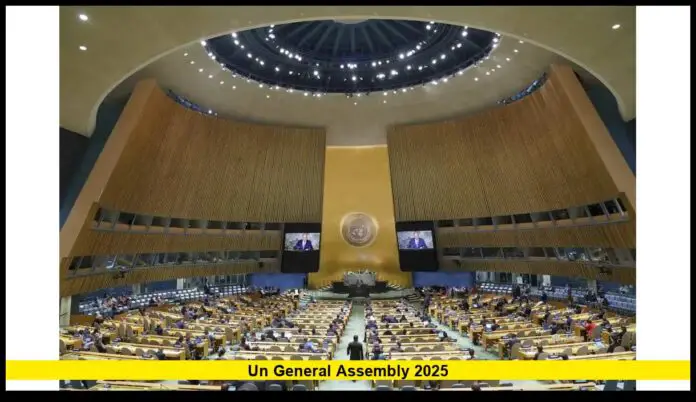
The UN General Assembly 2025 has opened in New York with world leaders gathering to address some of the most pressing crises of our time. From conflict resolution to climate change, the session is shaping global debate and revealing deep divisions alongside new opportunities for cooperation.
Table of Contents
Opening Address and Global Context
Secretary-General António Guterres set the tone with a warning about escalating global conflicts, rising inequality, and the urgent need for cooperation. His message underscored that no nation can solve today’s challenges alone, urging a renewed commitment to collective action.
The atmosphere at this year’s assembly reflects a world at a crossroads, where leaders are expected to make strong statements on sovereignty, human rights, and peace.
The Israel-Palestine Question
A central focus of the UN General Assembly 2025 is the decades-long Israeli-Palestinian conflict. Delegates debated a resolution supporting a two-state solution, urging de-escalation and renewed diplomatic talks.
Highlights include:
- Broad international support for a framework addressing both statehood and security.
- Calls for humanitarian relief and reconstruction aid in Gaza.
- Heightened pressure for the release of hostages and ceasefire agreements.
This issue continues to dominate side meetings and bilateral talks, with the assembly serving as a stage for countries to outline their positions.
France’s Landmark Move
France made headlines by officially recognizing the State of Palestine. The announcement sparked intense debate within the assembly, drawing applause from many nations while facing criticism from others who see the move as premature.
France also proposed the deployment of an international stabilization force in Gaza. Supporters argue this could help secure peace and aid delivery, while critics worry about sovereignty concerns and long-term feasibility.
Strong Positions on Sovereignty
Several leaders used their speeches to emphasize the importance of sovereignty in the face of external influence.
- Brazil’s President defended his nation’s judiciary against foreign sanctions, calling them unjust and intrusive.
- Other leaders highlighted how sanctions and unilateral restrictions undermine development, stifling cooperation between nations.
This recurring theme reflects growing tension between global governance and national independence.
Return of Syria to the World Stage
For the first time since the 1960s, Syria’s head of state addressed the UN General Assembly. His speech focused on sanctions relief, reconstruction, and demands for international recognition of Syria’s rebuilding efforts.
This appearance signals a potential diplomatic shift, as Syria seeks reintegration into global dialogue after decades of isolation.
United States at the Podium
President Donald Trump delivered a speech centered on the “America First” principle. His remarks questioned the role of the UN in enforcing global norms, reaffirmed U.S. support for Israel, and criticized what he described as unfair burdens placed on America in multilateral agreements.
While his speech resonated with some domestic priorities, it also drew sharp responses from other leaders who emphasized the need for stronger global cooperation.
European Union’s Unified Agenda
The European Union presented a united front with a strong message of multilateralism. EU leaders emphasized:
- A commitment to climate action and renewable energy expansion.
- The importance of human rights protections in the digital age.
- Support for Middle East peace initiatives and humanitarian efforts.
The EU also co-hosted side events on childhood protection, sustainable development in Africa, and conflict resolution, aiming to project itself as a defender of international law and collective solutions.
Security Measures Around the Assembly
Given the high-profile nature of the gathering, security in New York reached unprecedented levels. Authorities reported the disruption of illicit networks aimed at targeting communication systems. While details remain limited, officials stressed that precautionary measures ensured the safety of the assembly.
This year’s session serves as a reminder that diplomacy does not occur in a vacuum—global tensions spill over into security risks even on neutral ground.
Resolutions and Voting Patterns
Voting at the UN General Assembly 2025 revealed shifting geopolitical alignments. The two-state solution resolution, while nonbinding, received overwhelming support. Countries opposing it cited concerns about terrorism, security, or external imposition of solutions.
The voting patterns show widening divisions but also signal new coalitions forming in support of Palestinian statehood and humanitarian relief.
Other Key Global Issues Raised
Although conflict in the Middle East dominated headlines, leaders also addressed:
- Climate Change: Renewed calls for accelerated climate action, with emphasis on renewable energy investments and global financing for vulnerable nations.
- Migration: Appeals for stronger international frameworks to manage refugee flows caused by war, climate disasters, and economic instability.
- Global Inequality: Urgent demands for reform of global financial institutions to ensure fair access to development funding.
These broader issues highlighted the interconnected nature of crises facing the international community.
What Lies Ahead
The UN General Assembly 2025 demonstrates how global politics remain defined by competing visions of sovereignty, human rights, and multilateral cooperation. While progress has been made through resolutions and new recognition of statehood, the real test will be in implementation.
Moving forward, leaders will need to balance domestic interests with international responsibility. Whether in conflict zones, climate negotiations, or financial reform, the assembly has underscored that the world cannot afford further fragmentation.
Final Thoughts
The UN General Assembly 2025 is proving to be one of the most consequential in recent years. With passionate speeches, historic recognitions, and growing divides, it has captured the attention of the world.
As the debates continue, citizens everywhere will be watching closely to see whether these discussions translate into meaningful action. Which speech or resolution stood out most to you? Share your perspective below and join the conversation.

