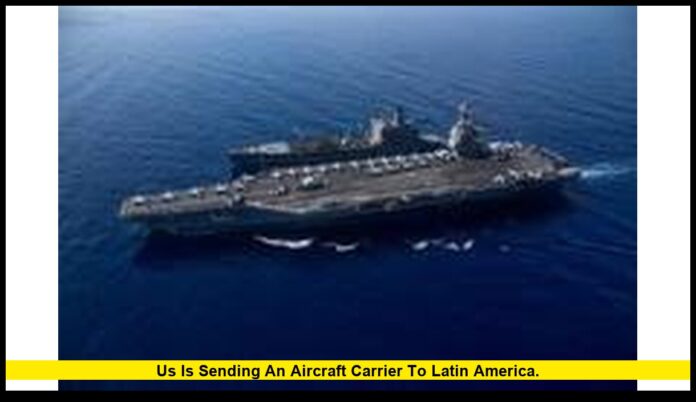
The US is sending an aircraft carrier to Latin America, marking a significant shift in Washington’s regional military posture. The decision comes amid mounting concerns over security, organized crime, and foreign influence in the Western Hemisphere. The deployment aims to reinforce America’s partnerships with regional allies while signaling deterrence to rival powers expanding their reach in the area.
This move, confirmed by defense officials, underscores the United States’ renewed focus on the southern hemisphere—a region that has seen increasing activity from global actors such as China, Russia, and Iran.
Table of Contents
Details of the Deployment
According to senior defense personnel, the U.S. Navy is deploying a carrier strike group to waters near Latin America for joint exercises, maritime security missions, and intelligence operations. The decision reflects both strategic and humanitarian objectives: combating transnational crime, enhancing naval cooperation, and ensuring freedom of navigation in critical sea lanes.
The aircraft carrier—supported by destroyers, cruisers, and supply ships—will operate under U.S. Southern Command (SOUTHCOM). Its mission will include:
- Countering illegal narcotics trafficking routes.
- Conducting joint drills with regional navies.
- Supporting humanitarian and disaster-relief operations.
- Demonstrating U.S. commitment to hemispheric security.
Officials noted that the deployment will last several months, covering both Caribbean and Pacific coastal waters.
Why Latin America Matters to U.S. Strategy
For decades, Latin America has remained vital to U.S. national interests. The region holds strategic maritime routes, energy resources, and key political partnerships. Recent years, however, have seen a surge in external influence, as global powers compete for economic and military footholds.
Key concerns driving this deployment include:
- Chinese investment in Latin American ports and telecommunications infrastructure.
- Russian naval activity, including visits by warships and nuclear-powered submarines.
- Iranian outreach through security cooperation with Venezuela and other nations.
- Rising organized crime, particularly involving drug cartels and human trafficking networks.
By sending an aircraft carrier to Latin America, the United States is signaling its intent to maintain stability and limit adversarial influence in its own hemisphere.
Historical Context: A Return to Regional Presence
While the U.S. routinely conducts naval exercises in Latin American waters, a carrier strike group deployment is rare. Historically, these missions have occurred during periods of heightened tension or major security initiatives.
In the 1980s, U.S. carriers patrolled the Caribbean to counter Soviet activity and enforce embargoes. In recent years, naval operations in the region have primarily focused on counter-narcotics efforts. This latest move represents the most visible U.S. show of force in the hemisphere in over a decade.
The operation also aligns with a broader policy shift emphasizing Western Hemisphere defense, part of Washington’s strategy to rebalance global military commitments amid ongoing challenges in Europe and the Indo-Pacific.
Regional Reaction
The announcement has drawn mixed reactions across Latin America.
- Colombia, Panama, and Brazil have welcomed the move, viewing it as a reaffirmation of U.S. security cooperation and deterrence against organized crime.
- Venezuela, Nicaragua, and Cuba, however, have criticized the deployment, calling it “provocative” and warning it could heighten regional tensions.
- Civil organizations across Central America have raised concerns about potential militarization, urging transparency on operations conducted near civilian zones.
For many nations, the presence of a U.S. aircraft carrier serves as both a symbol of reassurance and a reminder of Washington’s influence in regional affairs.
U.S. Strategic Objectives
The Pentagon has outlined several key objectives behind this operation:
- Deterring Foreign Military Influence
The U.S. seeks to counter the growing visibility of Chinese and Russian assets in Latin American ports and defense networks. This includes preventing foreign powers from establishing permanent military facilities. - Reinforcing Alliances
By conducting joint exercises, the U.S. aims to strengthen trust and interoperability with regional partners’ naval forces. - Enhancing Counter-Narcotics and Security Operations
The carrier’s air wing provides surveillance and reconnaissance capabilities vital to monitoring trafficking routes across the Caribbean and Pacific corridors. - Supporting Humanitarian Missions
The carrier strike group is also equipped to deliver humanitarian aid and disaster relief supplies—an essential capability during hurricane season.
A Broader Message to the World
Analysts note that sending a U.S. aircraft carrier to Latin America serves not only a regional purpose but also a global geopolitical message.
While the move reinforces hemispheric defense, it also signals that the United States remains capable of projecting power globally despite commitments in Europe and Asia. It communicates to allies and rivals alike that the U.S. can respond to multiple threats simultaneously.
The timing also reflects increased competition with China, whose Belt and Road investments in Latin America have deepened economic ties across the continent. The U.S. views these developments as strategic challenges that warrant closer military and diplomatic engagement.
Military Capabilities and Scale
The deployed carrier strike group will include:
- One nuclear-powered aircraft carrier, hosting over 70 fighter jets, helicopters, and surveillance aircraft.
- Two guided-missile destroyers for anti-air and anti-submarine warfare.
- One cruiser with advanced radar and long-range missile capabilities.
- Several logistics and support vessels for refueling and resupply.
Together, the group represents one of the most formidable maritime formations in the world—capable of both combat and humanitarian operations.
Possible Impact on Future U.S.-Latin American Relations
This operation could reshape U.S.-Latin American dynamics in several ways:
- It reasserts U.S. leadership in a region where many nations have diversified partnerships with China and Russia.
- It may encourage joint defense initiatives, focusing on shared security priorities like anti-smuggling, cyber defense, and disaster response.
- It could also spark diplomatic friction with left-leaning governments that view U.S. military deployments skeptically.
The success of this mission will depend on diplomatic engagement as much as naval power.
Looking Ahead
The deployment of an aircraft carrier to Latin America comes at a time when global tensions are high and regional power balances are shifting. The United States appears determined to reinforce its role as the primary security partner for Latin American nations, signaling a new era of hemispheric engagement.
Defense officials expect this operation to serve as a foundation for expanded security partnerships in 2026 and beyond. It may also lead to more regular U.S. naval presence in the Caribbean and Pacific zones bordering Central and South America.
As Washington repositions its military presence closer to home, the message is clear: the United States remains deeply invested in Latin American stability and determined to counter any external threats in its own hemisphere. What’s your view on this renewed regional focus? Share your thoughts below.

